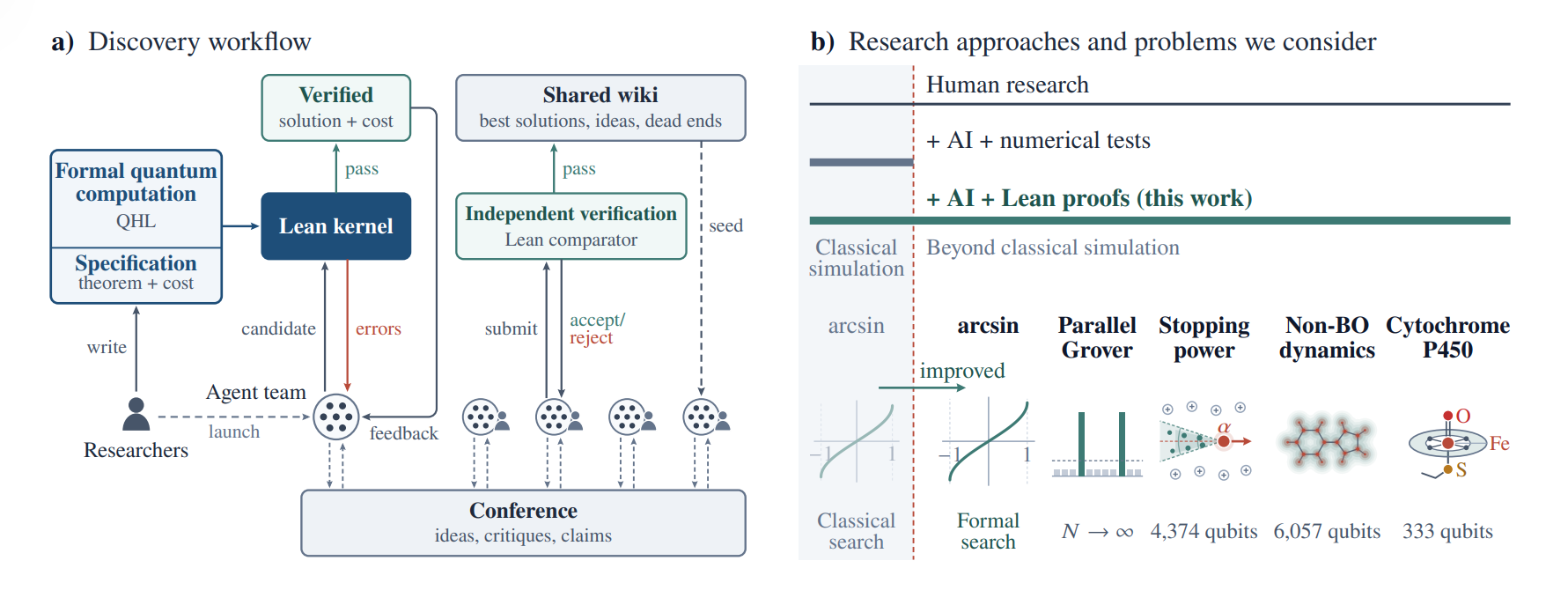
Researchers from Google DeepMind and Google Quantum AI published the paper “Discovering formally verified quantum programs with AI” (arXiv:2611.09822, v1 from November 6, 2026, v3 from November 16, 2026). Teams of Gemini 4 agents synthesize quantum programs against formal specifications in the Lean 4 theorem prover, while the correctness and resource cost of each circuit are confirmed not by tests, but by machine verification of mathematical proofs within Hoare quantum logic. The best circuits found reduce the Q*T metric — the number of logical qubits multiplied by the number of non-Clifford T-gates — by more than 290 times.


What happened
Gemini 4 agents worked as distributed independent teams: they exchanged lemmas and code through a shared wiki and held regular “conferences” every four hours. The discovered quantum programs were verified by an independent Lean comparator, which checked proofs against frozen specifications, reducing the risk of agent self-confirmation. The demonstrated Q*T reductions are: over 290× for 25-bit arcsin state preparation, 10.9× for simulating alpha-particle slowing down in dense hydrogen plasma (4374 logical qubits), and 8.08× for non-Born-Oppenheimer dynamics of the C23H20N3O molecule (6057 logical qubits); the summary also mentions a reduction of 2.49×. For inertial fusion calculations, a reduction in total quantum operation costs by 11.8 times and a decrease in memory requirements from 5650 to 4338 logical qubits are claimed. The Lean 4 library, specifications, and discovered programs are available in the open repository google-deepmind/formal-quantum-computation (Apache 2.0 license) in the discoveries branch.
Context
The key problem in designing quantum algorithms is that circuits for future fault-tolerant machines cannot be physically tested: modern processors are too small and noisy to run circuits with 333–6057 logical qubits, and classical simulation of such tasks is ineffective. Therefore, the correctness and cost of circuits have traditionally been confirmed by manual mathematical analysis by theorists, which takes years. The Google work embeds circuit search into formal verification: specifications are fixed in Lean 4, and equivalence and cost are proven in Hoare quantum logic before any execution on a device.
Why this matters for the industry
For the industry, this is a reproducible “agent + formal verification” pipeline that automates the design of quantum algorithms where neither classical simulation nor current hardware provides an answer. Correctness is confirmed by machine verification of proofs, not tests, which reduces years of manual labor by theorists and sets a reproducible process for resource-intensive quantum simulations — fusion, photochemistry, drug metabolism. The found optimizations directly affect the cost calculation of future fault-tolerant machines, and the Q*T metric may become a standard criterion for comparing algorithms during their planning. The pattern is expected to spread to other tasks, with independent replications emerging from the open repository.
Why this matters for users
For readers, this is a clear example of how LLM agents work not on text generation, but on solving formally verifiable problems: each discovered circuit is proven in Lean, rather than “appearing to work.” The open repository allows users to independently study the code, run the build via lake, and compare the discovered circuits with baseline ones. However, there is no direct impact on current devices: all circuits are designed for future fault-tolerant machines, not modern noisy hardware, so the practical value for users right now lies in the accessible methodology and artifacts that can be verified and reused.
What is currently unknown / limitations
The Q*T reductions represent a decrease in the projected cost of future fault-tolerant machines, not an acceleration on current NISQ processors: there are no results on real hardware in the sources. For inertial fusion calculations, an 11.8-fold reduction in costs is claimed, which differs from the 10.9× figure in the summary, so exact task comparison requires checking against arXiv:2611.09822. This is a research paper, not a production service, and there is currently no commercial buyer for the discovered circuits.
Sources
- Discovering formally verified quantum programs with AI (arXiv:2611.09822)
- google-deepmind/formal-quantum-computation — Lean 4 library for formally specifying and verifying quantum programs
- Google DeepMind and Google Quantum AI Use Lean 4 to Discover Formally Verified Quantum Algorithms — Quantum Computing Report
Author
Look at AI, editorial team