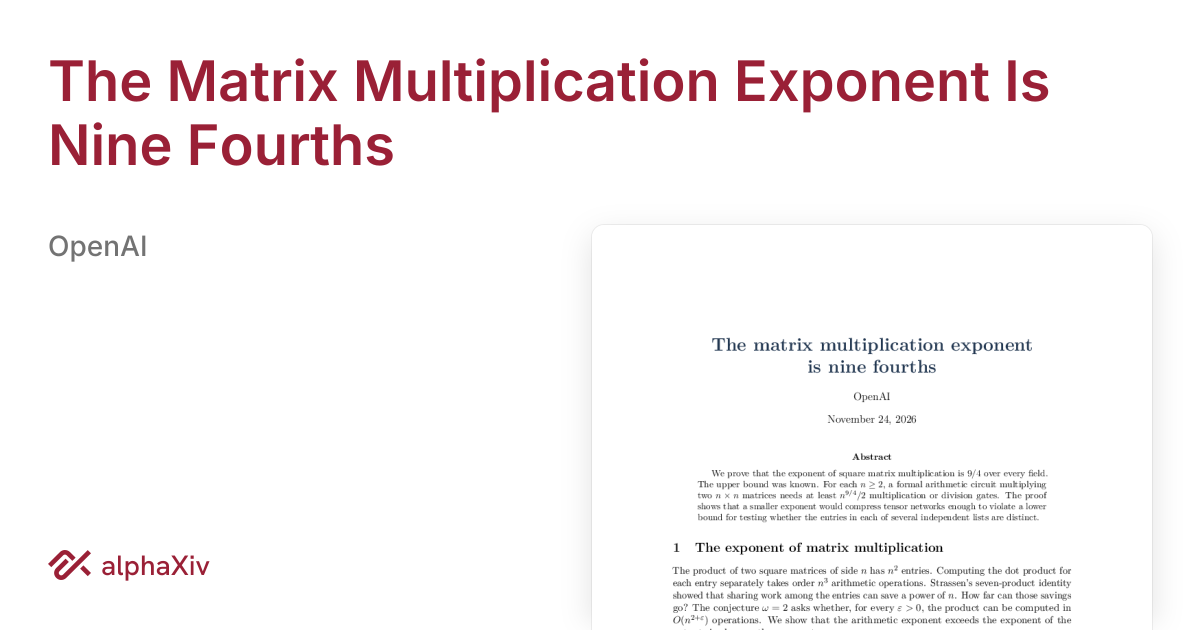
On November 24, 2026, OpenAI published the preprint “The matrix multiplication exponent is nine fourths,” claiming that the matrix multiplication exponent ω for square matrices is exactly 9/4 (2.25) over any field. The key novelty is the lower bound, which was missing for a complete proof: previously, the upper limit ω ≤ 9/4 was shown by OpenAI itself in October 2026 and independently re-proven by other groups. The proof is formalized in Lean, but only for circuits without divisions, and independent verification of the lower bound has not yet been conducted.

What happened
The work shows that any formal arithmetic circuit for multiplying n×n matrices requires at least ⌈n^(9/4)/2⌉ non-scaling multiplication or division gates. This lower bound completes the picture: the upper bound ω ≤ 9/4 was obtained by OpenAI in October 2026 and independently re-proven by other research groups, including Rafael Pass’s group and LMU Munich. Thus, if the lower bound is confirmed, the matrix multiplication exponent will be established exactly: ω = 9/4. The proof is formalized in the Lean language; however, the formalization covers only circuits without divisions; the most complex case has not been machine-verified.
Context
The matrix multiplication exponent ω is a fundamental constant in complexity theory, determining how fast square matrices can be multiplied. For many years, the community has discussed the hypothesis ω = 2, meaning the possibility of multiplying matrices almost as fast as adding them. Strassen’s 1969 algorithm yielded an estimate of log₂7 ≈ 2.807, and before OpenAI’s preprint, the best published upper limit was approximately 2.371177 — obtained by Dupont et al. in August 2026 using AlphaEvolve. Estimates in this area have changed slowly: the previous major shift dates back to works from 1979. Therefore, the claim of the exact value ω = 9/4 would be the most significant result in this field in decades.
Why this matters for the industry
If the result stands up to independent verification, it will refute the long-standing hypothesis ω = 2 and become the largest shift in matrix multiplication estimates since the works of 1979. This is a fundamental result for complexity theory, which underpins the computational core of machine learning, scientific simulations, and linear algebra. However, practical GPU cores will remain at the n³ level: fast algorithms have huge constants, so direct speedups on hardware are not expected in the foreseeable future. A separate value for the industry is the demonstration of the pipeline “AI model finds a result in pure math → formalization in Lean → independent verification,” which can become a model for building trust in AI conclusions in tasks where correctness is critical.
Why this matters for users
For readers, this is the loudest example to date of an AI model finding and formalizing a result in pure mathematics, not just in applied tasks. There are no direct product changes: GPU cores and ML stacks will remain n³, and no new APIs or libraries have appeared in the news. The practical value right now lies in observing how the scientific community verifies the result: it is worth watching the reaction of complexity theorists, the expansion of the Lean formalization beyond circuits without divisions, and the transition of the preprint to a peer-reviewed publication. These events will determine whether this becomes a confirmed discovery or just another retracted result in the series.
What is still unknown / limitations
Independent verification of the lower bound outside of OpenAI has not yet been conducted, and OpenAI itself warns of possible errors. The Lean formalization is incomplete: it covers only circuits without divisions, and the most complex case has not been machine-verified. The lower bound relies on an internal OpenAI model about which the company does not disclose details, making it the weakest link in the chain of proofs. At this point, it is a strong claim in the form of a preprint, not a confirmed result.
Sources
- OpenAI, preprint The matrix multiplication exponent is nine fourths (November 24, 2026) — openai/math on GitHub
- The Matrix Multiplication Exponent Is Nine Fourths — alphaXiv
- OpenAI preprint claims the matrix multiplication exponent is exactly 9/4 — Crypto Briefing
Author
Look at AI, editorial team