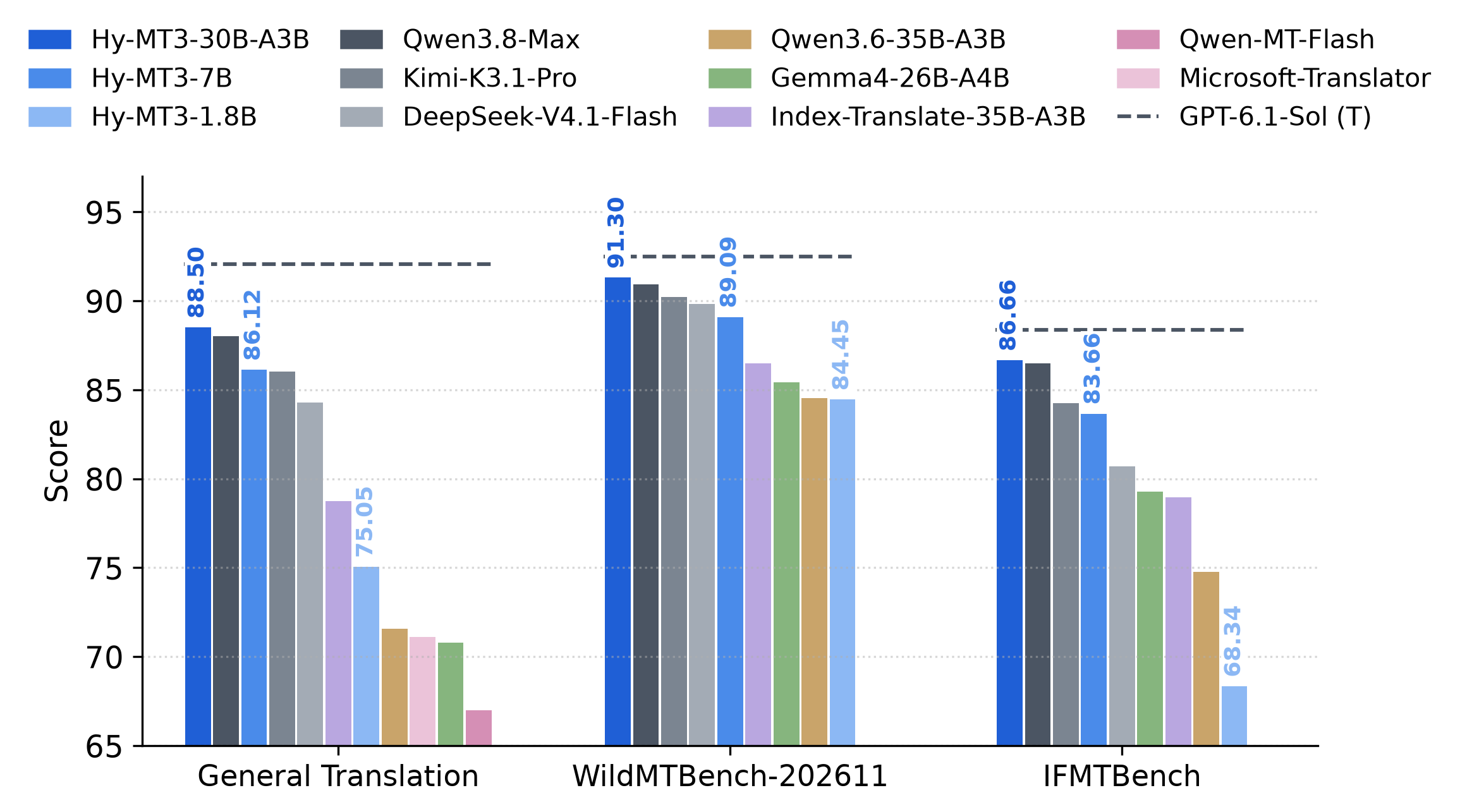
Tencent released the Hy-MT3 translation model family on November 24, 2026 — the third generation of the Hy line. The family includes Hy-MT3-1.8B, Hy-MT3-7B, and the flagship MoE model Hy-MT3-30B-A3B, supporting 102 languages, including Russian. The models are available on HuggingFace and ModelScope under the Apache-2.0 license, along with the open-source automatic evaluation tool TransRubric.


What happened
The release includes three models: Hy-MT3-1.8B, Hy-MT3-7B, and Hy-MT3-30B-A3B — an MoE architecture with 30 billion parameters, of which 3 billion are active. Language coverage has expanded from 38 to 102, including the addition of Russian. According to the report, compared to the previous generation, the share of samples with translation errors decreased by 43%, omissions and extra words by 74%, and instruction-following errors by 40%. In non-thinking mode, Hy-MT3-30B-A3B outperforms Qwen3.8-Max, Kimi-K3.1-Pro, and DeepSeek-V4.1-Flash, consuming less than 1 TFLOP per sample, while the compared models require more than 30 times the computation. Weights are available in Standard, FP8, and GGUF (llama.cpp) formats on HuggingFace and ModelScope, along with the automatic evaluation tool TransRubric.
Context
Hy-MT3 is the third generation of the Hy line, in which the number of supported languages has grown from 38 to 102. The key architectural bet of the release is an MoE model with a small number of active parameters: 3 billion active out of 30 billion total, which allows for a claimed budget of less than 1 TFLOP per sample. For open models, this is a rare case where a license allowing commercial use, ready-made quantizations for local inference, and an open quality control tool are provided simultaneously. The claimed improvements over Hy-MT2 are a comparison with its own previous version, not an external benchmark, so independent benchmarks are more important for assessing novelty.
Why this matters for the industry
An open MoE model with 3 billion active parameters that matches closed thinking models GPT-6.1-Sol and Gemini-4-Argon in non-thinking mode with more than 30 times less computation per sample reduces the cost of mass translation. A ready-made toolchain for game localization — TiMiHOKGameTranslator and evaluation with the Honor of Kings team — as well as robustness to OCR errors when translating images allow the model to be integrated into production pipelines. TransRubric (PDP 0.744, Avg Corr 0.832 on WMT26) provides reproducible automatic quality control for translation that can be included in CI/CD.
Why this matters for users
The Hy-MT3-1.8B, Hy-MT3-7B, and Hy-MT3-30B-A3B models can be downloaded from HuggingFace and ModelScope and run locally without an internet connection: FP8 and GGUF versions work via llama.cpp. According to the developers, Hy-MT3-1.8B outperforms commercial APIs — iFlytek Translator, Microsoft Translator, and Qwen-MT-Flash. 102 languages are supported, including Russian, and the README includes ready-made prompts for preserving terminology, formatting, and placeholders.
What is still unknown / limitations
Key comparisons — superiority over Qwen3.8-Max, Kimi-K3.1-Pro, DeepSeek-V4.1-Flash, and matching GPT-6.1-Sol, Gemini-4-Argon, as well as a budget of less than 1 TFLOP per sample — are data claimed in the developer's report that still need to be confirmed by independent tests. The claimed improvements over the previous generation are a comparison with its own version, not an external benchmark. The quality on the long tail of 102 languages, rather than top languages, is not visible from the provided sources. Training data and pipeline are not described in available sources, so evaluation is partially reproducible: you can run your own tests, but you cannot fully reproduce the release.
Sources
- Hy-MT3: More Accurate, Robust and Practical Multilingual Translation Models in the Wild (arXiv 2611.27673)
- Hy-MT3 — Tencent collection on Hugging Face
- Tencent-Hunyuan/Hy-MT3 (GitHub)
Author
Look at AI, editorial team