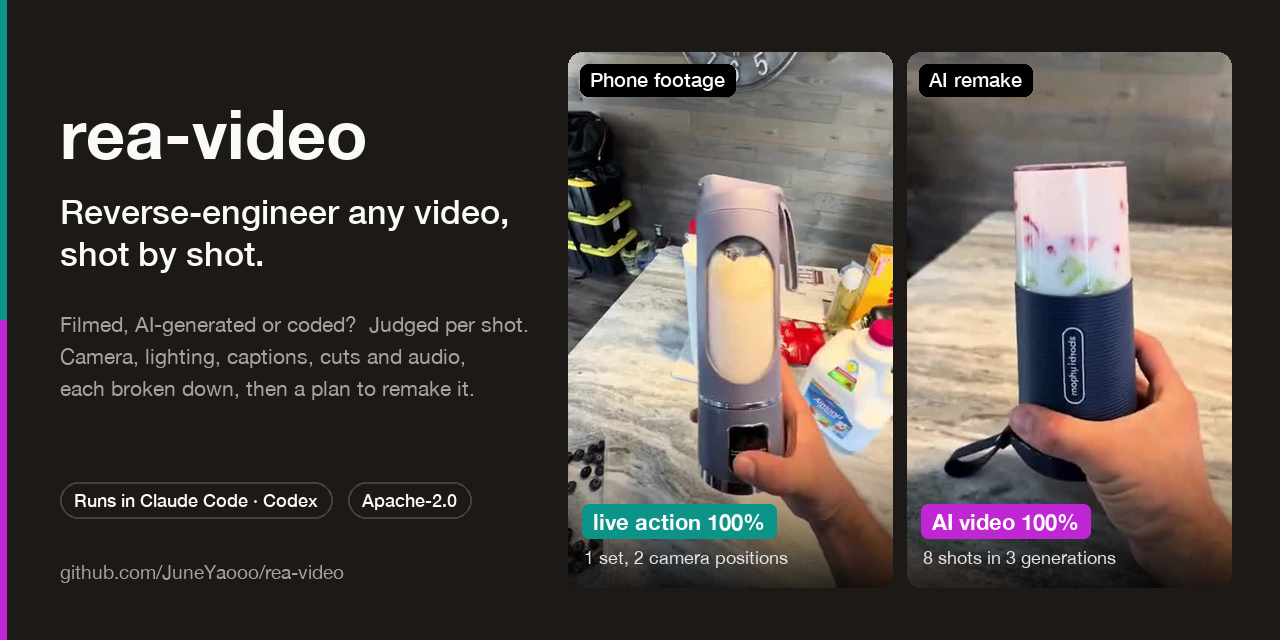
Around the open-source project rea-video, a suite of three tools for video "reverse engineering" has formed: each one cuts a clip into shots, determines the production method for each frame, and outputs a machine-readable breakdown from which you can build your own remake.
What happened
The rea-video project (author JuneYaooo, approximately 12.6k stars on GitHub, Apache-2.0 license) works as a CLI installed by an agent: it breaks a clip into shots and determines for each whether it was shot on camera, generated by AI, rendered in 3D, or assembled with code, then generates a report.html/PDF and a VIDEO.md file in an open format for AI agents. In the HeyGen hyperframes repository (approximately 88.9k stars), a skill called reverse-any-video appeared, which rebuilds video into an editable HyperFrames project with frame-by-frame diff verification; according to SKILL.md, the reverse function is part of the paid HyperFrames Pro tier. The ComfyUI-ReaVideoBreakdown node (author benjiyaya, 103 stars, MIT license) performs a similar breakdown inside ComfyUI via a native VLM encoder: shots are detected using HSV histograms, camera work is measured using Lucas–Kanade + RANSAC optical flow (pan in px/s, zoom in %/s, classification as static/smooth/handheld), and the output includes VIDEO.md, JSON, and a ready-made text-to-video prompt for each shot.
Context
All three tools rely on classic, well-studied CV methods: HSV histograms for shot change detection, Lucas–Kanade + RANSAC optical flow for camera motion estimation, AIGC tags in metadata, and VLM assessment for classifying the production method. The novelty lies not in the methods themselves, but in their composition into a single pipeline that concludes with the generation of text-to-video prompts. By default, the suite is tailored to the MiniMax H3 model, creating a de facto dependency of the ecosystem on a single model; switching to other models is only stated for rea-video. The VIDEO.md format is an open, machine-readable artifact intended for AI agents, but it is not yet a standard.
Why this matters for the industry
Breaking down video by shots with measurable camera work and ready-made prompts turns the "reverse engineering" of someone else's clip into a reproducible pipeline: shot detection, AIGC tags in metadata, optical flow, and VLM assessment provide a machine-readable VIDEO.md that agents (Claude Code, Codex) and ComfyUI nodes can directly use for remakes under MiniMax H3 and other models. For product teams, this is a ready-made building block for "break down a clip and give a remake plan" features, and for startups, it is a signal that the mechanics of video reverse engineering are becoming cheap and automatable. However, without validated benchmarks, this is currently not a state-of-the-art shift but a working tool for pilots: production lacks data on latency, inference cost, and independent accuracy assessment.
Why this matters for users
All three tools can be tried right now: rea-video is installed in Claude Code/Codex with a single command (requires ffmpeg and Python 3.10+), the ComfyUI node is cloned into custom_nodes without additional dependencies, and the HeyGen skill works via npx hyperframes (reverse is a Pro feature). This is a concrete way to understand how any clip was made and to replicate its structure with your own content: obtain VIDEO.md and report.html/PDF, or insert ComfyUI-ReaVideoBreakdown into an existing pipeline. A reasonable scenario for today is to use the suite as an auxiliary stage in a manual pipeline, rather than as an autonomous service.
What is currently unknown / limitations
The stated accuracy of 98.3–99.6% for determining the production method in offline mode is provided in the rea-video README without a description of the dataset, metrics, train/test split, or independent verification — this is a developer self-report, not a reproducible benchmark. For production, SLAs for latency and VLM inference cost per shot are missing, as well as independent quality assessment on diverse data. All three tools are designed for MiniMax H3 by default, so porting to other models is currently confirmed only for rea-video.
Sources
- JuneYaooo/rea-video — Reverse-engineer any video, shot by shot (GitHub)
- heygen-com/hyperframes — skill reverse-any-video (GitHub)
- benjiyaya/ComfyUI-ReaVideoBreakdown — shot-by-shot video reverse engineering for ComfyUI (GitHub)
Author
Look at AI, editorial team