On November 20, 2026, Thinking Machines Lab open-sourced the weights of the Inkling 2 Mini model — a multimodal looped transformer under the Apache 2.0 license. The model fits in 32 GB of memory and demonstrates strong results on agentic and coding benchmarks, while independent research by Goodfire showed that its architecture remains interpretable.

What happened
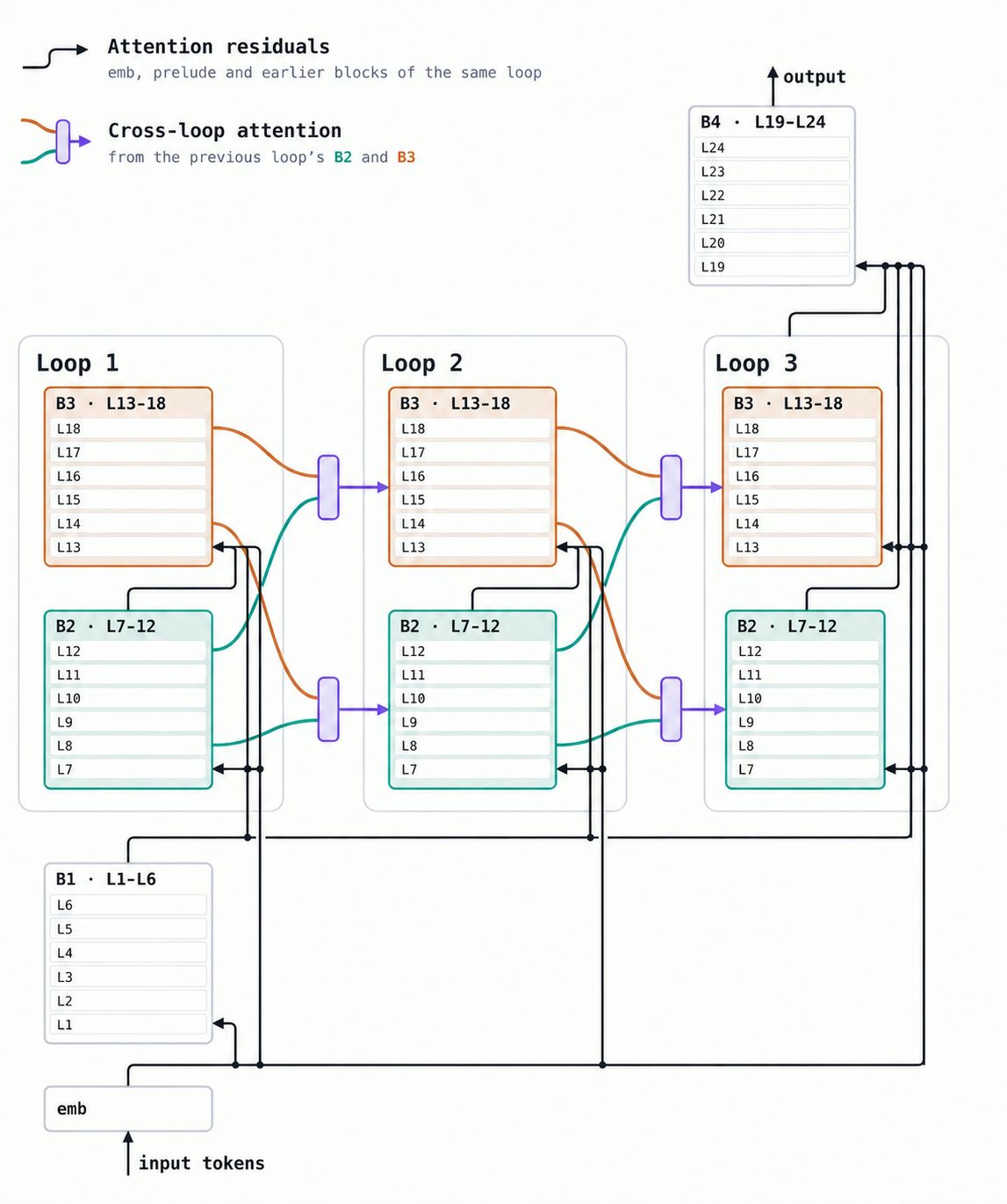
On November 20, 2026, Thinking Machines Lab published Inkling 2 Mini — an open multimodal model that accepts text and images as input and outputs text, under the Apache 2.0 license. The model contains 26.4B total parameters, of which 3.4B are active (5.4B effective per token), supports a context of up to 1M tokens, its checkpoint occupies approximately 20 GB, and it can run on 32 GB of VRAM or RAM, including on DGX Spark and Apple Silicon. This is the lab's first looped transformer: the architecture consists of 24 layers of decoder-only MoE, where 8 of 128 experts are activated per layer, and the middle 12 layers (blocks 2 and 3) are run three times with shared weights; the cross-loop attention mechanism allows layers to read outputs from the previous loop. According to reported benchmarks, the model scores 79.2% on SWE-bench Verified, 79.0% on BrowseComp, 92.8% on OmniDocBench v1.6, and 84.5%/49.3% on ARC-AGI v1/v2, outperforming Qwen3.8-27B and Gemma 4 31B in agentic and coding tasks. On the same day, Goodfire published a study on the model's interpretability.
Context
Inkling 2 Mini is based on an approach called 'depth scaling': the model's computational depth scales by repeatedly passing through the same layers, rather than by adding new parameters. Unlike classical transformers, where increasing depth requires growing the number of weights and checkpoint size, here one compact set of weights is run multiple times, and layers in subsequent loops gain access to previous outputs via cross-loop attention. This makes depth a resource independent of width and total parameter count. To understand the significance of the release, it is important to note that prior to Inkling 2 Mini, there were no public open looped transformers from major labs: the model became the first public example of this architecture with open weights.
Why this matters for the industry
For the industry, Inkling 2 Mini sets a reference architecture where depth becomes an independent scaling axis alongside width and parameter count. Repeated layer passes change the economics of inference: instead of tens of gigabytes of parameters for a deep model, a single checkpoint of about 20 GB is sufficient, making local agentic inference — coding, browser agents, document automation — accessible on affordable hardware without cloud APIs. The open Apache 2.0 license allows embedding the model in commercial products without licensing restrictions, and a ready ecosystem of runtimes lowers the barrier to entry for startups. The Goodfire verification is also important: the architecture remains interpretable — tuned-lens and coda-lens work on it, while logit-lens does not; there is no single residual stream, information is transmitted via block sums, and anomalous activations (coordinate d_2027, about 46% of the norm squared) act as 'tags' determining which blocks future loops read. This strengthens trust in looped models as a class of architectures.
Why this matters for users
Practically, Inkling 2 Mini can be run locally on 32 GB — on a MacBook, Mac mini, Mac Studio, DGX Spark, or a GPU with 32 GB VRAM — via vLLM, SGLang, llama.cpp, Ollama, Unsloth (GGUF), or Llama App, and fine-tuned via Tinker. This allows building a prototype of a local coding agent or long-context RAG product without the cloud and without licensing restrictions. When using it, one should consider the stated limitations: the model is prone to looping in reasoning, so strict token and iteration limits are needed; quality degrades on non-English languages, so it is not suitable for Russian-language scenarios without fine-tuning; and the triple layer pass increases computational costs per token compared to a single pass.
What is still unknown / limitations
The benchmark methodology, run conditions, and test sample sizes are not described in the provided materials, so the reported results (SWE-bench Verified 79.2%, ARC-AGI v1 84.5%) have not yet been confirmed by independent verification. For 'out-of-the-box' production use, the model is not yet ready: a tendency to loop in reasoning and quality degradation on non-English languages are stated. Production measurements of latency, throughput, and token cost, as well as runtime optimizations for the looped pattern, are still absent.
Sources
- thinkingmachines/Inkling-2-Mini — Model Card (Hugging Face)
- Interpreting Inkling 2 Mini — Goodfire Research
Author
Look at AI, editorial team