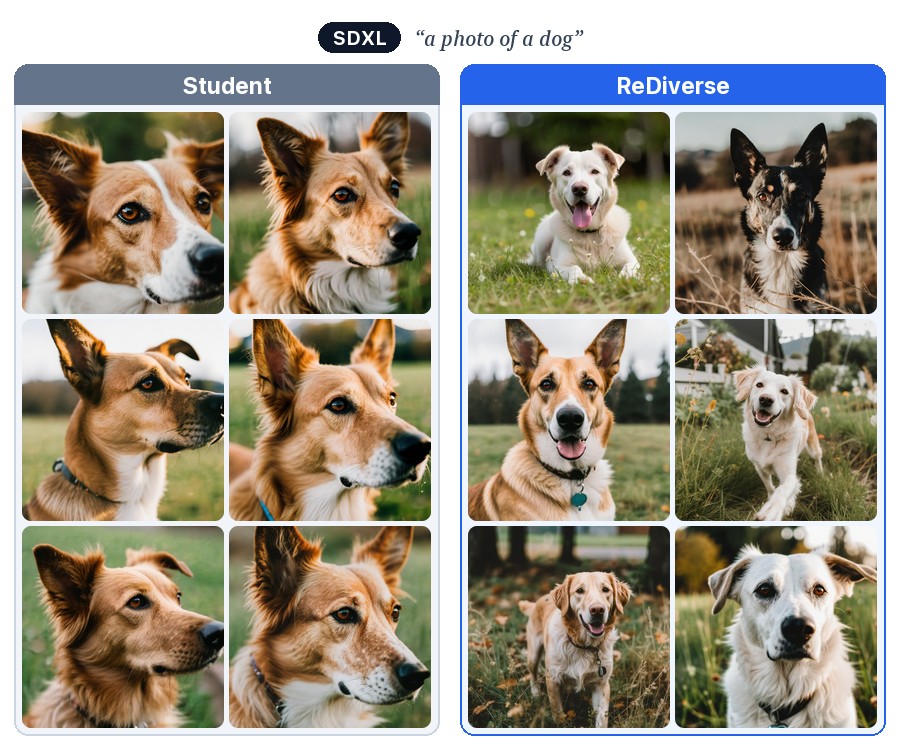
Researchers from UIUC, fal, and Johns Hopkins published the preprint ReDiverse (arXiv:2611.18550): few-step distillation does not lose the ability for variability but compresses activation variance into a small number of directions, causing different seeds to produce nearly identical images and clips. The failure is localized to one intermediate block during the first denoising step, allowing for targeted fixes—a lightweight LoRA rank 32 applied only to the first step or a training-free approach. On SDXL, SD3, Wan 2.1, and MiniMax-H3, with the same four steps, DINO diversity returns to near the full-step teacher level. Adapters ranging from 216–612 MB are already available on Hugging Face, and the code is open source. For anyone using fast distilled generators, diversity collapse shifts from a hidden limitation to a fixable configuration.


What Happened
On November 13, 2026, a team from UIUC, fal, and Johns Hopkins—Furkan Horoz, Ozgur Kara, Kaan Oktay, Adil Kaan Akan, Atakan Kara, Anand Bhattad, and James Matthew Rehg—released the ReDiverse preprint (arXiv:2611.18550). The authors probed the activations of distilled generators and obtained a clear picture: the student retains the teacher's overall variance level but compresses it into significantly fewer directions, with the effect peaking in one intermediate block during the first denoising step. For DMD2 on SDXL, the participation ratio drops to 0.40 while maintaining a total variance of 1.63. Two fixes are proposed: ReDiverse-FT—a LoRA rank 32 operating only on the first step—and ReDiverse-TF—a training-free variant where directions are restored via PCA calibration on teacher runs with the addition of random coefficients along principal directions. On five models with unchanged four steps (DINO metric: GenEval—553 prompts × 100 seeds, VBench—300 prompts × 10 clips), DINO diversity increased from 59.4 to 65.0 (teacher: 66.3) on SDXL, from 48.4 to 60.1 (teacher: 61.6) on SD3, from 31.6 to 52.2 (teacher: 51.6) on Wan 2.1, and from 36.5 to 50.9 (teacher: 52.5) on MiniMax-H3. Adapters and code are published openly.
Context
Few-step distillation is the standard method for accelerating diffusion models: recipes like DMD2, TDM, lightx2v, and Turbo compress hundreds of teacher steps into four to six student steps, forming the basis of dozens of generative pipelines. The complaint that different seeds yield nearly identical results has long circulated among those working with fast generators but remained an observation without explanation. The preprint moved this into a measurable plane: probing activations and participation ratio shows how many variance directions are actually used before and after distillation. This leads to a key shift in problem framing: diversity collapse is not a fundamental limit of few-step generation but a local distribution error in a specific block, opening the way for targeted fixes like pluggable adapters instead of retraining the entire model.
Why This Matters for the Industry
For teams where 4-step generation is already in production, this is a ready-made ingredient, not just a research idea. Adapters of 216–612 MB plug into existing SDXL (DMD2), SD3 (TDM), and Wan 2.1 (lightx2v) pipelines without changing the scheduler or step count and within the same inference budget. ReDiverse-TF allows for zero training steps, though it requires calibration runs of the teacher. This enables specific product mechanics—delivering N truly different variants for a single prompt within the same budget. If independent replications confirm the numbers, it is expected that diversity across seed sweeps will become a standard evaluation axis for distilled generators, on par with quality and speed, and that restoring variance directions will begin to be integrated into distillation recipes themselves.
Why This Matters for Users
If you are running SDXL, SD3, or Wan 2.1 in 4–6 steps and getting essentially the same image or clip when changing the seed, the problem can be solved in an evening: download your model's adapter from Hugging Face (hf.co/ReDiverse) and enable it in your current process, or run ReDiverse-TF to avoid training altogether. Prompt adherence is not compromised: CLIPScore remains within 0.5 points of the original student, while diversity rises to near the full-step teacher level. A specific caveat concerns MiniMax-H3 and Pika H3 Flex: their licenses prohibit use in the EU, UK, South Korea, and the US, so for practical deployment these models are open only in jurisdictions outside these restrictions, remaining research scenarios in other cases.
What Is Still Unknown / Limitations
This is a preprint that has not undergone peer review, and all figures are not yet confirmed by independent replications. Quality in the work is closed by exactly two metrics—CLIPScore and DINO diversity—with no human evaluations in the material. An anomaly on Wan 2.1 is concerning: the fixed student (52.2) outperforms the full-step teacher (51.6), suggesting that the diversity metric may be gamed, variability is not synonymous with quality, and this gap cannot be interpreted without human evaluations. There are no latency measurements in the preprint, so the impact on real inference speed remains an open question, and the training-free variant requires 25 runs of the full-step teacher for direction calibration—a direct inference cost.
Sources
- Restoring Diversity in Distilled Image and Video Generators by Probing Activations (arXiv:2611.18550)
- GitHub: H-furkan/rediverse — code, activation probes, and ReDiverse-FT adapters
- Hugging Face: ReDiverse — organization with adapters for SDXL, SD3, Wan 2.1, MiniMax-H3, Pika H3 Flex
Author
Look at AI, editorial team