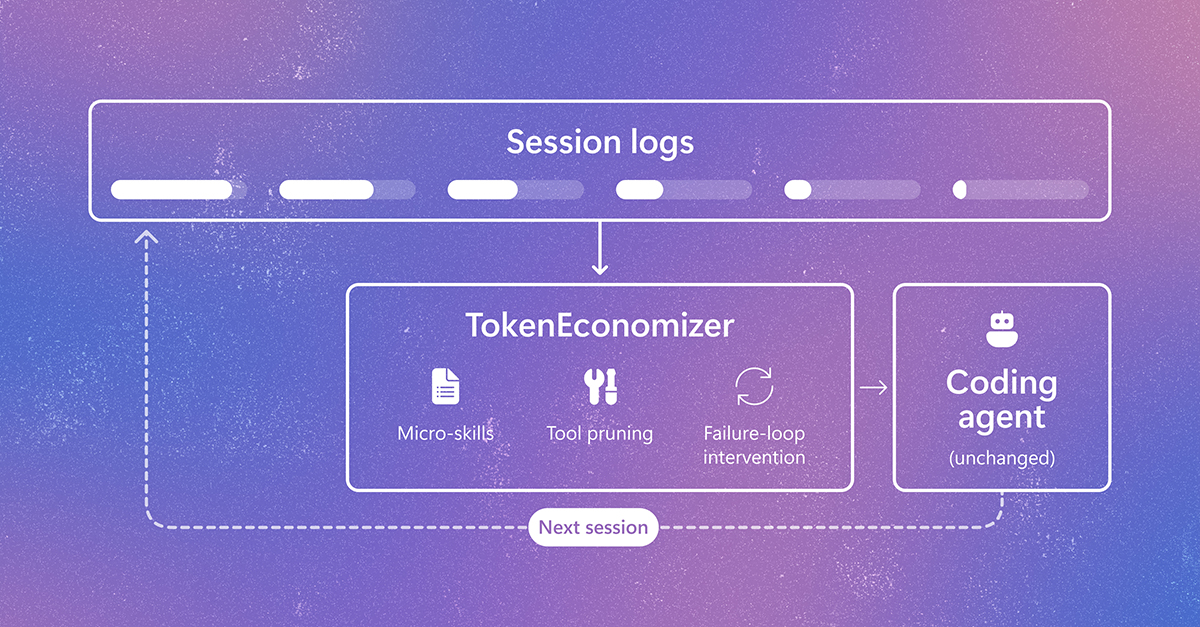
Microsoft Research, in collaboration with UC Berkeley, Microsoft Security, and Voyage AI, has released TokenEconomizer, a plugin that reduces the cost of AI coding agents by learning from logs of past sessions in the same repository. The plugin makes no changes to the model or the agent: it acts as an external black-box controller that filters out repetitive routine. Across 277 SWE-Bench tasks from six repositories, the average savings were 18.4–30.9%, while Pass@1 was maintained or increased in four out of five agent and model combinations. The code is published in the microsoft/TokenEconomizer repository on GitHub.


What happened
Researchers from Microsoft Research, in collaboration with UC Berkeley, Microsoft Security, and Voyage AI, presented the open-source plugin TokenEconomizer, which connects on top of ready-made programming agents, including Claude Code, and manages their spending without fine-tuning or model replacement. The controller operates through three mechanisms: micro-skills adds one-line notes about accumulated repository experience to the initial context, tool pruning disables tools that the agent rarely uses in that repository, and failure-loop intervention recognizes cycles of repeated errors and interrupts them with a hint from a judge model. Evaluation was conducted on 277 real SWE-Bench tasks from six repositories across five agent and model combinations: the average cost savings were 18.4–30.9%, and Pass@1 was maintained or increased in four out of five combinations. Savings were also confirmed on the independent Web-Bench dataset. Research materials include a publication on the Microsoft Research portal and an open implementation in the microsoft/TokenEconomizer repository.
Context
The motivation for the work is detailed in the team's own diagnostics: they profiled Claude Code on 60 SWE-Bench tasks and identified a characteristic pattern of losses. It turned out that after five completed tasks in one repository, 30% of tool calls duplicated actions from previous tasks in the same repository; of the 23 tool descriptions passed to the agent in a single turn, 16 were never called; and 17% of failed tasks consumed 32% of all expenses. This is a picture of a typical agent pipeline: each new session solves the task as if from a blank slate, re-explores the repository, tries out tools, and repeats unsuccessful attempts, which remain the main budget consumers. Standard ways to reduce costs — switching to a cheaper model or manual prompt tuning — either threaten quality or require constant supervision. The proposed approach rests on a different foundation: it is a repository-specific experience layer on top of existing agents that manages routine at the session level while the model itself focuses on the task.
Why this matters for the industry
For the AI industry, this is primarily a reassessment of where the budget for agent products actually goes: a significant portion of expenses is not "intelligence" but repetitive routine, which can be managed by a separate orchestration loop without changing the model or rewriting the existing stack. For teams deploying agent fleets in production, this directly affects unit economics: the cost of a completed task becomes a manageable variable alongside model choice, without losing solution quality in verified configurations. Implementation appears low-risk: an external controller is connected on top of the active agent, rollback to the previous scheme is trivial, and open code allows verifying the mechanics before a pilot. The authors effectively describe a new class of product — a repository-specific experience layer on top of ready-made agents; if results are confirmed in independent measurements, such layers may become standard components of agent platforms, and accumulated repository experience — a transferable asset between agents and models.
Why this matters for users
Practical benefits concern those who work with agents like Claude Code in persistent repositories. The plugin is installed alongside the existing agent without a separate API key and without changing the model, learns from your session logs, and training data remains local. Savings are achieved without manual prompt tuning, but they are not instant: cumulative costs drop below the baseline level only around the sixth task in the repository. Therefore, real benefits are expected in projects where tasks flow through the same codebase, while for one-off tasks and in unfamiliar repositories, the gain is more modest than the average SWE-Bench results. A reasonable strategy is a shadow pilot on one active repository, measuring cost, Pass@1, and latency before and after connection, assuming savings closer to the lower bound until the repository has accumulated experience.
What is still unknown / limitations
Results were obtained by the development team itself, and there are no independent reproductions yet. A single average savings range cannot be expected across all scenarios: on security audit tasks in new repositories, it was 6.4–19.6%, on Web-Bench — 16.0–21.2%, meaning the gain depends significantly on how familiar the codebase is to the agent and the type of tasks. In one out of five agent and model combinations, Pass@1 was not maintained, and the materials do not disclose which combination it was or why; applicability boundaries by model and agent type are also not described. The representativeness of the six selected repositories for the industry as a whole remains an open question. Furthermore, the method fundamentally depends on accumulating experience within a single repository: for one-off tasks and in unfamiliar codebases, payback occurs slowly or not at all.
Sources
- Microsoft Research Blog — TokenEconomizer: Learning from Experience to Make AI Coding Agents More Efficient
- GitHub — microsoft/TokenEconomizer
- Microsoft Research Publication — TokenEconomizer: Experience-Driven Black-Box Cost Control for Coding Agents
- Hacker News — TokenEconomizer discussion
Author
Look at AI, editorial team