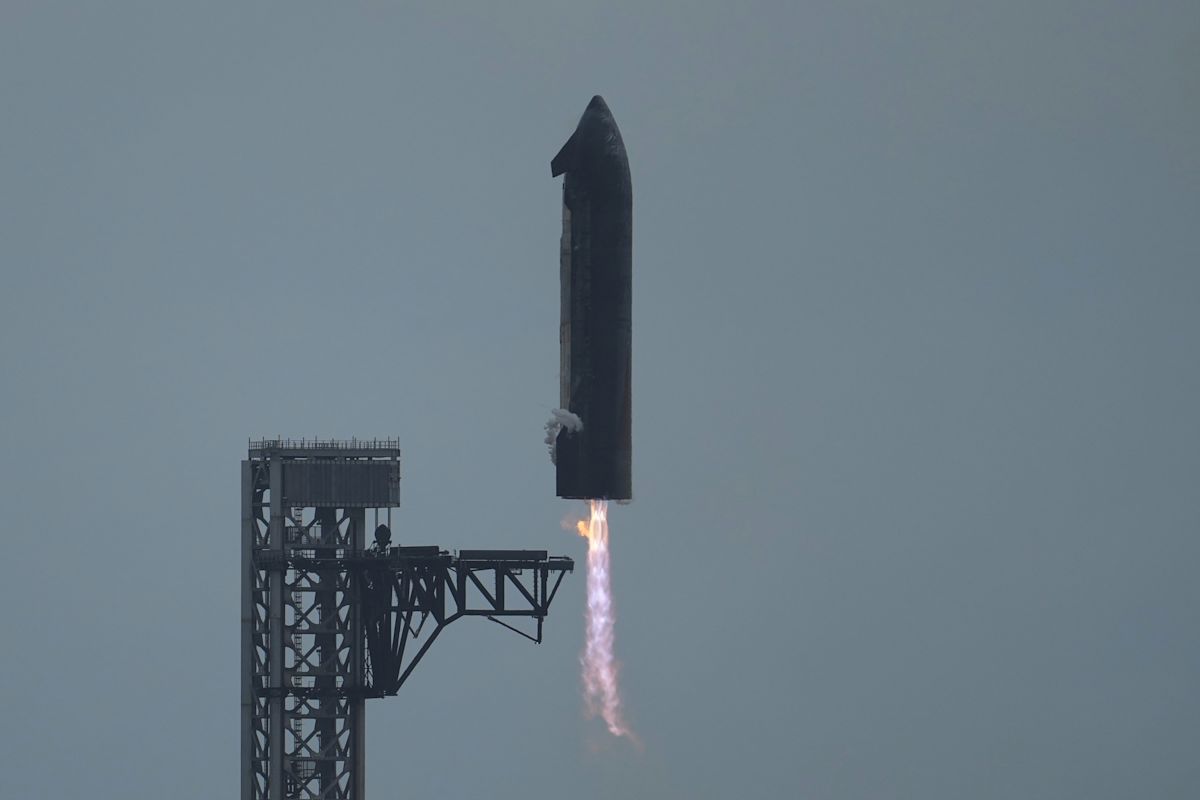
On November 14, 2026, at the Starbase launch site in Texas, the Mechazilla tower caught the Starship spacecraft for the first time after a full orbital flight. This was Ship 42 from SpaceX's 15th test launch: the upper stage, returning from space, was captured by the tower's mechanical 'chopsticks.' The Super Heavy booster was lost in the same flight: its engines shut down earlier than scheduled during descent, and the self-destruct system destroyed the booster over the Gulf of Mexico.

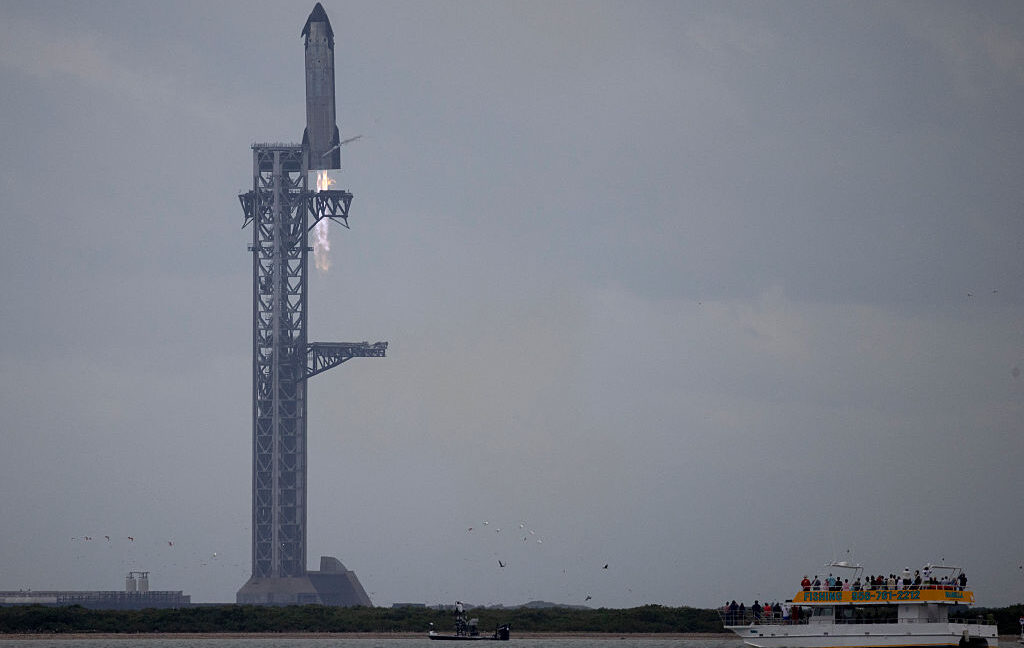
What happened
Ship 42 in SpaceX's 15th test flight spent about 22 hours in orbit, completed 14 orbits around Earth at an altitude of approximately 265 kilometers, and deployed 26 Starlink satellites. On the return journey, the upper stage entered the atmosphere and completed the full return phase, after which the Mechazilla tower caught it with mechanical clamps — a first for a Starship spacecraft in the program's history. Three things were tested in a single mission: orbital flight with payload deployment, survival during reentry, and mechanical capture by the tower. The first stage had less luck: during the descent phase, the Super Heavy engines shut down earlier than calculated, and the self-destruct system destroyed the booster over the Gulf of Mexico.
Context
Starship is designed as a fully reusable two-stage system, and both stages are intended to return after each launch. SpaceX is solving this problem with capture: the Mechazilla tower catches the stages with mechanical 'chopsticks' instead of landing on their own legs. Until November 14, this return method had been confirmed only for the Super Heavy booster — the tower had successfully caught it three times. Catching the ship is considered more complex: the upper stage returns from space and undergoes full atmospheric entry, so its thermal protection takes the main thermal load and becomes a critical node for reusability, rather than the capture mechanics themselves. Another part of the context is the production pace: SpaceX is already producing the upper stage approximately every three weeks, and the factory is designed to assemble one ship in three days.
Why this matters for the industry
The first ship catch moves Starship from the demonstration stage to conveyor logic: return mechanics are now proven for both stages individually, and the market is shifting from the question of 'is cheap orbit possible' to 'when and at what price.' The stated economics with full reusability — a target of about $100 per kilogram of payload versus approximately $3,000 per kilogram for the partially reusable Falcon 9 — would make most competing rockets uncompetitive for years to come, if the goal is achieved. Customers and investors tend to build such scenarios into their strategies in advance, competitors are forced to respond publicly, and buyers must not lock in long-term prices on old terms. A successful catch also accelerates SpaceX's related programs: Starlink deployment, the Artemis lunar program, and the design of orbital infrastructure for AI tasks. The event has no direct impact on launch prices: commercial rates have not been published, and Starship remains a test program.
Why this matters for users
For readers, the situation does not change directly today: this is a test flight, not a product — Starship has no API, public rates, or service terms. The practical point to watch is attempts at a 'double return,' where both the booster and the ship are caught in a single flight: it is this series that will determine when Starship begins to massively reduce launch prices. Starlink subscribers care more about the pace of constellation deployment: 26 satellites in one flight set a template that will determine coverage and connection quality in the future. Another indicator of the moment is the relaunch of previously flown stages: as soon as reuse begins, it will be possible to speak of a transition from demonstrations to a system.
What is still unknown / limitations
One successful catch proves feasibility, but methodologically it is not equivalent to validation: the main technical risk shifts from the realm of realizability to the realm of repeatability and stage reusability. The counterexample is contained in the event itself — the Super Heavy booster was lost in the same flight, so individual successful missions do not yet add up to statistical system reliability. Economic figures — about $1 million per refueling and less than $100 per kilogram of payload — appear in sources as target benchmarks without a public calculation methodology, and they should be distinguished from confirmed facts. It is unknown what condition Ship 42's thermal protection is in after return and how long it will take to prepare the ship for the next flight; the timeline for when a series of double returns will become routine remains an open question.
Sources
Author
Look at AI, editorial team