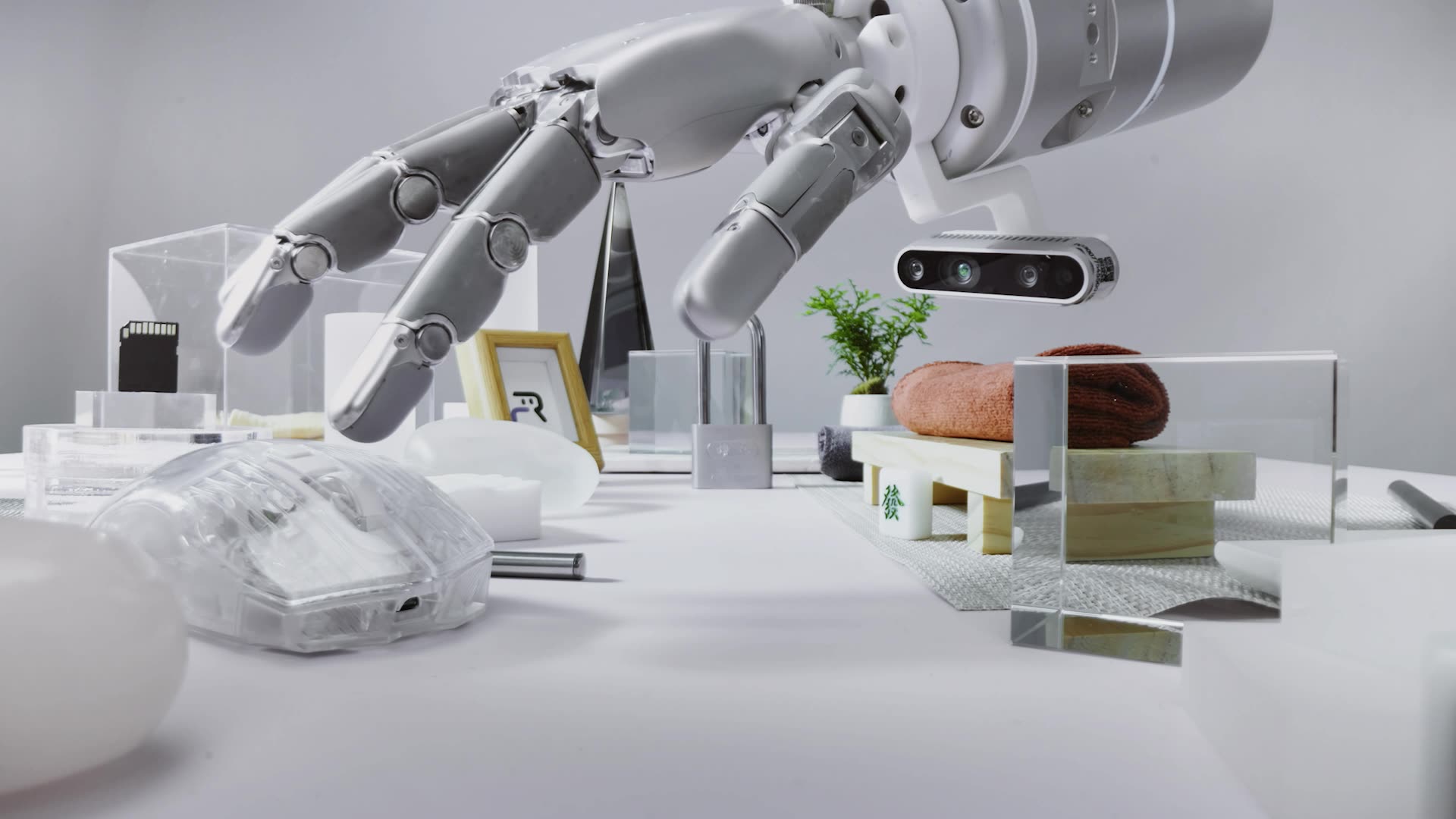
Ant Group's robotics division, Robbyant, has open-sourced the tactile foundation model LingBot-Touch, releasing weights, inference code (repository Robbyant/lingbot-touch, Apache-2.0 license), and technical report arXiv:2611.12806. Built on a JEPA architecture, the model maps signals from piezoresistive, magnetic, and visuotactile sensors into a unified latent space and was trained on 4,983 hours of tactile recordings. According to the team, it transfers to new sensors and robotic hands without fine-tuning, with LingBot-Touch-Tiny and LingBot-Touch-Small checkpoints already available on Hugging Face and ModelScope.


What Happened
Robbyant released three components simultaneously: LingBot-Touch-Tiny (5.46 million parameters) and LingBot-Touch-Small checkpoints on Hugging Face and ModelScope, inference code with examples in the Robbyant/lingbot-touch repository under the Apache-2.0 license, and technical report arXiv:2611.12806. The model is built on a JEPA architecture with a shared Haptic Transformer and learns to predict latent representations from the spatiotemporal context of tactile signals. Training was conducted on 4,983 hours of recordings—464,431 episodes and 1.33 billion frames from three types of sensors: piezoresistive (2,197 hours), magnetic (1,136 hours), and visuotactile (1,650 hours). The claimed zero-shot transfer was tested on 26 real-world tasks across two platforms—Sharpa Wave (20 tasks) and XHand (6 tasks)—including handling fragile objects and bimanual coordination; additionally, the model was validated on 12 simulated tasks using reinforcement learning.
Context
Tactile sensing is the most lagging area in robotic perception. Foundation models for vision and language have long become an industry standard, yet open tactile representation models of comparable scale have been virtually nonexistent: piezoresistive, magnetic, and visuotactile sensors speak different "languages," and perception models for each platform typically had to be trained from scratch. The problem is exacerbated by a data deficit—collecting tactile recordings requires physical hardware, making a dataset of nearly five thousand hours with a billion frames a rare asset in its own right. The choice of JEPA is methodologically aligned with the challenge of heterogeneous sensing: prediction in latent space, rather than raw signals, gives the model a chance to map different sensor types into a common coordinate system. Against this backdrop, an open release under Apache-2.0 changes the landscape—what was previously a closed competency of specific laboratories becomes a downloadable module.
Why This Matters for the Industry
The key value for the industry is the potential reusability of the tactile layer. If a unified latent space truly works across sensor types, teams no longer need to build a perception model from scratch for each piece of hardware: the cost of deploying manipulators decreases, and control policies can be learned on top of ready-made latents, accelerating development. The open Apache-2.0 license and accessible checkpoints provide external teams with a ready-made base layer for their own robots without licensing barriers; for startups without resources for their own tactile datasets, this significantly reduces prototyping costs. In the coming months, expect independent attempts to reproduce cross-sensor and cross-platform transfer, the emergence of adapters for other sensors, and the first third-party benchmarks. If transferability is confirmed outside Robbyant's ecosystem, tactile encoders may standardize similarly to open vision encoders, and sensor manufacturers may consolidate around a common representation.
Why This Matters for Users
The barrier to entry is reduced to near zero: Tiny and Small checkpoints can be downloaded from Hugging Face or ModelScope, inference code and examples for Sharpa and XHand sensors are in the Robbyant/lingbot-touch repository, and step-by-step instructions are designed for Python 3.12 and PyTorch 2.11 and work on CPU. Engineering validation on one's own data takes days, not months: it is enough to take the compact Tiny checkpoint with 5.46 million parameters and extract tactile representations in one's own pipeline, provided the sensors are compatible with supported types. For those working in robotics or following embodied AI, this is a ready-made entry point into tactile perception without a GPU cluster and without collecting massive datasets. For other readers, the release clearly shows how robot touch is beginning to take shape as a standard open component—following the same trajectory that image and text encoders took in the past.
What Is Still Unknown / Limitations
The main promise—transfer to new sensors and hands without fine-tuning—has so far been tested only on two platforms by the authors themselves, Sharpa Wave and XHand, both of which belong to a single related vendor ecosystem; transfer to arbitrary hardware does not follow from the open materials. Results are stated in the team's own technical report and have not been reproduced by independent parties, and the selection of tasks and metrics remains with Robbyant. There is no public data on inference latency, which is important for assessing applicability in real-time control. Finally, LingBot-Touch is a tactile representation encoder, not a ready-made control policy: for a working robot, physical hardware with compatible sensors and a separate control layer will be required, so it is too early to talk about production deployment.
Sources
- Robbyant/lingbot-touch — Open-source LingBot-Touch repository (GitHub, Apache-2.0 license)
- LingBot-Touch Tactile Foundation Model — Official Robbyant Technology project page
- LingBot-Touch: A Foundation Model for Heterogeneous Tactile Representation Learning — arXiv technical report
- Ant Group's Robbyant open-sources tactile AI model for robot hands — TechNode
Author
Look at AI, editorial team