On November 10, 2026, Google released Gemini 4 Carbon — the flagship model of the Gemini 4 family, designed for complex multi-step programming, agentic tasks, and scientific reasoning. As Google states, Carbon ranks first in agentic benchmarks CursorBench 4.0, Perplexity WANDR, and Zapier AutomationBench, while the cost of a solved task is more than twice lower than that of the nearest external model. Along with the release, a preview of team orchestration /swarm in Antigravity was opened, and an introductory rate is in effect until November 30, 2026, after which the price will double.

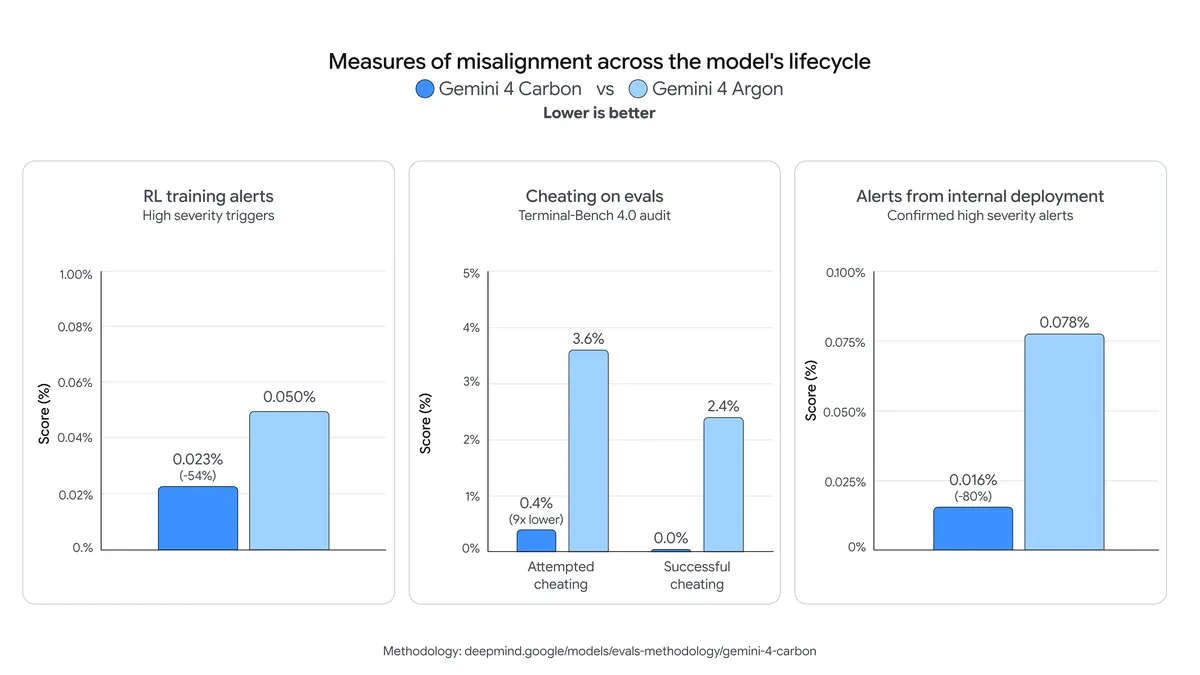
What happened
The company presented Carbon as a heavier and more token-expensive model in the lineup: it is designed for complex multi-step scenarios, while Gemini 4 Argon remains the primary model for routine engineering work. In AutomationBench 1.0.6 on 657 tasks, Carbon scored 53.9% in High effort mode — compared to 51.3% for Argon, 44.7% for Claude Sonnet 5.5, and 41.4% for GPT-6 Astra. In Antigravity, the /swarm team preview is open: a single prompt launches a coordinated group of agents that write, check, and test code in parallel. Simultaneously, the Multimodal Knowledge Agent (MKA) benchmark was introduced jointly with Artificial Analysis: in it, Carbon ranks second in quality at an average price more than six times lower than the leader.
Context
Agentic scenarios consume an order of magnitude more tokens than a single request, so the market is increasingly focusing on the cost of a successfully completed task rather than the token price: the ratio of solved tasks to the cost of running them is measured by agentic benchmarks. A heavy flagship in the lineup covers cases where an erroneous step costs more than token savings, while routine work remains with the cheaper model — the "light plus heavy" combination is becoming a standard architecture for agentic products. AutomationBench figures are also posted on the public Zapier Benchmarks page, where tasks are executed in external infrastructure, simplifying the re-verification of some results. In the broader perspective, the release confirms a shift in competition from the question of which model is smarter to the question of which model and orchestration combination solves tasks more reliably and cheaply.
Why this matters for the industry
For the industry, the key effect is pressure on the economics of the most expensive segment of agentic development: complex multi-agent pipelines, migrations, and debugging, where an error at a specific step is more expensive than the tokens themselves. Carbon's positioning — high accuracy on expensive agentic tasks at a lower cost to close them — hits the price positions of Claude Sonnet 5.5 and GPT-6 Astra in corporate agentic workloads: if the stated figures are at least partially confirmed, corporate procurement will be recalculated not by token price, but by the cost of solved tasks. The two-tier structure of the lineup pushes teams toward routing — routine steps on the cheaper model, complex ones on the flagship. The /swarm preview transforms Antigravity from an IDE with a single agent into an orchestrator of agent teams; upon exiting the preview and the appearance of API primitives, other development tools may copy the pattern. The focus on cybersecurity — results in SEC-bench Pro, ExploitGym, and CWE-bench v1, as well as the discovery of a 0-day vulnerability in SaaS in two hours jointly with Wiz — extends application beyond code into offensive and defensive security.
Why this matters for users
The model is already available via the Gemini API (paid tier) in AI Studio and Android Studio, as well as in Google Antigravity and Gemini for business. An introductory rate is in effect until November 30, 2026 — $2 per 1 million input tokens and $10 per 1 million output tokens, after which the price will rise to $4 and $20, respectively: the next twenty days or so are convenient for running a real pipeline through Carbon and calculating the actual cost and success rate of tasks compared to Argon, Claude Sonnet 5.5, and GPT-6 Astra. In Antigravity, you can manually test the /swarm preview on your own task and assess whether the "agent team" pattern transfers to your scenario. Researchers have access to an application for six months of free access to Argon and Carbon. For permanent pipelines, it is advisable to set up routing and caching in advance so that bills do not spike after November 30.
What is currently unknown / limitations
All claims about first places and twice the lower task cost rely on Google's own figures; there are no independent measurements at the time of publication. Carbon's lead over Argon in AutomationBench is approximately 17 tasks out of 657, so without confidence intervals and repeated runs, the difference may lie within the noise. Carbon was tested at High effort, and the comparison of effort and computation with competitors is not described, so the leadership may reflect a greater volume of computation per task rather than an advantage of the architecture itself. The MKA benchmark debuted with the release, creating a premise for systematic sampling error, although the participation of the external aggregator Artificial Analysis partially reduces this risk. The scientific result "40 times more protein homologs" has not yet been reproduced by external teams, and its methodology is not disclosed in the provided materials. In addition, it has not been announced when /swarm will exit the preview or whether it will have API primitives.
Sources
- Gemini 4 Carbon is now available — Google Blog (Koray Kavukcuoglu)
- Gemini 4 Carbon AutomationBench Results: 53.9% — Zapier Benchmarks
Author
Look at AI, editorial team