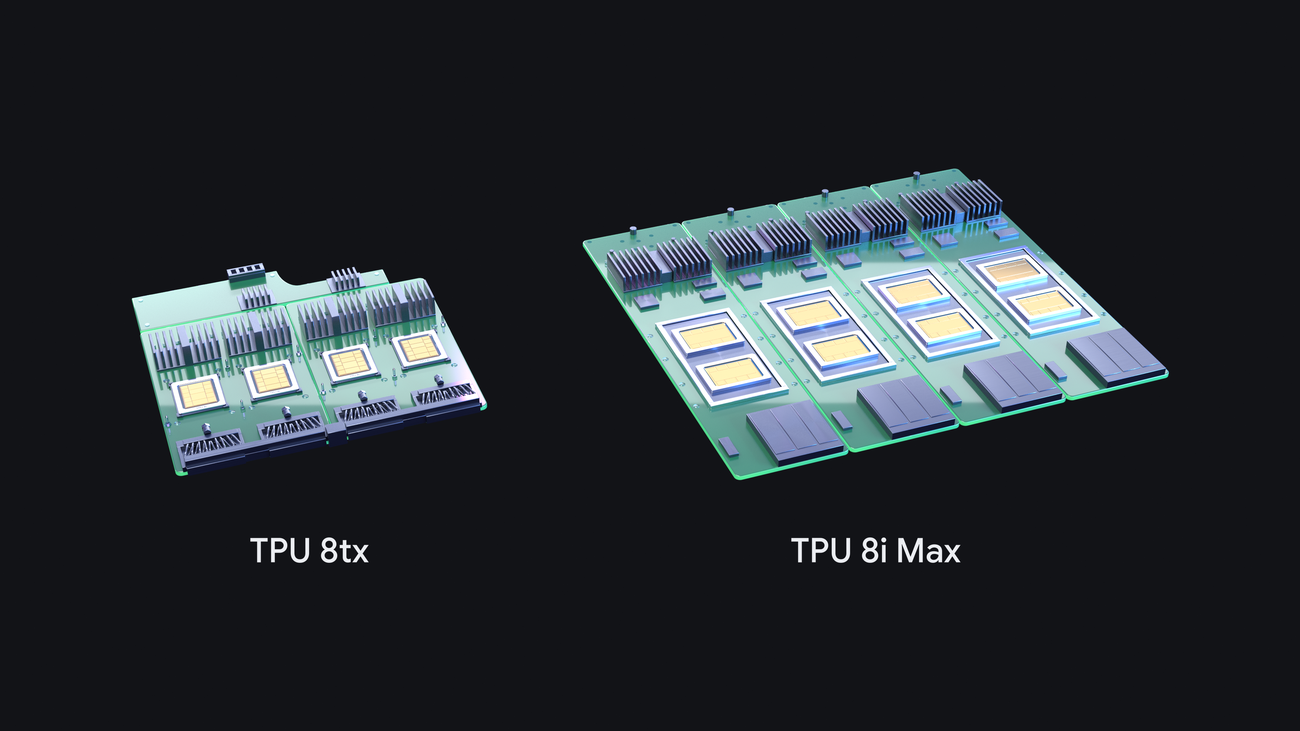
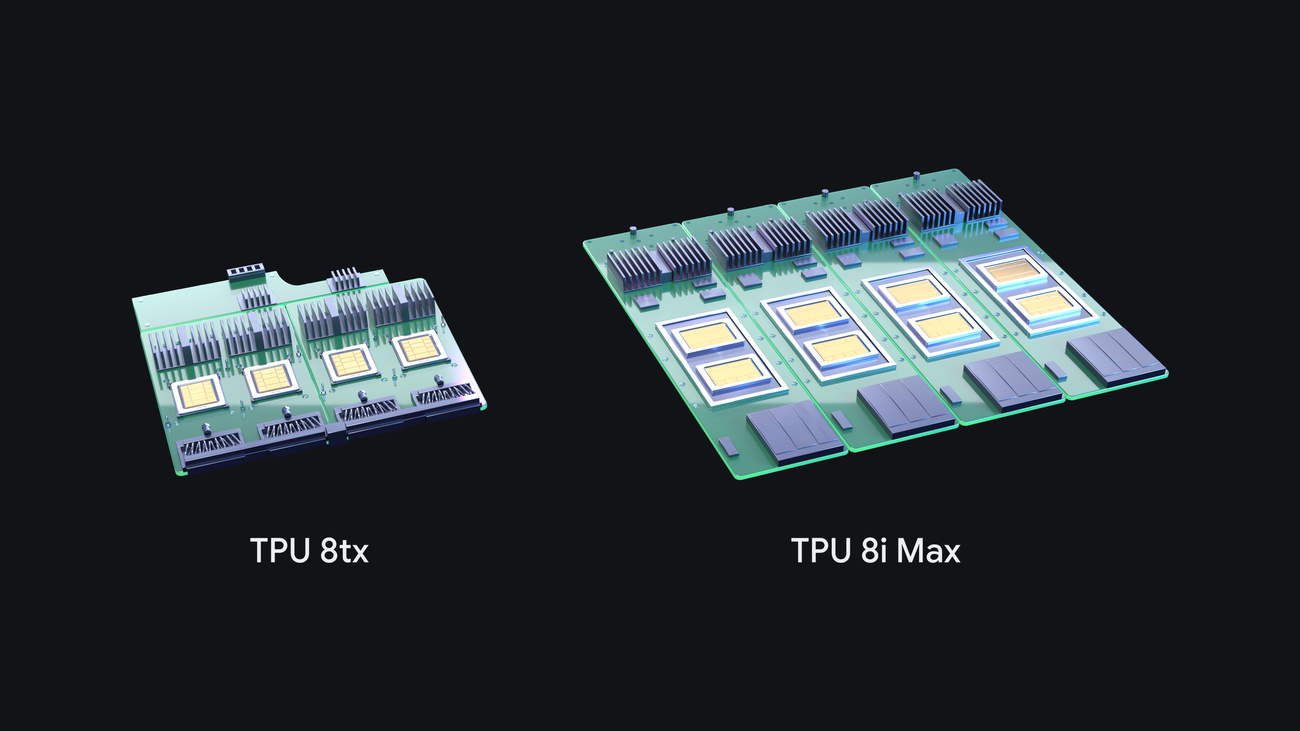
On November 9, 2026, Google completed its eighth-generation TPU lineup with four systems: following TPU 8t and TPU 8i, the TPU 8tx with a hardware confidential computing mode and the TPU 8i Max with two chips in a single enclosure, designed for million-token contexts, were released. Simultaneously, the company open-sourced TorchTPU and the XLA Serving Engine, although prices, regions, and availability dates for the new accelerators have not yet been announced.

What happened
The announcement includes two new hardware systems and a package of software components. TPU 8tx is built on TPU 8t silicon and operates in conjunction with AMD EPYC 5th-generation hosts; it supports hardware-level confidential computing, meaning data and model weights remain isolated even during active processing, with latency reported by Google to be up to two times lower than that of TPU 8t. TPU 8i Max combines two TPU 8i chips in a single enclosure: compute power, SRAM capacity, and HBM bandwidth are doubled, and increased compute density per rack should help handle very long contexts. In parallel, the code for TorchTPU for natively running PyTorch and Hugging Face models on TPU, the C++ runtime XLA Serving Engine for serving models on TPU, GPU, and CPU, as well as the TPU Sync and Agent Compute Engine components, was open-sourced: the former, according to Google, reduces KV-cache transfer latency by more than 90%, while the latter offloads the state of idle agent sessions from the chip in milliseconds.
Context
Prior to this announcement, the eighth generation of TPU consisted of two systems, TPU 8t and TPU 8i, and Google structured all four releases of the year as a unified portfolio addressing two notable market demands. The first is hardware data protection: regulated industries and the government sector require that information not be decrypted in memory even during processing. The second is agentic workloads, which require million-token contexts and long-lived sessions, not just peak FLOPS. A separate historical barrier has been the ecosystem: teams with a PyTorch stack had to adapt their code for TPU separately, while competitors worked in the familiar CUDA environment. The choice of metrics is also telling: Google evaluates the new systems not by raw performance, but by end-to-end metrics of agentic pipelines—KV-cache transfer latency, session state management, and rack density.
Why this matters for the industry
For the first time this year, Google released four TPU systems and shifted competition from the level of individual chips to the level of ready-made systems, where chips, the Boardfly network, hosts, and packaging work as a single unit. Competitors—NVIDIA, AMD, and AWS Trainium—will now have to respond to enterprise segment demands not only with raw performance but also with hardware confidentiality and rack density. For teams that previously did not consider TPU, the open-sourced TorchTPU and multi-backend serving layer reduce migration costs, while the combination of TPU 8i Max, TPU Sync, and Agent Compute Engine sets a new benchmark for the unit economics of agentic products: lower cost of serving long contexts and higher session density per rack. If adoption materializes, this will become a potential platform shift for startups on the PyTorch stack.
Why this matters for users
Developers with PyTorch and Hugging Face workloads can access some changes now: TorchTPU is open-sourced, so code runs natively on TPU without rewriting, and ready-made backends for vLLM and SGLang simplify inference—portability of one's own pipeline can be tested in an experimental environment before purchasing hardware. The choice between the new systems is determined by the scenario: TPU 8tx is suitable where data cannot be decrypted in memory, for example in finance, government, or healthcare; TPU 8i Max is for cases where a huge context is needed in a single run, from dozens of parallel agents to entire codebases or hours of video. It is still too early to plan capacity and budget for the new accelerators, so the practical first step for a team is to pilot the open-source software and prototype the "sleep and wake" pattern for agent sessions at the application architecture level.
What is still unknown / limitations
The main uncertainties are concentrated in the hardware. Prices, regions, and GA dates for TPU 8tx and TPU 8i Max have not been announced, so the systems cannot be considered ready for industrial operation or included in capacity and budget planning. The claim of latency up to two times lower than TPU 8t is given without a description of workloads and configurations, and it is impossible to verify it until independent measurements appear. Million-token contexts are not accompanied by any measurements: there is no data on latency, throughput, or generation quality, and TPU 8i Max is scaling through the packaging of two chips, not a new architecture. Real overhead figures for confidential computing in production and the maturity of vLLM and SGLang backends for TPU will remain open until GA and external verification.
Sources
- Introducing TPU 8tx and TPU 8i Max — Google Blog (Amin Vahdat, SVP and Chief Technologist, AI and Infrastructure)
- Google expands eighth-generation TPU portfolio with two new TPU systems — Data Center Dynamics (Charlotte Trueman)
Author
Look at AI, editorial team