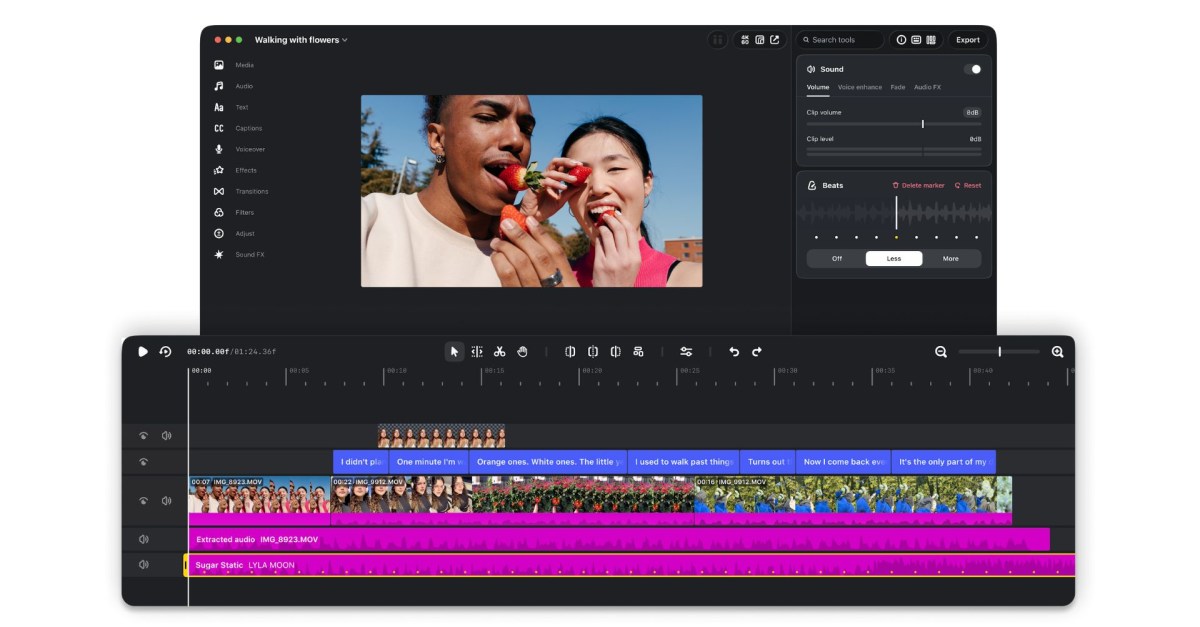
Meta has released Edits Desktop, a free macOS version of the Edits video editor with a built-in MCP server. Once an external AI agent, such as Claude, Codex, or Muse, is connected, it gains access to over 300 tools covering nearly the entire editor interface. This release transforms a standard editing program into an agentic environment, cementing Meta's bet on editing workflows that can be delegated to LLM agents.


What happened
On November 5, 2026, Meta released Edits Desktop for macOS, making the desktop version of its mobile video editor Edits free. The application features a multi-track timeline, keyframes, color correction with color wheels, log conversions, and curves, unlimited auto-subtitles, and 4K export without a watermark. The main feature of the release is a built-in MCP server (Model Context Protocol, a protocol for connecting external AI agents to applications). The settings include ready-to-copy commands for connecting Codex, Claude, or Muse, after which the agent has access to over 300 tools covering nearly the entire editor interface. According to Matthew Simari, head of product management for Edits, any agent can be used, not just Meta's proprietary Muse. The application is updated weekly, and downloads are available at edits.instagram.com/desktop.
Context
Edits is an editing application that Meta is developing in conjunction with Instagram, which is owned by Meta—a company recognized as an extremist organization and banned in Russia. According to available data, 50 million people used Edits over the past year, and the company is now moving the product to the desktop. The technological foundation of the agentic scenario is MCP (Model Context Protocol), a protocol by which third-party AI agents connect to applications and interact with their features through a standardized set of tools. This precedent is important because, until now, agent access to serious editing software has been limited: Blackmagic's DaVinci Resolve already has MCP, but only in the paid version, while the familiar method of agentic video editing exists in a different form—headless pipelines using ffmpeg, without a visual interface at all. The release of a free editor fits into the broader normalization of agent-first interfaces, where programs are designed with machine control in mind, on par with human control.
Why this matters for the industry
For the industry, this is a claim to a platform shift: Edits Desktop becomes the first major editor from the social media world with an open MCP that any external agent can connect to, not just a proprietary one. The GUI becomes a surface controlled by an LLM, and this increases competitive pressure: CapCut gains a free agentic competitor from Meta, while Adobe and Blackmagic get an additional incentive to enhance their own agentic interfaces to avoid ceding the new layer of editing. For builders and startups, this is a zero-cost testbed for agent-UX: prototypes for delegating editing to an agent can be built without license costs. The downside is dependence on a giant's weekly-updated toolkit: basic editing is finally commoditized, and pipelines built around someone else's closed API inherit platform risk. If the bet pays off, a hybrid workflow of "agent makes the rough cut—human polishes it manually" will become the norm in short vertical formats, while headless editing will remain the domain of ffmpeg and specialized APIs.
Why this matters for users
Practical value for the reader: on Mac, the editor is installed for free from the edits.instagram.com/desktop page, the agent is connected via a standard command from the application settings, after which it can be tasked with editing, and you can see in real time what it is doing on the timeline. There is no need to pay for licenses—this is the main consumer benefit of the release. Expectations should be calibrated: according to the post author's experience, the agent handles simple reels, but editing via the GUI is approximately ten times slower and worse than the same agent working directly with ffmpeg. There is no complex motion at the level of After Effects in Edits, and the scenario is strictly interactive: you cannot delegate overnight batch processing and mass video production to an agent in the editor because there is no headless mode.
What is currently unknown / limitations
Assessments of editing quality currently rely on the personal experience of one author on a few simple reels: there are no reproducible benchmarks for quality, the number of failed tool calls, or the percentage of successful tasks, so optimistic conclusions like "the barrier has really been lowered" are not methodologically confirmed. Long-term reliable agent work with a GUI remains a weak point of modern models: turning an editor into an agentic environment creates a potential testing ground, but does not demonstrate the capability itself. With weekly updates, the set of 300+ tools will change quickly, so pipelines around MCP are unstable; it is unknown whether Meta's documentation and tool versioning will affect this—this will determine whether independent measurements of GUI agent quality and metrics like cost per video in tokens will appear. Finally, the application currently exists only for macOS; there are no versions for Windows and Linux.
Sources
- The Verge: You can edit your videos with AI on Instagram's new desktop Edits app
- Edits Desktop — official download page (Meta)
Author
Look at AI, editorial team