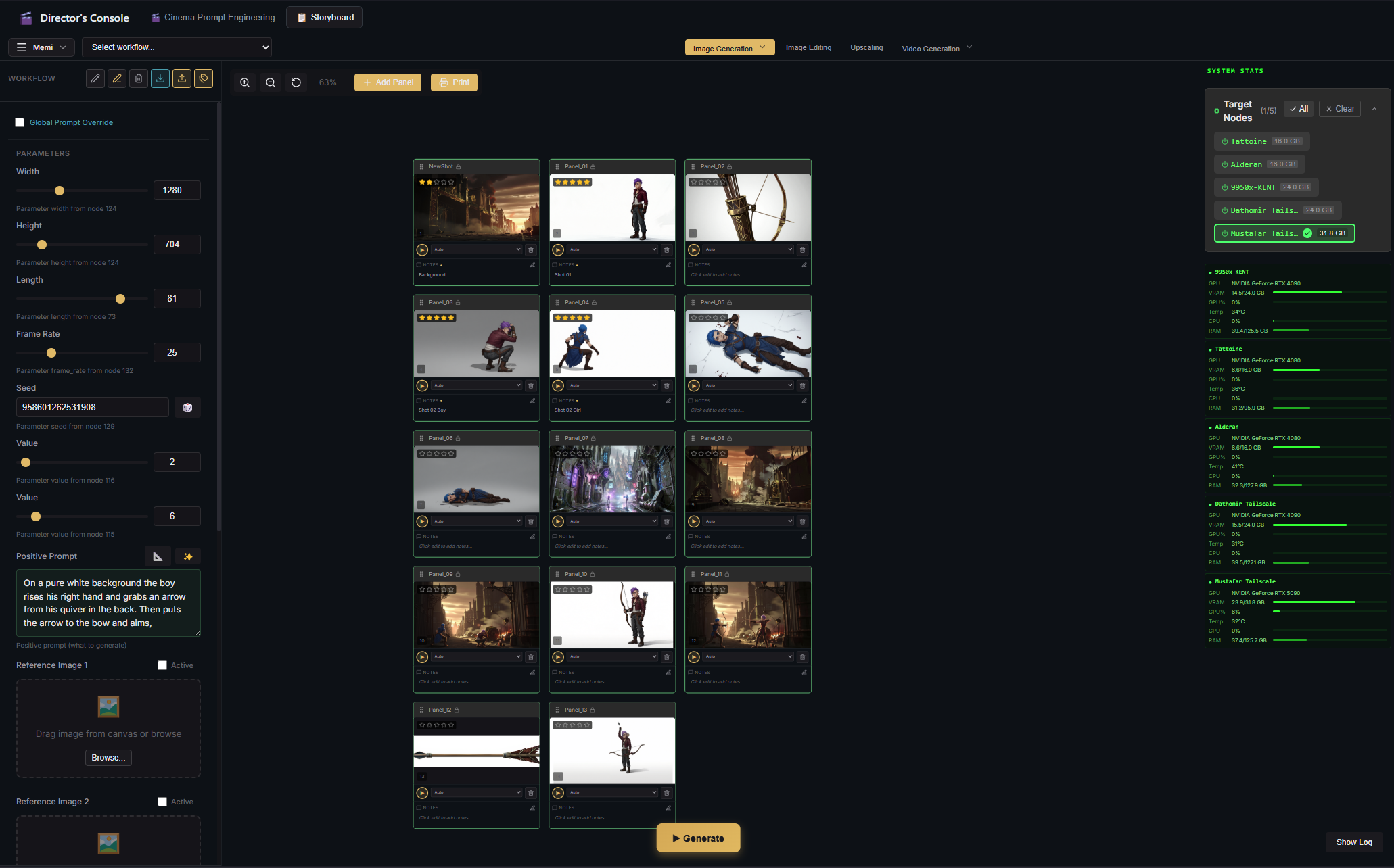
MoEffect Studio, led by Nick Pittas, has published a suite of open-source tools on GitHub that embed generative AI into classic VFX pipelines. The suite includes the NukeToComfyUI and AE2ComfyUI bridges, the Comfyui_Media media node, the ComfyUI_CameraAngleSelector, and the Director's Console web interface featuring a Storyboard. The projects are distributed for free: Nuke and After Effects feed frames and masks to generative models, and the finished material returns to the original composition while preserving alpha, color format, and timeline.

What happened
The public release occurred on GitHub: five NickPittas repositories are available to everyone, with the latest commits in the main projects dated November 8, 2026. Director's Console is a web application for scene direction featuring Cinema Prompt Engineering, a Storyboard board, a gallery, and an embedded Pi/Codex agent; the project has already garnered 370 stars. The NukeToComfyUI bridge connects Nuke and ComfyUI via FromNuke, ToNuke, FromNukeVideo, and ToNukeVideo nodes: it transports PNG8 and EXR16 with alpha, can pad sequences to an 8n+1 frame grid, and displays progress with the ability to cancel tasks. AE2ComfyUI performs the same role for After Effects, returning results over the original layer with timeline alignment, and supports saving in ProRes 4444 and H.264. The Comfyui_Media node loads MOV, MP4, EXR, and PNG files with presets for WAN and LTX models, includes a viewer with a wipe feature, and writes results to H.264, ProRes 4444, and frame sequences. ComfyUI_CameraAngleSelector provides a 3D interface for selecting from 96 angles—specifically 8 directions, 4 heights, and 3 frame sizes—and prepares prompts for the LoRA Multiple-Angles for the Qwen-Image-Edit-2511 model from FAL; the project has 127 stars.
Context
The release bridges a long-standing gap between two worlds. Classic VFX lives in Nuke and After Effects, where alpha, color space, and timeline are as important as the image itself, while generative models have largely remained in a separate ComfyUI ecosystem. MoEffect's bridges implement a sidecar pattern: the DCC remains the source of truth, sending frames and masks to ComfyUI via HTTP on port 8765, while the finished result returns to the same composition with preserved color format and timeline. This keeps workflows under the control of the pipeline owner. The camera angle selector does not add a new method of camera control; it is an interface layer over the existing LoRA Multiple-Angles for Qwen-Image-Edit-2511 with ready-made prompts from FAL, and the media node presets are targeted at WAN and LTX video models. Essentially, MoEffect has given away for free the integration layer that studios and consultants previously built and sold individually.
Why this matters for the industry
For studios and teams building products around generative video, the main effect is a reduction in the engineering cost of implementing neural generation. There is no need to rewrite the pipeline: the DCC stores the source files, and ComfyUI connects to it as a generative node. Preserving EXR16 and ProRes 4444 with alpha and timeline makes model output immediately compatible with compositing, removing the main technical objection to production implementation. Simultaneously, the "plumbing" between generative models and VFX applications is being commoditized: integration services that were previously sold separately are now free, weakening the business case for teams pitching "we will connect neural generation to your pipeline," while value shifts toward orchestration, quality control, and direction. If the bridges withstand studio loads involving long sequences, alpha, and timelines, the "generation as a neural node in Nuke and After Effects" pattern may become established in hybrid pipelines, and forks of the console with agents may follow. This is currently a prediction, not a fact established by sources.
Why this matters for users
Everything described can be installed today for free: the tools are distributed in open source, installed via git clone and running python tools/install.py, require Python 3.10 or 3.11 or newer, ComfyUI itself, and for the After Effects bridge, After Effects 2022 or newer with Media Encoder. A realistic first step is a pilot on shot types where the cost of error is low: styling, inpainting, padding, and reworking frames with masks. Frames and masks are fed from Nuke or After Effects, and the finished result returns to the composition with alpha and timeline alignment. In Director's Console, users can build a storyboard and start rendering with work distribution across multiple ComfyUI nodes, while the shot angle is selected in a 3D interface for LoRA Multiple-Angles.
What is still unknown / limitations
Several points remain unclear. The 8n+1 grid step and presets for WAN and LTX appear to be adjustments for video model limitations, but sources do not explain the reason, so this should be considered a hypothesis until the code is read. Parallel rendering through multiple ComfyUI nodes is not supported by descriptions of queues, task distribution, and fault tolerance, making it premature to call it a replacement for a render farm. The stability of the bridges on large studio projects with long sequences has not yet been confirmed by precedents. Alongside the open repositories, the source mentions a custom CorridorKey build without open details. Finally, the camera angle selector does not provide a new camera control method: its capabilities are limited to what the existing LoRA Multiple-Angles already does.
Sources
- GitHub — NickPittas/DirectorsConsole: web console with Cinema Prompt Engineering, Storyboard, and Pi/Codex agent
- GitHub — NickPittas/NukeToComfyUI: Nuke and ComfyUI bridge with PNG8/EXR16 transport and 8n+1 grid
- moeffect.gr — ComfyUI Nodes & Bridges: overview of MoEffect nodes and bridges
Author
Look at AI, editorial team