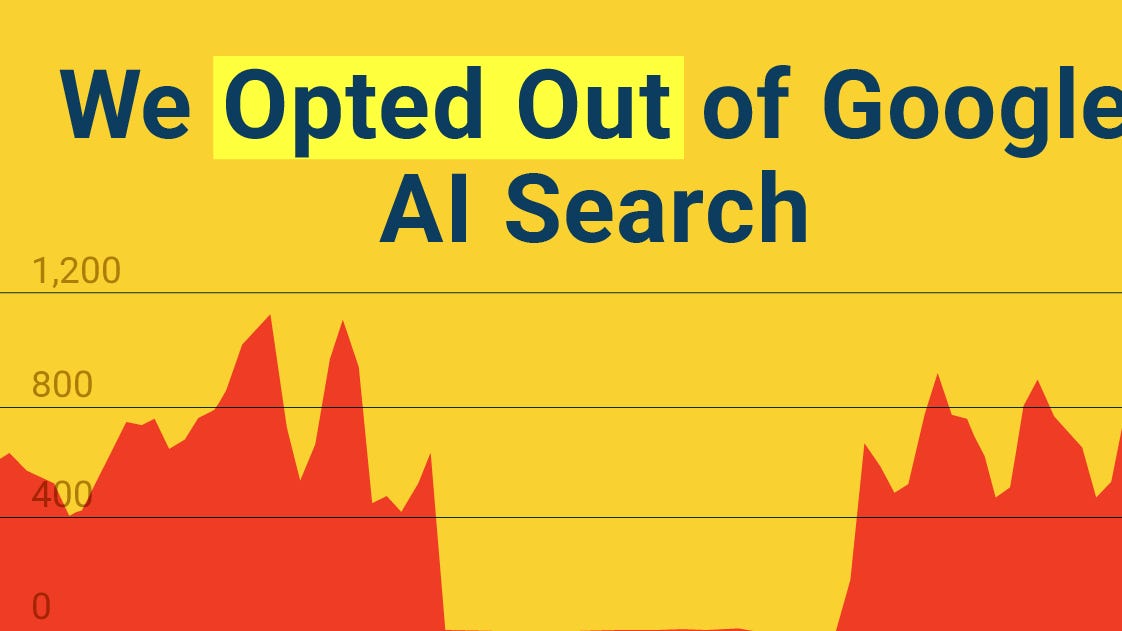
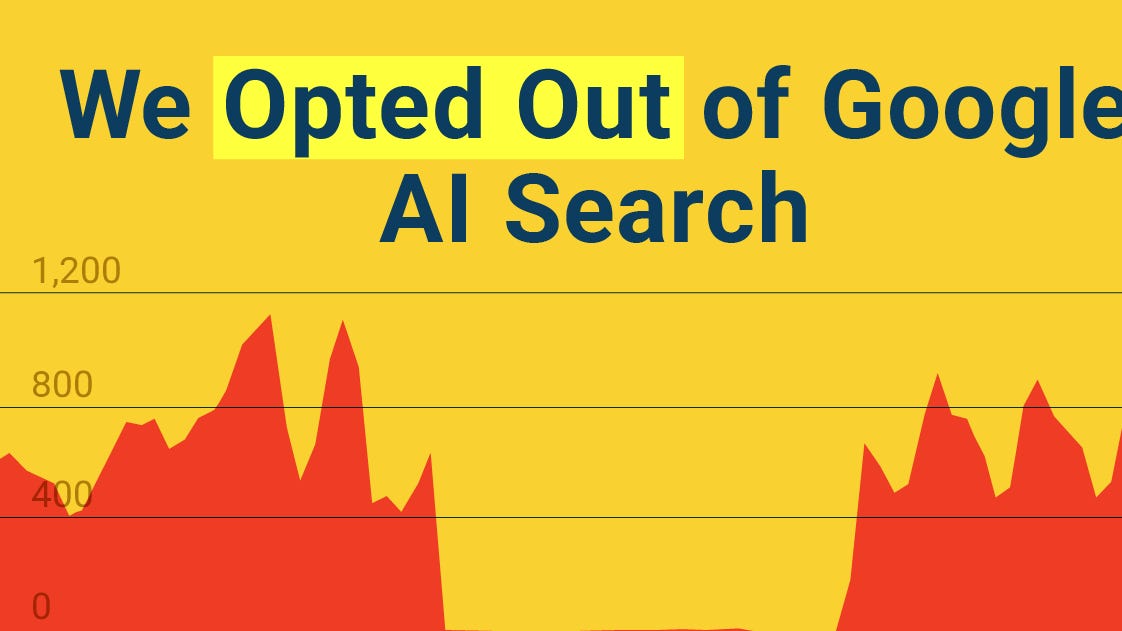
Cyrus Shepard, an SEO consultant from the Zyppy project, conducted a 28-day experiment: from September 1, 2026, his site was excluded from Google's AI search features, and on September 29, it was reinstated. According to Google Search Console data, AI answers with source links brought the site about 21% of all clicks and approximately 23% of traffic when accounting for the 'halo effect,' while the CTR of AI surfaces was roughly twice that of standard organic results. The experience showed that voluntarily giving up AI visibility is more expensive than it might initially appear.

What happened
On September 1, 2026, Cyrus Shepard opened the Search generative AI control section in Google Search Console and excluded the zyppy.com site from AI Overviews and AI Mode, then returned the toggle to its original state exactly 28 days later, on September 29. During the observation period, Search Console data showed that AI impressions ranged from 500 to 1,000 per day, or about 10% of the site's total search impressions, yet this segment accounted for about 21% of all clicks. The estimated CTR for AI search was approximately 0.9%, with a range of 0.7% to 1.1%, compared to about 0.4% for standard organic search. Additionally, the author recorded a 'halo effect': when a page was mentioned in AI answers, the CTR of its organic links increased by approximately 2.3%, so Shepard estimates the total value of AI visibility at about 23% of traffic. The technical side of the toggle was quick: Google removed the site from AI answers in less than an hour, and after re-enabling, impressions returned almost instantly.
Context
The opt-out from Google's AI search features became available to site owners in August 2026 via Search Console; AI Overviews are generative answers within the search results themselves, while AI Mode is a separate search mode with conversational answers, and both are accompanied by links to sources. Until now, publishers have not had public quantitative measurements of how much traffic they gain from appearing in such answers: concerns about click leakage to AI answers have been raised for a long time, but confirmed figures were virtually non-existent. Shepard's material became the first public quantitative benchmark of this kind. It was picked up by specialized press—Search Engine Journal headlined that Google's AI features sent an estimated 21% of one site's clicks, and the word 'estimated' is an important caveat. The experiment also became a topic of discussion on Hacker News.
Why this matters for the industry
For the AI industry, Shepard's measurement is the first numerical starting point for decisions regarding AI visibility: if the proportions are at least approximately reproducible, voluntarily opting out of AI citations zeroes out about 21% of direct clicks and, according to the author's estimate, simultaneously depresses organic traffic through a trust effect. This turns AI search from a marketing showcase into a measurable distribution channel and strengthens publishers' positions in the debate over who should pay for the content on which AI answers are built. The discussion is also fueled by the regulatory timeline: by December 3, 2026, Google is required, at the demand of the UK regulator CMA, to provide publishers with aggregated metrics for impressions, clicks, and CTR for AI Overviews and AI Mode, and by March 2027, to launch page-level controls, after which the industry will have a denominator against which this single-site case can be calibrated. The window is already open for tooling teams: they can build dashboards and alerts for the AI channel share, automate AEO optimization, and frame a site's inclusion status in AI answers as a managed experiment with dates and metrics.
Why this matters for users
If you run a website or blog, the opt-out option from Google AI search is not a free way to 'remove' AI citations: along with them, direct AI clicks and the boost in organic CTR disappear instantly, so Shepard himself advises staying in AI answers and intentionally optimizing for inclusion in them. You can get your own picture without relying on others' benchmarks: open the Generative AI Features report in Search Console, ensure your site is not excluded from AI Overviews and AI Mode, and calculate your share of AI impressions and AI clicks within one to two weeks of observation. For readers, this same mechanism explains why some sites are not in Google's AI answers: their owners may have consciously excluded them, and, judging by the measurement results, the price of such a decision may be significantly higher than they assumed.
What is still unknown / limitations
The status of the cited figures is no higher than a strong hypothesis, not an established fact: this is a case study of a single site without a control group, and the secondary source in the headline explicitly marks the result with the word 'estimated,' with the author indicating a CTR range of 0.7% to 1.1%, but no confidence intervals or day-to-day variance in the description. The most vulnerable link is the 'halo effect': attributing a 2.3% increase in organic CTR to mentions in AI answers requires a counterfactual assessment, which a 'before and after' design on a single site cannot provide, and seasonality and other September confounders are not disclosed in the material. Furthermore, the logic for counting impressions in Search Console for AI surfaces (AI Overviews and AI Mode) is not detailed in the documentation, so the comparison of CTR 'AI vs. organic' may partially be an artifact of different definitions of an impression; market median metrics will appear later—when the mandatory CMA aggregated metrics begin to arrive by December 3, 2026, against which a separate case can be calibrated.
Sources
- We Opted Out of Google AI Search – Here's What Happened (Zyppy Signal, Cyrus Shepard)
- Google's AI Features Sent One Site An Estimated 21% Of Its Clicks (Search Engine Journal)
- We Opted Out of Google AI Search – Here's What Happened | Hacker News
Author
Look at AI, editorial team