
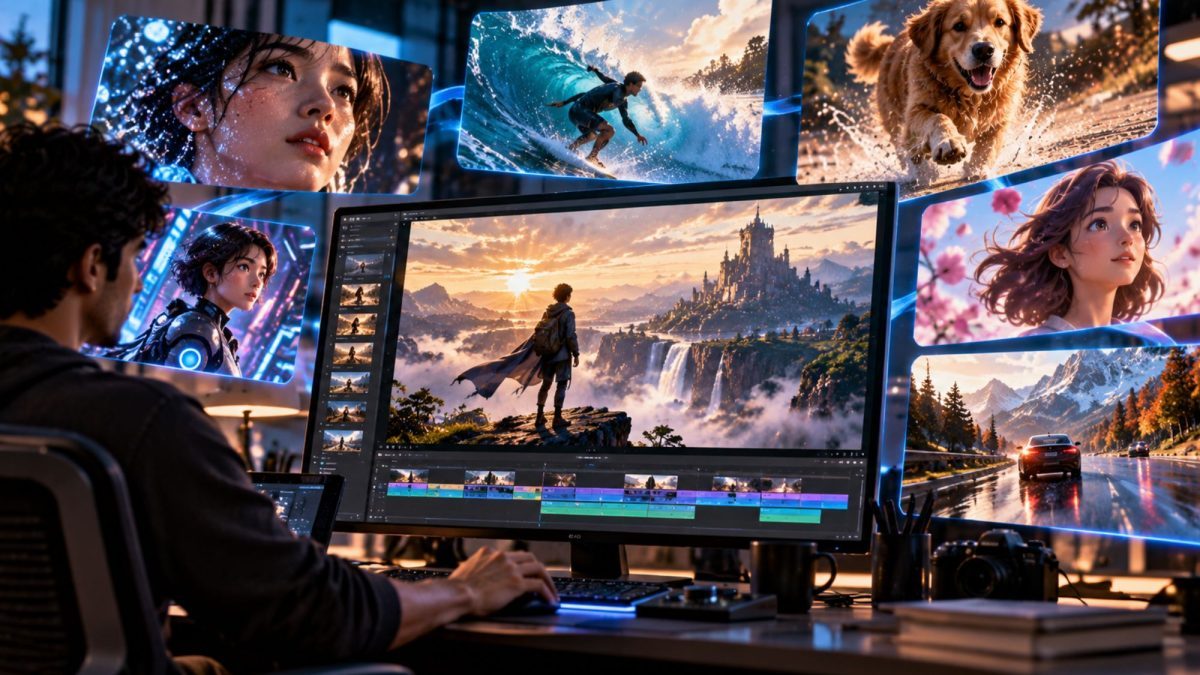
A banner reading "Create cinematic 4K videos with Seedance 2.5" has appeared on the official Seedance 2.5 page in the Dreamina service (ByteDance/CapCut): the model is for the first time officially positioned as a native 4K video generator without upscaling finished clips, featuring 10-bit color and an economical draft mode where cheap 480p previews are generated before the final render. ByteDance launched the Seedance 2.5 4K version on October 23, 2026, via the Volcano Engine cloud platform as a trial for select corporate clients, but the exact date for wide 4K access in the consumer service has not yet been announced.

What happened
The news hook was the appearance of an advertising banner on the official Seedance 2.5 page in Dreamina with the direct promise "Create cinematic 4K videos with Seedance 2.5." In this positioning, high resolution is to be achieved directly at the generation stage, rather than by upscaling an already finished clip; the product also highlights 10-bit color and an economical draft mode, meaning a two-stage scenario where 480p previews are used for selecting variants, while the final render remains the final output. In parallel, the corporate launch phase is known: ByteDance released the Seedance 2.5 4K version on October 23, 2026, via the Volcano Engine cloud platform, initially as a trial for select corporate clients. 4K has not yet reached the mass consumer — the promise is already on the Dreamina product pages, but the date for wide access has not been named.
Context
The history of Seedance 2.5 is developing in stages. The model was announced on June 23, 2026, at the Volcano Engine FORCE conference, and the consumer release of the base version took place on July 31, 2026, via Jimeng and Dreamina. The base Seedance 2.5 generates 30-second clips with synchronized stereo sound and accepts up to 50 multimodal references: 30 images, 10 videos, and 10 audio files; it is already available to subscribers, with 4K included in the Standard plan at $56 per month, which, according to PC Tech Magazine, provides for about 36 videos, while the basic plan is free and gives 16 credits. Against this backdrop, the contrast with competitors is noticeable: according to a PC Tech Magazine table, OpenAI Sora 2 is limited to 1080p and 25 seconds, Google Veo 3.1 supports 4K but only for 8 seconds, and Kling 3.0 is 1080p and 10 seconds. The combination of resolution, duration, and synchronized sound remains the main axis of competition for video models, and this is exactly what the promotion of Seedance 2.5 targets.
Why this matters for the industry
For the industry, the important factor is not the 4K label itself, but the product shift: ByteDance is moving native 4K rendering from the corporate Volcano Engine environment, where it has been open to a limited circle of companies since late October, to the consumer Dreamina, setting a new price and product benchmark for the generative video market. The specific cost-saving mechanism is a two-stage pipeline: "massively cheap 480p drafts, selection, expensive finalization of selected items to native 4K": this is a ready-made UX pattern for iterative production that reduces inference spend on failed generations. For builders, the second asset is the combination of up to 50 multimodal references in a single generator, which allows building repeatable production pipelines with character and style retention instead of one-off demonstrations. If the combination of "native high render plus cheap draft" becomes the norm, competitors will have to catch up in both resolution and duration, and over time the discussion will shift from resolution to consistency, controllability, and audio-video synchronization — this is an industry forecast, not a stated fact.
Why this matters for users
The practical benefit for readers does not depend on the expected 4K: in Dreamina, it is already possible to generate 30-second clips with sound and synchronized editing using the base Seedance 2.5, which accepts up to 50 references and is available to subscribers starting with the free plan of 16 credits. According to PC Tech Magazine, 4K is included in the Standard plan at $56 per month, which provides for about 36 videos. The draft mode changes the logic of subscription consumption: it is cheaper to select variants by 480p previews and only bring the selected duplicates to the final render, which is particularly suitable for advertising and music videos where a cinematic picture and precise adherence to references are important. A reasonable zero action today is to run 2–3 of your own scenarios on the base version and check whether character consistency is maintained through a series of references; on this basis, decide whether the move to Standard for 4K is justified.
What is still unknown / limitations
The main limitation is the level of proof: the fact of the vendor's statement has been verified, i.e., the banner on the Dreamina product pages and secondary reviews (Lapaas Voice based on TechNode materials, PC Tech Magazine), but the capability of "native 4K without upscaling" remains a declaration. There is no technical report, model card, benchmarks, or independent tests, so the solution may contain classic upsampling — without a public methodology, this cannot be verified. The comparison table with Sora 2, Veo 3.1, and Kling 3.0 is a third-party editorial review, not a vendor methodology, and its representativeness has not been established. There is no data on the API, render time, or limits in the sources, so automation based on the service is not yet described. Finally, the exact date for wide consumer 4K access has not been announced, there are no consumer 4K generations yet, and an independent assessment of the stated capability is currently impossible in principle.
Sources
- Seedance 2.5 page in Dreamina (ByteDance/CapCut) — official banner "Create cinematic 4K videos with Seedance 2.5"
- Lapaas Voice (based on TechNode materials): ByteDance Releases Seedance 2.5 4K AI Video Model for Film and Television Production
- PC Tech Magazine (Travis Head): Seedance 2.5 Brings 30-Second 4K AI Video to Content Creators and Businesses
Author
Look at AI, editorial team