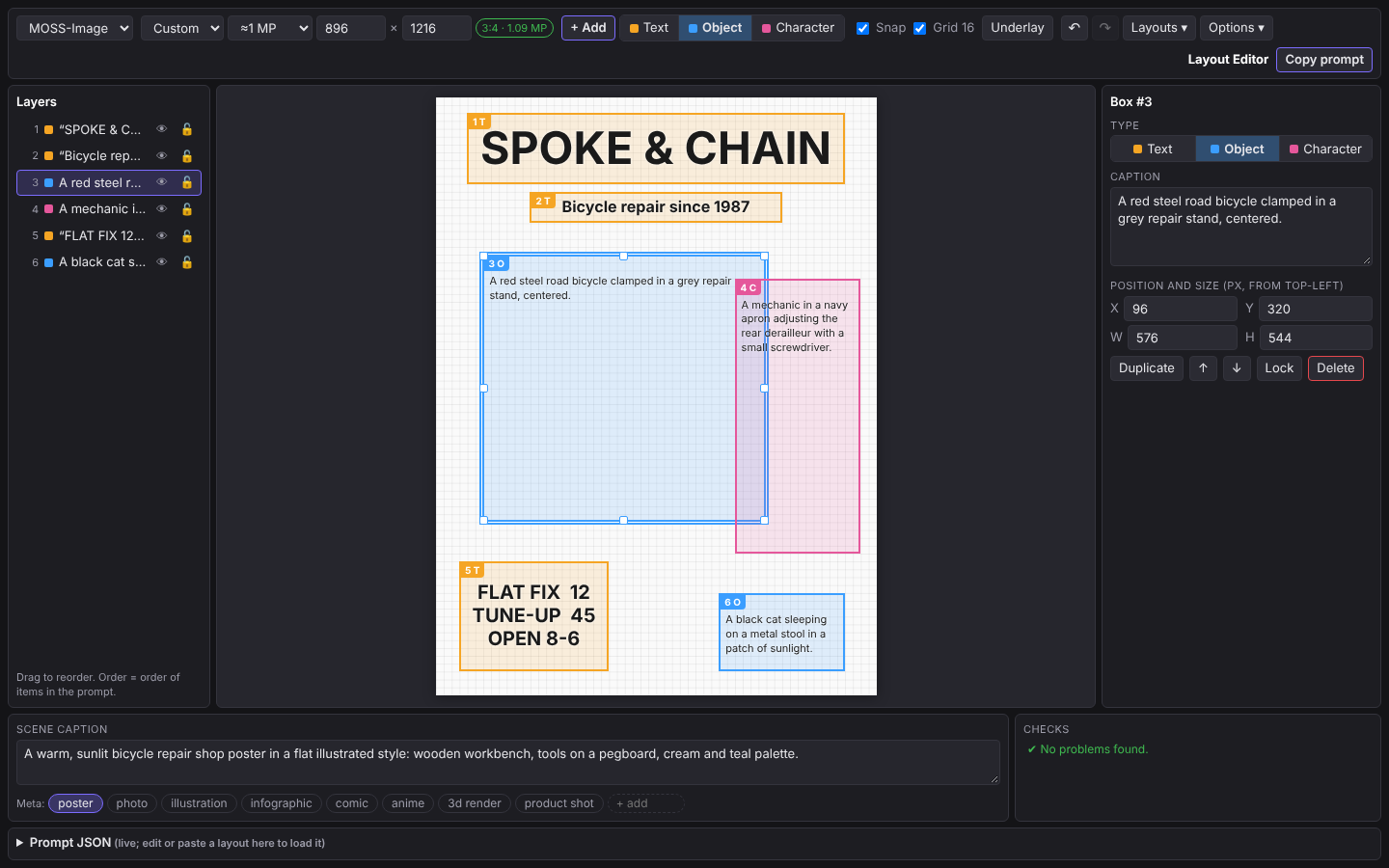
The open-source image generation model MOSS-Image from OpenMOSS has rapidly accumulated a third-party stack of free tools within weeks: a searchable catalog of styles and characters, a visual layout editor, a custom sampler for ComfyUI, a compressed INT4 build for browser execution, and two-step generation using a new distillation method without an external teacher. The Telegram channel 'Neuronaut' compiled these developments into a digest of approximately twenty resources. The practical takeaway for readers: everything listed works without installation and without a GPU, directly in the browser.


What Happened
The Telegram channel 'Neuronaut' published a digest of about twenty free resources from the ecosystem of the open-source MOSS-Image model by OpenMOSS. The MOSS-Image-Character-Catalog on Hugging Face (Space by user hide1) is now fully online and functions as a search tool: according to the repository README, it contains 33,935 characters and 314 styles with previews and full prompts; the current version v0.1.2 is dated November 4, 2026. For scene assembly, user jambavant released SwarmUI-LayoutEditor on GitHub (MIT license, version from October 28): three types of boxes — text, object, and character — are arranged visually, and the layout is exported as a JSON prompt in MOSS-Image format; the editor also works as a standalone page in the browser. Inference is accelerated by two independent releases: DeltaEngine/MossInt4 — a four-step SFT in INT4 format with a size of 7.5 GB, designed for full model execution in the browser via WebGPU, and akhaliq/MOSS-Image-IDM-2-Steps — two-step generation via IDM (Intrinsic Distribution Matching), a distillation variant without an external teacher, built for the bf16 version of the model. The selection also mentions a custom sampler comfyui-moss-smart-sampler for ComfyUI with sigma-position redistribution and a stream of LoRAs on Civitai, including double exposure and Disney-2D LoRAs.
Context
MOSS-Image is an open layout-aware model: the scene is described not only by a text description but also by layout structure, with text rendering within the image being a strong point of the generation. This structuring leads to a mechanical difference from familiar prompts: the layout is defined by boxes and serialized into JSON, which can be edited, stored, and transferred between tools — this is how both the catalog prompts and the layout editor export work. The user environment around such a model follows the trajectory of Stable Diffusion: first catalogs and editors, then custom samplers, quantized builds, and LoRA libraries — according to the digest author, a stack of comparable scope formed around MOSS-Image in approximately three weeks. A separate methodological layer is IDM: unlike familiar distillation, where a few-step version is trained by an external teacher, here supervision is provided by the feature statistics of the generator itself, meaning there is no teacher at all. If the method is described in a technical report and reproduced, it will change the economics of releasing fast versions of image models.
Why This Matters for the Industry
For the industry, the main signal is not the model itself, but the transformation of open-source MOSS-Image into a public platform with a third-party stack: catalogs, layout editors, custom samplers, INT4 quantization, and a stream of LoRAs have already appeared, and tools like MossPhoton and HaDeS Suite are adapting to the model within days, according to the digest. Inference optimization is proceeding in three independent directions — compression for edge execution, reduction of step count, and rescheduling of sampling — meaning engineering solutions are not tied to a single project. The product opportunity lies not in a thin wrapper around generation, but in the combination of 'machine-readable layout as a JSON prompt plus browser-based inference without GPU': a minimal vertical prototype where an LLM generates a JSON layout and MOSS-Image performs the rendering can be assembled in days using ready-made components. Based on this, vertical products are logically expected — comic generators, storyboards, and advertising creatives, where JSON layout becomes the exchange format between the language model and generation. With near-zero experimentation costs, teams benefit; pressure increases on sellers of prompt packs and simple wrappers around generation. If IDM is published and reproduced, teacher-free distillation may become the standard way to reduce the cost of few-step versions of open image models within six months.
Why This Matters for Users
Everything in the digest can be tried for free, without installation and without a GPU. Characters and styles can be searched in the catalog, ready-made full prompts can be copied as-is, and Shuffle mode helps randomly browse options. Composition is easier to assemble visually: in SwarmUI-LayoutEditor, text, object, and character boxes are arranged directly in the browser, after which the layout is exported as a JSON prompt in MOSS-Image format. Rendering is also available in the browser: the four-step INT4 version of the model runs via WebGPU. ComfyUI users can accelerate generation with a custom sampler, and ready-made LoRAs — including double exposure and Disney-2D — can be found on Civitai. The takeaway for the reader: it is possible to create a poster, cover, or template scene today, without a GPU server and without a single installation.
What Is Still Unknown / Limitations
Key figures from the digest — 33,935 characters, 314 styles, INT4 build size, and step count — are taken from repository READMEs and Telegram announcements: the sources contain no article, ablation, or independent benchmark, so they cannot yet be verified as scientific data. No fact in the selection is accompanied by a quantitative assessment: there are no measurements of text rendering quality or layout compliance, and quality after INT4 quantization relative to the bf16 version and after two IDM steps has not been measured at all. The IDM method is not described in a technical report, so its reproducibility remains a hypothesis. Estimates of 'approximately three weeks' and 'adaptation in days' are the digest author's assessments, not measured values, and the behavior of custom sampler presets has not been independently verified.
Sources
- MOSS-Image Character and Style Catalog — Hugging Face Space (hide1)
- jambavant/SwarmUI-LayoutEditor — layout editor for MOSS-Image (GitHub)
- DeltaEngine/MossInt4 — 4-step MOSS-Image SFT, INT4, WebGPU (Hugging Face)
Author
Look at AI, editorial team