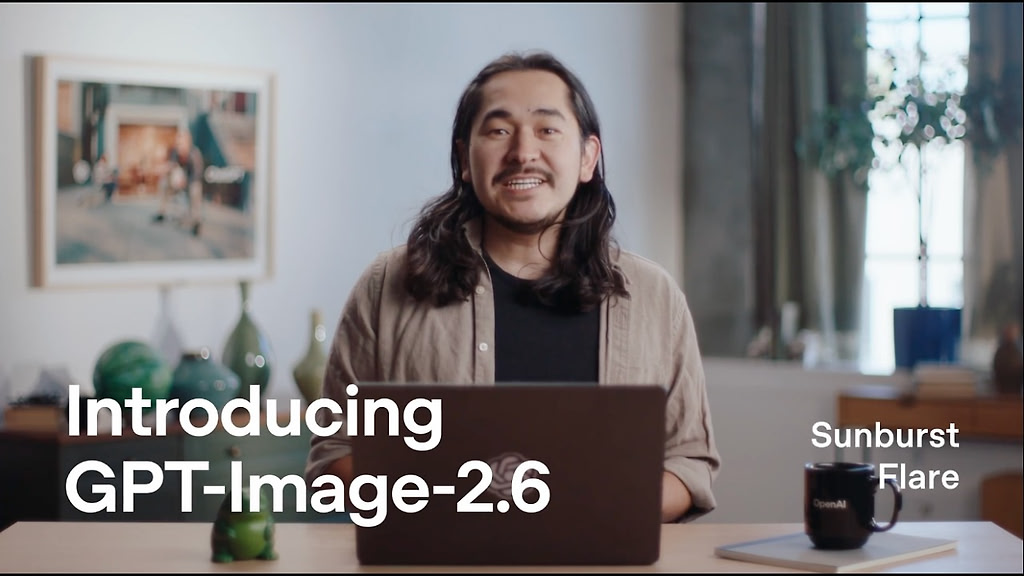
On November 4, 2026, OpenAI released the Images 2.6 update in ChatGPT and Codex: the interface now features animated GIF generation from a text prompt or an uploaded image, with speed adjustment and individual frame editing, while the API opened up two models — GPT-Image-2.6 Flare, which creates an image in approximately 6 seconds, and GPT-Image-2.6 Sunburst, which focuses on quality, consistency during edits, and SVG export. The update is available in browser, desktop, and mobile versions, and the company claims accelerated generation and record usage volumes against this backdrop.


What happened
The Images 2.6 update has been rolled out to ChatGPT and Codex on web, desktop, and mobile. GIFs can be created in two ways: from a text description or based on an uploaded image that serves as a reference. After generation, the animation speed can be changed, and individual frames can be corrected. In parallel, OpenAI opened two modes in the API: GPT-Image-2.6 Flare is oriented toward speed and generates an image in approximately 6 seconds, while GPT-Image-2.6 Sunburst is designed for high quality, maintains consistency during repeated edits, and supports SVG export. The company also reported that image generation has become 50% faster.
Context
Image generation for OpenAI has long ceased to be a demo and has become a mass product layer: in September, users were creating about 3 billion images per week, and by the time of the release, the figure had grown to more than 4 billion. This dynamic indicates that the update expands an already familiar feature rather than launching a new class of technology. A separate storyline is OpenAI's return to the niche of short animations and storyboards, which the company had left after closing the Sora project: now frame-by-frame control has been handed over to the image model. The division of the API into Flare and Sunburst repeats the classic fork in generative services between speed and quality: one mode is designed for quick iterations, and the other for final artifacts.
Why this matters for the industry
For developers, this is a rare scenario: access to new models in the API is open on the day of the announcement, so pilot pipelines on Flare and Sunburst can be assembled immediately. The mode fork simplifies architecture: quick draft generations go to Flare, while final artifacts and edits with consistency preservation go to Sunburst, including SVG scenarios. GIF generation and reference images cover the task of short animations and storyboards without deploying video generation, which reduces the cost of producing marketing creatives and visual prototypes. The downside: image generation is becoming a basic layer within a large product, and thin wrappers around text-to-image lose their independent value. A cautious forecast: if the consistency of frame-by-frame edits in Sunburst is confirmed in practice, one should expect competitors to align on the combination of animation plus frame editing and the emergence of routing layers that divide traffic between speed and quality modes.
Why this matters for users
The features are already working on all ChatGPT plans in browser, desktop, and mobile versions. In practice, this means that your image can be turned into a short animation, and a scene described in text can be obtained as a ready-made GIF, after which the tempo can be adjusted and unsuccessful frames corrected. Typical scenarios: animations for posts and stories, visual illustrations for explanations, and quick checking of visual ideas without a designer and video editor. Special attention should be paid to how the character and scene are preserved between frames during edits: there are no public measurements of this consistency, so the final quality is best evaluated on your own examples.
What is still unknown / limitations
Several points remain open. The claim of a 50% speedup is not accompanied by a comparison base and measurement protocol, so it should be perceived as a vendor guideline rather than an established fact. Consistency during frame-by-frame edits has been announced, but there are no public metrics on how and how reliably it works. The SVG export mechanism has not been disclosed: it is unknown whether a native vector is issued or the result of tracing a raster image. For the API, prices, rate limits, and SLA have not been published, which hinders planning production loads. Finally, the growth in the number of generations from 3 to more than 4 billion per week characterizes the scale of usage, but not the quality of the model or the cost of a single image.
Sources
- Images, upgraded—introducing ChatGPT Images 2.6 (OpenAI Developer Community)
- ChatGPT now lets you generate GIFs (Mashable)
- OpenAI Ships ChatGPT Images 2.6 With GIFs and Faster API Models (AI Weekly)
Author
Look at AI, editorial team