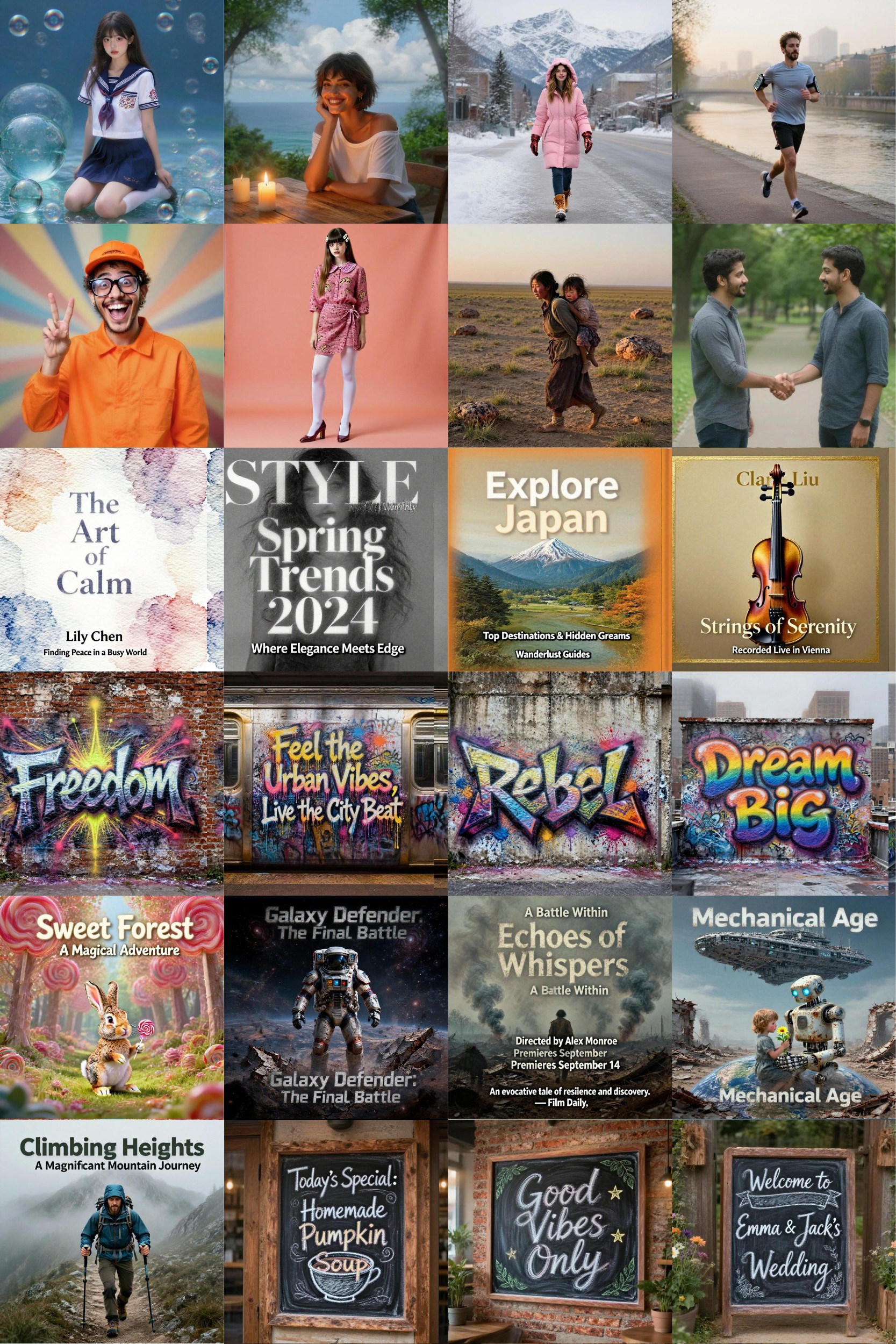
The Inclusion AI team, in collaboration with Westlake University, Tsinghua, and other partners, has published the IDM (Intrinsic Distribution Matching) method for single-step and few-step image generation — a new edition of DMD distillation that does not require an external encoder like DINOv2. The paper is posted on arXiv, the official code is open under the Apache 2.0 license, and according to the authors, the method preserves readable text in images better than other compared approaches at two generation steps on Z-Image-Turbo 6B and Qwen-Image 20B backbones. Model weights have not been released as of publication, so generation can only be run after their release.


What happened
On October 29, 2026, the paper arXiv:2610.39633 describing the IDM (Intrinsic Distribution Matching) method appeared on arXiv, and simultaneously the repository github.com/inclusionAI/IDM was opened under the Apache 2.0 license with an inference.py script. In the authors' comparison table at 2 NFE, the method outperforms Z-Image-Turbo, DMD2, TwinFlow, APEX, and an improved version of one of their own backbones, Z-Image-Turbo++, scoring 94.25% on LongText-CN and 90.20% on LongText-EN. The stated latency is 0.25–0.30 seconds for the 6B model and 0.35–0.44 seconds for the 20B model on a single A100 in BF16. The method was tested on Z-Image-Turbo 6B and Qwen-Image 20B in two modes: full fine-tuning and LoRA.
Context
The approach is built on top of DMD (Distribution Matching Distillation), which compresses a multi-step image generator to one or two steps; however, in standard recipes for such compression, feature quality control relies on a separate external encoder like DINOv2. IDM instead matches the means and per-coordinate standard deviations of features extracted from an EMA copy of the generator itself, preserving full DMD correction, so only the generator, text encoder, and VAE are needed for inference. The authors tested the method on two backbones of different scales to reduce the risk of overfitting to a specific checkpoint — a common pitfall in distillation papers. The claimed speed and text preservation in images target the two main product barriers of few-step models, which are the focus of the long-text generation benchmarks used in the paper.
Why this matters for the industry
The main consequence for the industry is pipeline simplification: without an external encoder, fewer networks remain at inference, reducing the set of models in serving and lowering its costs. The recipe has been verified with full fine-tuning and in LoRA mode with an r=64 configuration updating 0.4B parameters, making the transfer of the method to third-party checkpoints cheap. Code under Apache 2.0 accelerates commoditization: this is a shift in the cost curve, not a platform shift, and if the claimed characteristics are confirmed, the speed of few-step generation becomes a hygiene factor rather than a defensive barrier for a specific team, with differentiation shifting to quality and product integration. If weights are released and self-reports are confirmed, IDM could become a reference option for generating images with text in one or two steps, and the community will quickly verify the comparison table; in the long term, the recipe using feature statistics from an EMA copy of the generator, if reproducible on other architectures, could make few-step generation the default serving pattern.
Why this matters for users
For readers who need images with text — posters, menus, covers — preparation can begin now: clone the github.com/inclusionAI/IDM repository, set up the environment according to inference.py, debug preprocessing, the text encoder, and VAE, and run custom quality check scenarios in advance to enable generation on the day weights are released. If the claimed metrics are confirmed in practice, two-step generation with a latency of fractions of a second on a single card will be suitable for interactive products where images appear before the user's eyes, and LoRA adapters will allow fixing specific styles and brands.
What is currently unknown / limitations
Until weights for IDM for Z-Image and Qwen-Image are released, generation cannot be run: only code and an inference script for environment preparation are available. The presented comparison with five methods is a self-report by the authors; independent quality verification on third-party benchmarks has not yet been conducted. The stated latency is an author measurement on a single GPU type, A100 in BF16, without data on batch processing and throughput. The decisive factor will be the community's reproduction of metrics and confirmation of quality on new backbones.
Sources
- Intrinsic Distribution Matching (arXiv:2610.39633)
- GitHub — inclusionAI/IDM: Official code for Intrinsic Distribution Matching
- IDM — Intrinsic Distribution Matching (official project page)
Author
Look at AI, editorial team