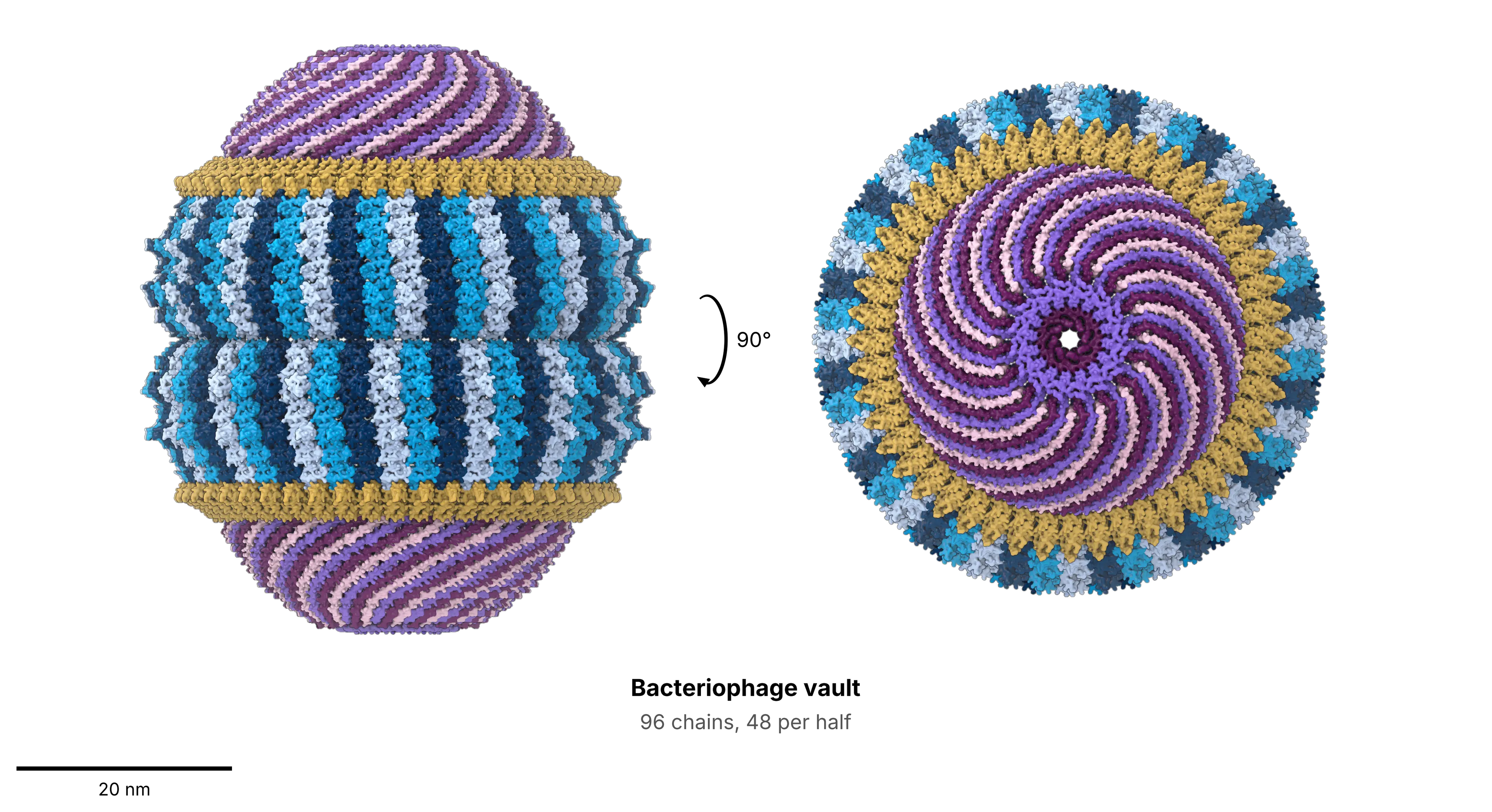
Anthropic has published the results of its biology lab's work: with the participation of Claude, researchers obtained the 3D structure of a prokaryotic vault particle for the first time — the L05 nanoparticle from a bacteriophage, assembled in E. coli. The AI agent accompanied the research at all stages, from searching protein sequence databases to processing microscopy data, and the preprint detailing the methodology is now open for reading.
What happened
The structure was determined using cryo-electron microscopy, a method where thousands of frozen copies of a particle are photographed with electrons and assembled into a single 3D model; the resolution was 3.2 Å. Inside the particle, there are 96 protein copies compared to 78 in humans, the mass reaches approximately 9.5 MDa, and the volume is about 25% larger than that of mammalian vaults. Claude worked at all stages: it searched for relatives of the main vault protein in a database of approximately 15 billion sequences and found them in 29 bacterial and 4 archaeal phyla, designed DNA constructs for 44 candidates, helped optimize particle isolation via gel filtration, and processed microscopy data. Particle isolation time was reduced from approximately three days to 90 minutes, the first complete 3D model was ready in 34 hours instead of several weeks, and the entire research cycle took less than four months.
Context
Vault particles were discovered back in 1986: these are large hollow protein nanoparticles found in mammalian cells, although their function remains unknown to this day. Prokaryotic relatives of these particles had not been structurally described prior to this work, so the map of the L05 nanoparticle fills a gap for an entire class of objects evolutionarily distant from human vaults. The new structural variant has already provided a first clue: in the pocket of each protein copy, researchers hypothesize a binding site for coenzyme A, which may ultimately indicate the particle's biochemical role in the cell.
Why this matters for the industry
For the AI industry, the main result is not the protein structure itself, but the first documented completion of a full wet-lab cycle under the management of an LLM agent with measurable time savings at key stages. The preprint by Athukoralage et al. (2026) serves as a reproducible template for multi-agent research with human checkpoints: groups with expertise in cryo-EM and laboratory work can try to replicate the pipeline now, although there is no ready-made public API or framework for scientific agents in the sources, and this is currently a case study rather than a tool. Meanwhile, the vault platform itself looks promising for biotech: duplication of wall segments increased the particle volume by approximately 20%, making such nanoparticles a candidate for the role of tunable nanocapsules and enzyme delivery systems.
Why this matters for users
This case clearly shows that AI agents are already performing a significant portion of real scientific work, but errors were not avoided: one unsuccessful recommendation from Claude delayed experiments by two weeks, and a missed data processing stage led to an incorrect 3D map. Researchers caught both issues manually and did not hide them in the report, which increases trust in the methodology. For readers, this is a useful calibration skill: when evaluating similar news about "AI scientists," it is worth looking for descriptions of agent failures and verification data in the primary source, not just final claims.
What is still unknown / limitations
This is a single vendor case: Anthropic is both the producer of Claude and the author of the research, so statements about the agent's role are better read as a description of methodology with elements of presentation, rather than an independent assessment of the model's capabilities. There is no controlled baseline in the sources — there is no comparison of the same project without an agent or with a different model, so Claude's contribution to acceleration is currently inseparable from the research team's contribution. The preprint has not undergone peer review, independent replication of the result has not yet occurred, and a detailed specification of the multi-agent system is not provided in the publications, which limits reproducibility.
Sources
- Investigating vault particles with Claude — Anthropic Research
- Anthropic maps first 3D structure of a prokaryotic vault particle using Claude — Crypto Briefing
- Athukoralage et al. (2026): Prokaryotic homologs of the major vault protein form engineerable vault nanocapsules (preprint)
Author
Look at AI, editorial team