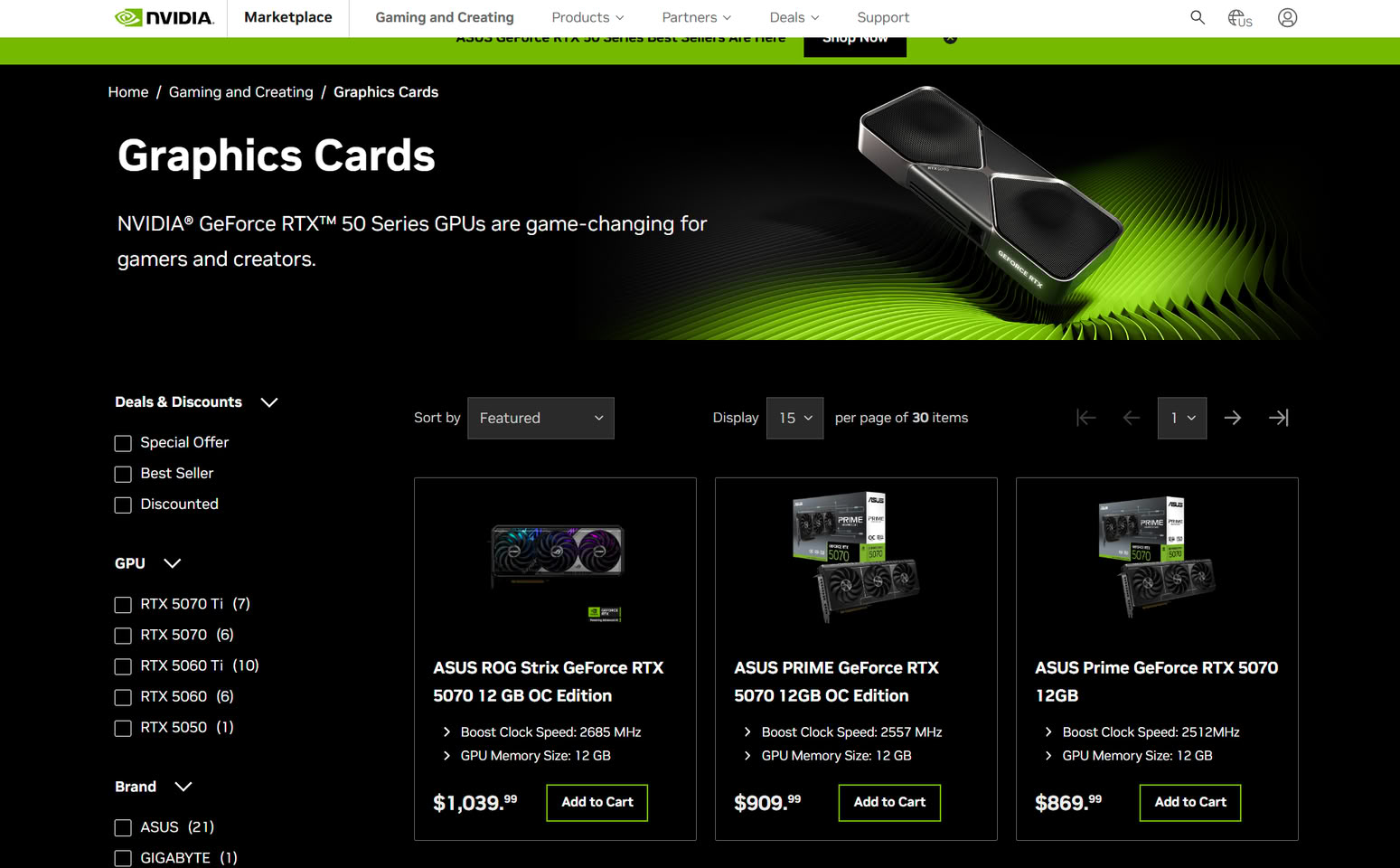
The GeForce RTX 5080, featuring 16 GB of GDDR7 and a starting price of $999, has disappeared from NVIDIA's official US store: as of October 30, 2026, the RTX 5070 Ti is the highest-tier card in the catalog. Meanwhile, at major US retailers, the RTX 5080 has been priced around $2,000 since late October—roughly double the stated $999. NVIDIA has not officially commented on the situation; rumors suggest that vendors have only the last remaining stocks of 16-gigabyte chips, and that an RTX 5080 version with 24 GB of memory is being prepared for the 2026–2027 transition.


What happened
On October 30, 2026, the RTX 5080 card vanished from the NVIDIA US Marketplace—this occurred approximately two weeks after the flagship RTX 5090 was removed, which disappeared from the catalog around October 16. The RTX 5090 managed to briefly return to the store at a price of $5,599—nearly 2.8 times the $1,999 MSRP—before disappearing again. The RTX 5080 card page on NVIDIA's site remains accessible and continues to list a price starting at $999, while minimum prices at major American retailers have held around $2,000 since late October. The company is not commenting on either the removal of its cards from the store or the further rise in retail prices.
Context
This is not about a technical update, but about the state of the consumer GPU market: the stated starting prices of the Blackwell line have de facto ceased to be functional, as the actual retail level consistently exceeds the MSRP, and the availability of flagship cards in official sales has become volatile. The brief return of the RTX 5090 to the catalog and its subsequent disappearance indicate that this is not a one-time supply glitch, but a persistent gap between official and actual prices. For local model deployment, the decisive parameter remains the amount of video memory, not the SKU's position in marketing materials, so the withdrawal of top-tier cards from sale directly changes realistic inference node configurations. Under these conditions, a consumer video card becomes an unreliable dependency for any products where inference is planned to be "local."
Why this matters for the industry
For the industry, the direct consequence is a doubling of GPU infrastructure costs for rendering, local inference, and training relative to previous MSRP-based budgeting: workstations with the RTX 5080 now have to be budgeted at actual retail prices, not paper prices. In such an economy, a local card loses to cloud APIs in most scenarios, except for privacy- and latency-sensitive tasks. Roadmaps need a buffer on two levels: current plans for expanding local computing power are hitting limited stocks of 16-gigabyte chips at vendors, while the next cycle will depend on a potential 24-gigabyte version, which would raise the baseline VRAM volume for local LLM and RAG workspaces. The practical response is to design hardware as a swappable dependency: an abstraction layer between local, cloud, and API inference, and separate profiles for different memory volumes.
Why this matters for users
Buying an RTX 5080 through NVIDIA's official US store is currently impossible, and buying from retailers requires a double budget reserve compared to the stated price, so an upgrade should either be planned with the full sum in mind or postponed. First, it is worth checking if this specific card is truly needed: 16 GB of GDDR7 is usually sufficient for 4-bit quantized models of tens of billions of parameters with moderate context, and if the task is less demanding, an available RTX 5070 Ti or a cloud option might be cheaper. Overpaying resellers for an urgent purchase is risky: rumors about limited stocks and a 24 GB version by the 2026–2027 transition mean that pricing can change quickly. A reasonable strategy is to monitor the return of the RTX 5080 to the NVIDIA catalog and official announcements, rather than relying on pages with prices that are not available for purchase.
What is currently unknown / limitations
The main uncertainty is the status of the rumors: reports that vendors have been shipped the last stocks of 16-gigabyte chips, which will last for approximately two months of retail sales, and that an RTX 5080 with 24 GB is being prepared, rely on unnamed sources, contain no technical details—neither the chip name, memory bus, nor bandwidth—and have no official confirmation. The reason for the removal of the cards from the catalog is also not established: available data is compatible with at least three hypotheses—a line update before new SKUs, a shortage or redistribution of GDDR7 memory, and a shift in priority toward data centers—and they cannot be distinguished based on current information. Retail minimum estimates are based on late-October data and may change.
Sources
Author
Look at AI, editorial team