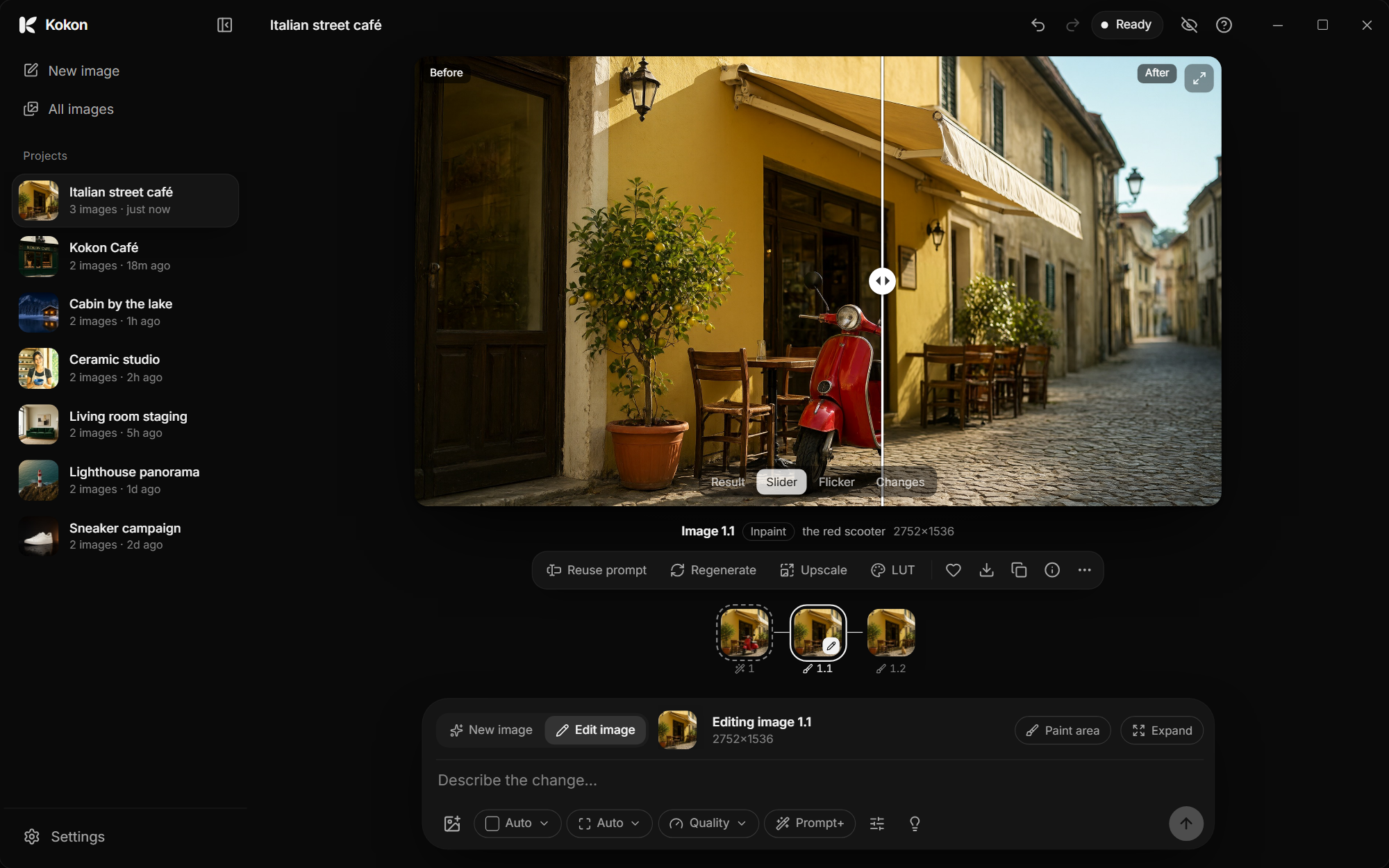
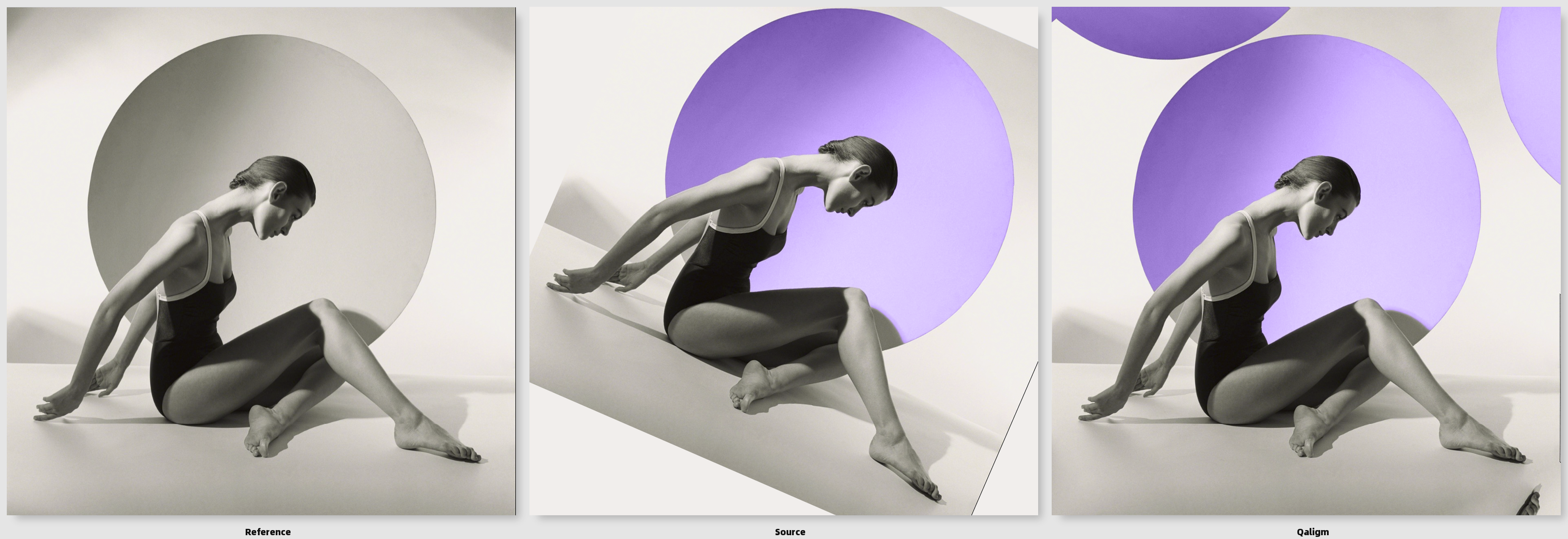
A set of third-party tools has quickly formed around the open model Qwen-Image 2.1, changing local workflows: Qalign aligns edited image pairs, eliminating pixel drift; madebyollin's VAE removes the decoder's checkerboard artifact; and distilled Lightning, DMD2 2-step, and PrunaAI's 6-step LoRA reduce generation from 40 steps to 2–6. Simultaneously, Kokon was released—a desktop editor for Qwen 2.1 that requires no ComfyUI nodes: it runs on Windows, macOS, and Linux with 8–12 GB VRAM and features an MCP server for AI agents. The tools are free and integrate into existing pipelines with minimal changes, making local photo editing faster, cheaper, and cleaner.


What happened
A recent roundup from the Telegram channel GreenNeuralRobots aggregates several independent releases for Qwen-Image 2.1. Qalign version 0.5.0 aligns image pairs and corrects pixel drift in edits using classical computer vision methods: BR and RANSAC with up to 10,000 keypoints, phase correlation, multi-scale ECC, and optional optical flow, without using any ML models. The texture-fix-vae-for-qwen-image-2.1 component by madebyollin replaces the VAE decoder and removes the 2-pixel checkerboard artifact. The Lightning version by LightX2V and DMD2 2-step accelerate generation, with DMD2 limiting the process to 2 steps instead of 40 and featuring a realtime demonstration on HF Spaces. PrunaAI's 6-step LoRA P-Q-Image-2.1 v0.2, with 6-steps-upsampled, is provided with a claimed acceleration of approximately 5x. Kokon has been updated to versions 0.10/0.11: it is a node-free desktop editor for Qwen 2.1, featuring Prompt+ on Qwen3-VL 8B, support for up to three custom LoRAs in beta mode, and an MCP server. Finally, splat-repair-lora v1.1 from October 28, 2026, fixes holes and blurring in distant perspectives of SHARP 3D Gaussian splats.
Context
None of these releases represent a scientific breakthrough: they are engineering fixes and distillations on top of the open Qwen-Image 2.1, but together they address three barriers in local pipelines—latency, quality, and controllability. The checkerboard pattern belongs to a known class of VAE decoder artifacts, so a fix at the VAE level indicates that the source of the problem in Qwen 2.1 lies in the decoder, not the diffusion process. Step distillation is a well-established class of methods, and DMD2 is known from the literature, making claims of 2 steps instead of 40 plausible. Pixel drift is a known issue in step-by-step edits, where the image geometrically diverges from the original after modification; classical computer vision solves this deterministically and at almost no cost: Qalign consumes zero VRAM because it does not load ML models at all. SHARP splats, in turn, suffer from holes and blurring in distant perspectives—a niche occupied by the repair adapter, continuing the community's familiar line of niche LoRAs.
Why this matters for the industry
The main industry signal here is that value is shifting from base models to the layer of tools surrounding them: the cost of local edits drops due to 2–6 steps instead of 40, while artifacts and drift are eliminated by free components. On this stack, a startup can build a prototype of a vertical photo service in days: 2–6 step modes, VAE replacement, Qalign alignment, and Kokon as an editor, with workstations becoming cheaper since 8–12 GB VRAM is sufficient. Kokon's MCP server paves the way for agent-based distribution: the editor becomes a service that an AI agent calls programmatically, rather than a screen a user clicks manually. If the release pace is maintained, the choice of base model for a product will be determined by the maturity of its surrounding ecosystem, not just the model's quality; it is also likely that distilled presets will become the default configuration, while the 40-step base branch will remain for maximum quality scenarios.
Why this matters for users
Users can utilize these tools immediately, and almost everything connects in a single step. Replacing the VAE with texture-fix removes the checkerboard artifact without pipeline rework; PrunaAI's step-distilled LoRA or DMD2 reduces the number of steps and wait time; and Qalign is inserted after editing, before final verification, to align the result with the original. For those tired of ComfyUI graphs, Kokon provides a standard desktop application with a before/after slider, version tree, and prompt field, featuring Prompt+ on Qwen3-VL 8B and the ability to connect up to three custom LoRAs, though the latter is currently in beta status. Owners of budget graphics cards will likely appreciate the 8–12 GB VRAM requirement and the availability of versions for Windows, macOS, and Linux, while the separate MCP server allows routine edits to be delegated to an AI agent. Those working with SHARP 3D Gaussian splats should look at splat-repair-lora to improve distant perspectives.
What is still unknown / limitations
Two key numbers have not yet been confirmed by an independent measurement protocol. 'Realtime' in the DMD2 demonstration description is not a technical specification: the hardware, resolution, and measurement methodology are not specified, and the number of steps alone does not equal latency. Similarly, the claimed ~5x acceleration for PrunaAI's 6-step LoRA is a vendor estimate without specifying seed, GPU, or resolution, which should be read as a marketing hypothesis until reproduced. The claimed PSNR increase for splat-repair-lora from 17.09/17.76 to 19.63/21.09 dB appears significant, but training was conducted on 38 Blender/SHARP pairs—a tiny sample—and without clarity on train/test split, the result should be considered promising but unproven. Finally, all new tools are in v0.x versions, so their APIs and behavior may change, and standardized benchmarks for edit fidelity at low step counts do not yet exist.
Sources
- Qalign — Image pair alignment with pixel drift correction for Qwen 2.1 edits (GitHub, v0.5.0)
- Kokon — Local photo editor based on Qwen-Image 2.1, Prompt+ on Qwen3-VL 8B, MCP server (GitHub, v0.11.2)
- splat-repair-lora — LoRA for Qwen-Image-2.1, repair of distant perspectives in SHARP splats (GitHub, v1.1)
Author
Look at AI, editorial team