
At the GitHub Universe conference on October 28, 2026, GitHub announced a transition of the platform to "agentic software delivery," where autonomous AI agents perform the majority of the work, and the developer becomes an orchestrator. The core of the update includes the GitHub Copilot app for managing parallel agent sessions, the Copilot projects feature that launches agents across multiple repositories, and the generally available Copilot Fusion router, which automatically selects the model for a specific task. For GitHub Enterprise, all Copilot features are now included without a separate subscription—billing is based on actually consumed AI credits.


What happened
At GitHub Universe, the platform announced the status of each innovation. Copilot Fusion moved to General Availability (GA): the router itself selects the LLM and one of the execution modes—Single, Cascade, or Critique—for a specific task. According to GitHub, the Fusion Max configuration scored 60 points on the third-party Artificial Analysis Coding Agent Index benchmark: this is two points less than Opus 5.5 Max, with approximately half the cost and 40% less time per task. Copilot projects is in public preview. Session continuity synchronizes session context between the mobile app, VS Code, CLI, and the web version of the platform, while a new code review Max mode has been added for code verification.
Context
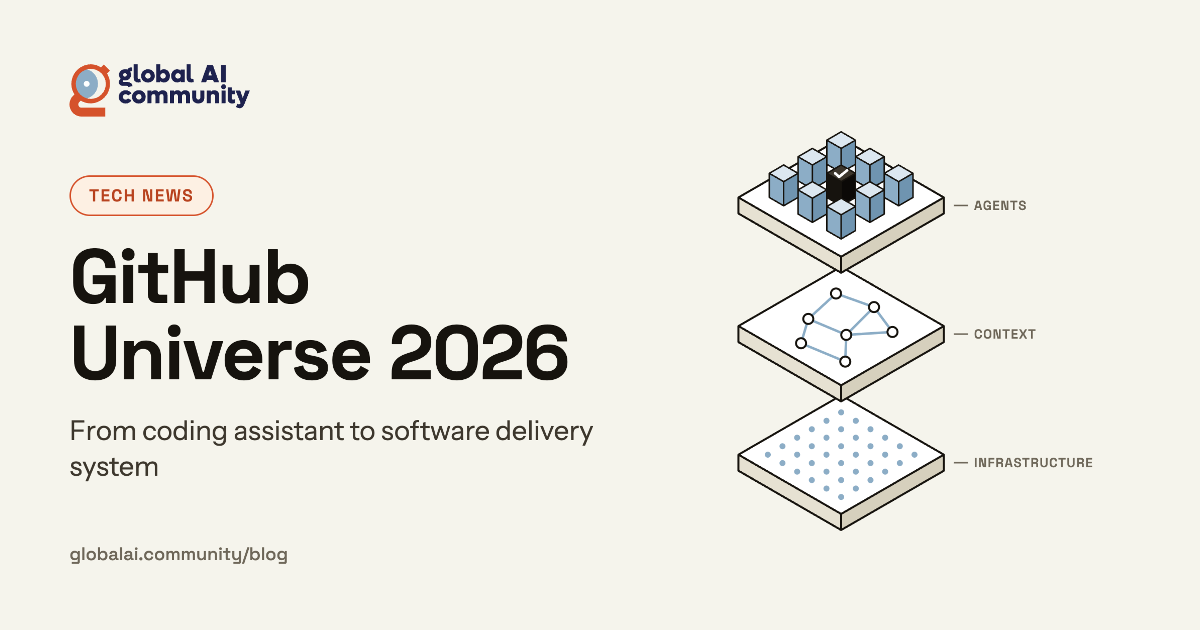
The shift is happening at the level of the entire development ecosystem: the platform through which the largest audience of developers passes is ceasing to be an "IDE assistant" environment and is declaring itself an orchestrator of autonomous agents. In this architecture, Copilot Fusion is not a new model, but a routing layer over existing LLMs that selects the inference strategy for a task; the scientific novelty here is minimal, but the product significance is great because the choice of model and mode shifts from the human to the platform. The system comparison was conducted through the third-party Artificial Analysis index, rather than a vendor-made benchmark, and this approach is methodologically stronger than individual assessments, although details of the measurement are currently lacking. The transition of corporate clients to AI credits links benchmark claims with real money: confirmed savings directly reduce the cost of agentic development. Infrastructure retooling for agentic workloads has also been announced: 4 million CPU cores, 160 PB of storage, 50 Tbps channels, and a restructuring of Git architecture with the separation of storage and compute, as the flow of parallel agent sessions requires a different engineering base than the classic development cycle.
Why this matters for the industry
For the industry, this is not a release of individual features, but a change in scenario: the largest distribution point for developers is moving to a model where autonomous agents perform the main work, and billing is tied to the volume of consumed AI credits. Inference costs become a variable expense, and the baseline for competitive comparison shifts from "the model with the best score" to "the routing and orchestration system with the best quality per dollar and per hour." For subscription-based assistant vendors, this is direct pressure: GitHub Enterprise buyers no longer need a separate Copilot budget, making it harder to sell them comparable solutions. At the same time, a market for agentic development tooling is opening up: session management tools, agent access policies, expense dashboards, and credit quotas. If the claimed cost and time benefits are confirmed, platform-level routing may become the standard, and competition will shift toward validating such results.
Why this matters for users
You can join now. Copilot Fusion is enabled on all paid Copilot plans, and a 30% discount on model costs is in effect until November 30, 2026—a convenient window to measure the actual cost and speed of agents on your own tasks. Copilot projects is open in public preview: pilots with multi-repository agents are possible, but a production-critical path should not yet be built on the preview. The code review Max mode will be an addition to the workflow. Separately, it is worth budgeting for AI credits and monitoring consumption in advance: with pay-as-you-go billing, managing costs is more difficult than with a fixed subscription.
What is currently unknown / limitations
The key unknown is the vendor's comparison methodology: the two-point gap on the agent index is disclosed without a list of tasks, number of runs, metrics, and control conditions, so the difference between systems cannot yet be interpreted statistically, and the cost and time advantage remains a vendor claim without independent runs. Copilot projects is in public preview, and the timeline for its general availability has not been announced. The mechanisms for counting AI credits for GitHub Enterprise are not described in detail, so actual consumption on specific workloads should be measured in advance. Predictions about the standardization of routers and the shift of engineers' roles to agent orchestration are an interpretation of the overview, not facts from the sources.
Sources
- GitHub Universe 2026: Evolving every layer of the stack (GitHub Blog, Jay Parikh)
- About GitHub Copilot Fusion (GitHub Docs)
- GitHub Universe 2026: from coding assistant to software delivery system (Global AI Community)
Author
Look at AI, editorial team