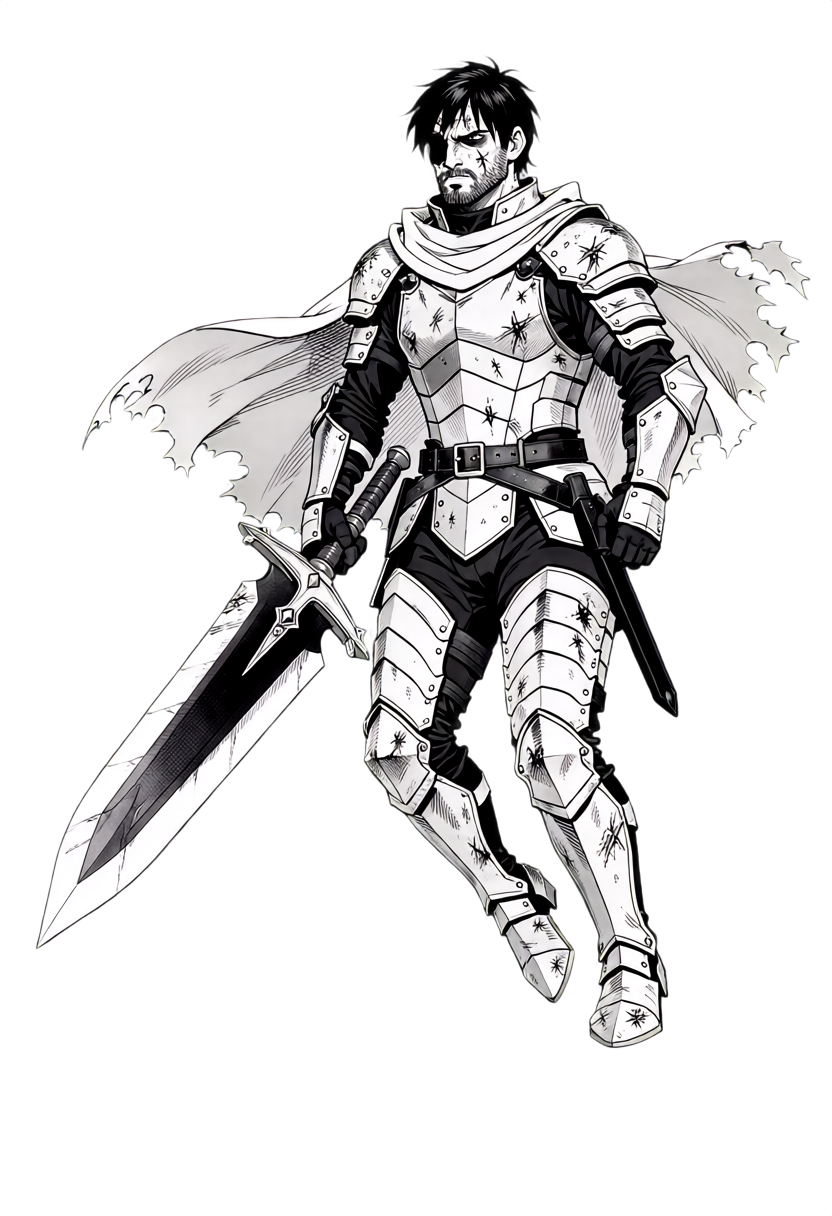
The open text-to-image model MOSS-Image (OpenMOSS-Team, Apache-2.0 license), published on Hugging Face on October 11, 2026, received several third-party additions for ComfyUI in its first two weeks after release: a node that feeds reference image tokens directly into the Qwen3.5-9B text encoder instead of a text prompt; a LoRA that outputs PNGs with a true alpha channel directly from the sampler, without chroma keying or background removal; and a sharpness slider that works without trigger phrases. Individual LoRAs can be trained on a single consumer graphics card, and the entire pipeline runs locally.


What Happened
On October 19, the repository thezveroboy/ComfyUI-MossTextEncoder (MIT license) appeared, featuring the cond2img node by @chlorinemag: it feeds reference image tokens directly into the Qwen3.5-9B encoder instead of a text prompt and accepts up to 16 images with masks; the stated use case is training and testing third-party LoRAs. On October 26, the LoRA paralaif/MOSS-Manga-Alpha-Image-LoRA was published: rank 32, a dataset of 503 synthetic RGBA images, trained on a single RTX 5060 Ti 16 GB in about 1,500 steps; as a result, the sampler itself outputs PNGs with a true alpha channel, using the 4-channel RGBA VAE from the FLUX.2 klein model (trmz/flux2-klein-alpha). This LoRA has also been adapted for Krea 2 via the Wan-Alpha v2 VAE, but it does not work with Kroma. On the same day, aoleg/MOSS-Sharpness-Slider was released (rank 8, 72 photos, about 500 steps; the author published a checkpoint from 400 steps) — a sharpness and blur slider without a trigger, controlled by LoRA strength from 1 to -1.
Context
The peculiarity of MOSS-Image is that conditioning is fed into it through a single channel — the Qwen3.5-9B text encoder. The cond2img node relies precisely on this entry point: according to its description, the encoder accepts not only text but also "non-text" image tokens, turning an image into a prompt. The second background element is the portability of latent spaces: transparency is achieved by swapping the VAE for a four-channel RGBA variant taken from other models (FLUX.2 klein, and for Krea 2 — Wan-Alpha v2), so the alpha channel is formed during the sampling stage, not in post-processing, where chroma keying and background removal were previously required. The third element is the economics of fine-tuning: 503 synthetic images in approximately 1,500 steps on a single RTX 5060 Ti 16 GB set a low barrier to entry for refining a newly released open model, and a synthetic dataset instead of manual annotation makes this path reproducible.
Why This Matters for the Industry
For the industry, the main signal is the pace: within two weeks, a third-party ecosystem of ready-made add-ons has formed around the Apache-2.0 model, which already runs locally in ComfyUI on consumer cards. Typical features of commercial editors — transparent assets, reference-based control, parametric style sliders — are appearing here through community efforts without vendor APIs or licensing restrictions. The low barrier to fine-tuning means that a specialized LoRA for a fresh release can appear in a matter of days, and an architecture with a modular encoder and swappable VAE adapters turns an open model into a platform with community plugins. If the pattern of "third-party RGBA VAE plus conditioning via encoder" is confirmed in independent reproductions, pluggable RGBA-VAEs for different backends and ready-made services around these patterns are likely within a six-month horizon, including converters from reference to condition; within a two-year horizon, the advantage may shift to products owning their own self-hosted pipelines on open weights.
Why This Matters for Users
Everything can be verified locally in ComfyUI today. To get PNGs with alpha channels, it is enough to install the custom loader ComfyUI-RGBA-VAE, connect the flux2_klein_alpha_rgba_vae.safetensors file from trmz, and end the prompt with the phrase ", isolated on a transparent background" — the saved file will have an alpha channel; for Krea 2, there is a specific version of the LoRA with two Wan-Alpha v2 VAEs. Sharpness and blur are adjusted by LoRA strength from 1 to -1 without any trigger phrase, allowing a smooth transition of the frame from soft to contrasty. The cond2img node connects as a standard custom node and saves time when testing third-party LoRAs: instead of a text description, up to 16 reference images with masks are fed in. The original post collects links to all repositories and model cards, including a workflow for regional prompting that requires only 10 GB of VRAM.
What Is Still Unknown / Limitations
Available sources do not provide quality benchmarks for these tools against closed solutions: stated features and dates do not replace measured comparisons, so the discussion of ecosystem speed remains an observation, not a verdict. The acceptance of image tokens by the Qwen3.5-9B encoder is described by the author of the cond2img node and deserves independent reproduction. The generalization of the alpha LoRA beyond the manga domain (a dataset of 503 synthetic images) has not been evaluated. The sharpness slider is noticeable only on MOSS Base and has almost no effect on SFT+Turbo, and the published checkpoint was taken from 400 steps out of a total length of about 500 steps, so the impact of SFT and distillation on low-rank control directions needs to be re-verified. Predictions about the market for pluggable VAEs and the shift of advantage to open weights are hypotheses requiring verification.
Sources
- GitHub: thezveroboy/ComfyUI-MossTextEncoder — cond2img node for vision-conditioning in MOSS-Image (MIT)
- Hugging Face: paralaif/MOSS-Manga-Alpha-Image-LoRA — RGBA transparent PNGs from the sampler (rank 32, 503 images)
Author
Look at AI, editorial team