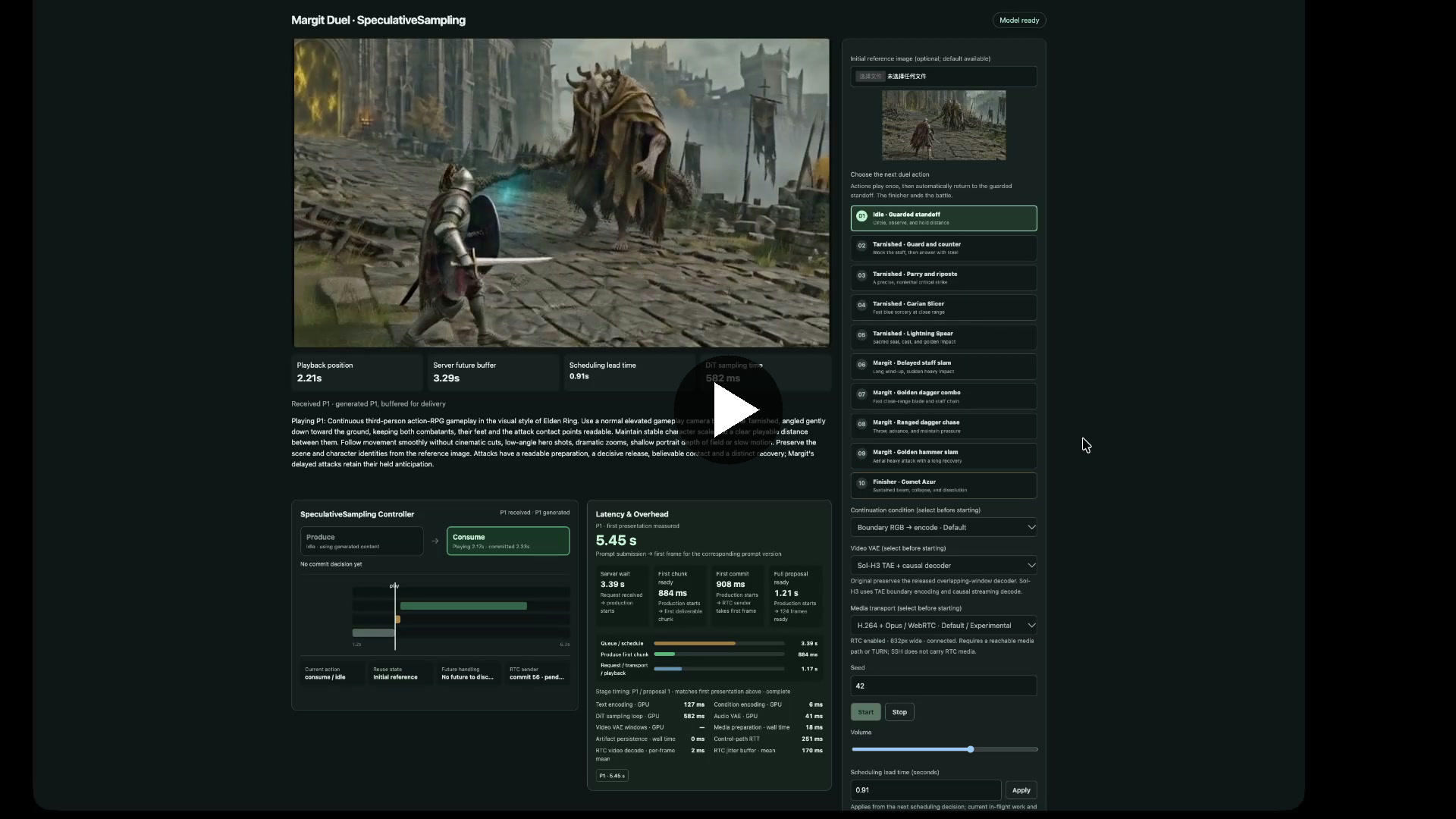
The Speculative Sampling method turns existing bidirectional video models into interactive ones without any fine-tuning: the model pre-computes a large chunk with embedded noise padding, predictions are cached and distributed as playback progresses, and when the input changes, only the unfixed tail is recalculated. On a validated stack of eight NVIDIA B300 accelerators, the MiniMax H3 model delivers the first frame of interactive video in approximately 1.4 seconds. The preprint is published on arXiv under number 2610.20556, and the code is open on GitHub under the Apache 2.0 license.

What happened
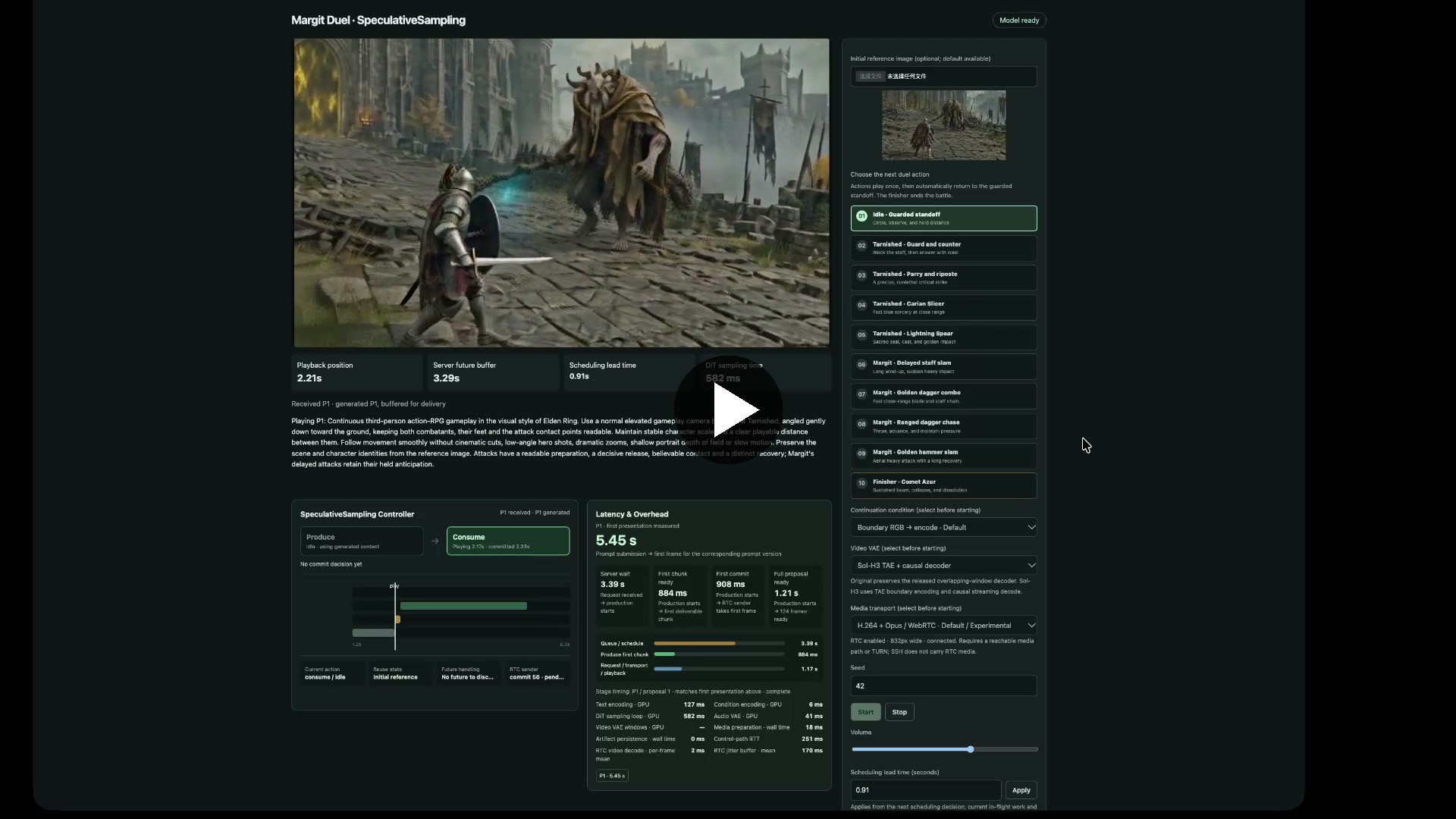
On October 14, 2026, researchers Yubo Huang, Yuxuan Zhang, Jiaming Liu, Sirui Zhao, and Enhong Chen published the preprint Speculative Sampling in Interactive Video Generation (arXiv:2610.20556) and simultaneously released the code on GitHub under the Apache 2.0 license. The method is training-free: the video model pre-generates a large bidirectional chunk with embedded noise padding, after which predictions accumulate in a cache and are served to the viewer as playback progresses. When the user changes the generation condition, the immutable prefix is preserved, and only the not-yet-fixed tail is recalculated. The validated configuration used a stack of eight NVIDIA B300s, resolution 832x480 at 24 FPS, a 124-frame chunk lasting about five seconds, streaming VAE decode Sol-H3-VAE, and stream delivery via WebRTC. The MiniMax H3 model in this configuration showed a TTFF of approximately 1.4 seconds, and the repository README cites a calibration scheduling lead of 0.91 seconds for this setup.
Context
Previously, interactive generation latency was directly tied to chunk size: the lower bound of expected latency E[R+Q] >= T/2 was set by the chunk itself, forcing a choice between a small chunk for responsiveness and a large attention window for image quality. Bidirectional models require a large window for good video, so developers had to compromise. An alternative route was post-training in the style of Self-Forcing, where the model is pre-trained for interactive mode, but this path requires a training run. Speculative Sampling breaks this link: latency no longer depends on chunk size, and the attention window becomes a tuning parameter rather than a hard constraint, which can be adjusted for specific tasks.
Why this matters for the industry
Interactive video systems no longer have to sacrifice quality for small chunks: existing bidirectional checkpoints can be served in real time without post-training, meaning without access to the model owner's training pipeline. Engineering focus shifts from reducing chunk size to accelerating sampling within the chunk, and the method is compositional and, according to the demo pipeline, combines with few-step distillation — the demo already works on a four-step distilled checkpoint. This paves the way for interactive video applications, primarily games and simulations, built on already released checkpoints. If the approach is confirmed in independent measurements, caching predictions with tail recalculation may become a standard real-time inference layer for interactive video, similar to how speculative decoding became for language models.
Why this matters for users
The demo can be reproduced now: the Yubo-Shankui/SpeculativeSampling repository under the Apache 2.0 license contains the launch code h3_live_demo.py, the FastVideo-FastH3-4-step-Preview-v1-Dense-DataFree checkpoint is available on Hugging Face, and VAE StreamRender-H3 is used for decoding. The main practical threshold is hardware: validated figures were obtained on a stack of eight NVIDIA B300s, and without it, the claimed metrics are not guaranteed by this method. Ready-made scenarios provide two entry points: free TI2V interaction and a boss fight with Margit from Elden Ring, while a separate guide promises to build a custom interactive game in about five minutes. A demo video is posted on the project page, allowing the responsiveness of live video to be assessed before reading the code.
What is currently unknown / limitations
The central thesis that a large window is preserved without quality loss is not supported by metrics in the provided materials: there are no comparisons with small-chunk baselines or post-training in the style of Self-Forcing — no FVD, no human evaluations, and no ablations on noise padding. Only one checkpoint, MiniMax H3, and one configuration, 832x480 at 24 FPS, were validated, so the transferability of conclusions to other models and resolutions is not demonstrated. The authors currently do not recommend using integrations for LTX and Wan until their tuning is complete. Today this is a self-hosted demo, not a product: there are no independent reproductions or measurements by other teams in the materials, and expectations for scaling the method depend on such verification.
Sources
- Speculative Sampling in Interactive Video Generation preprint (arXiv:2610.20556)
- Speculative Sampling project page with demo
- Yubo-Shankui/SpeculativeSampling GitHub repository
Author
Look at AI, editorial team