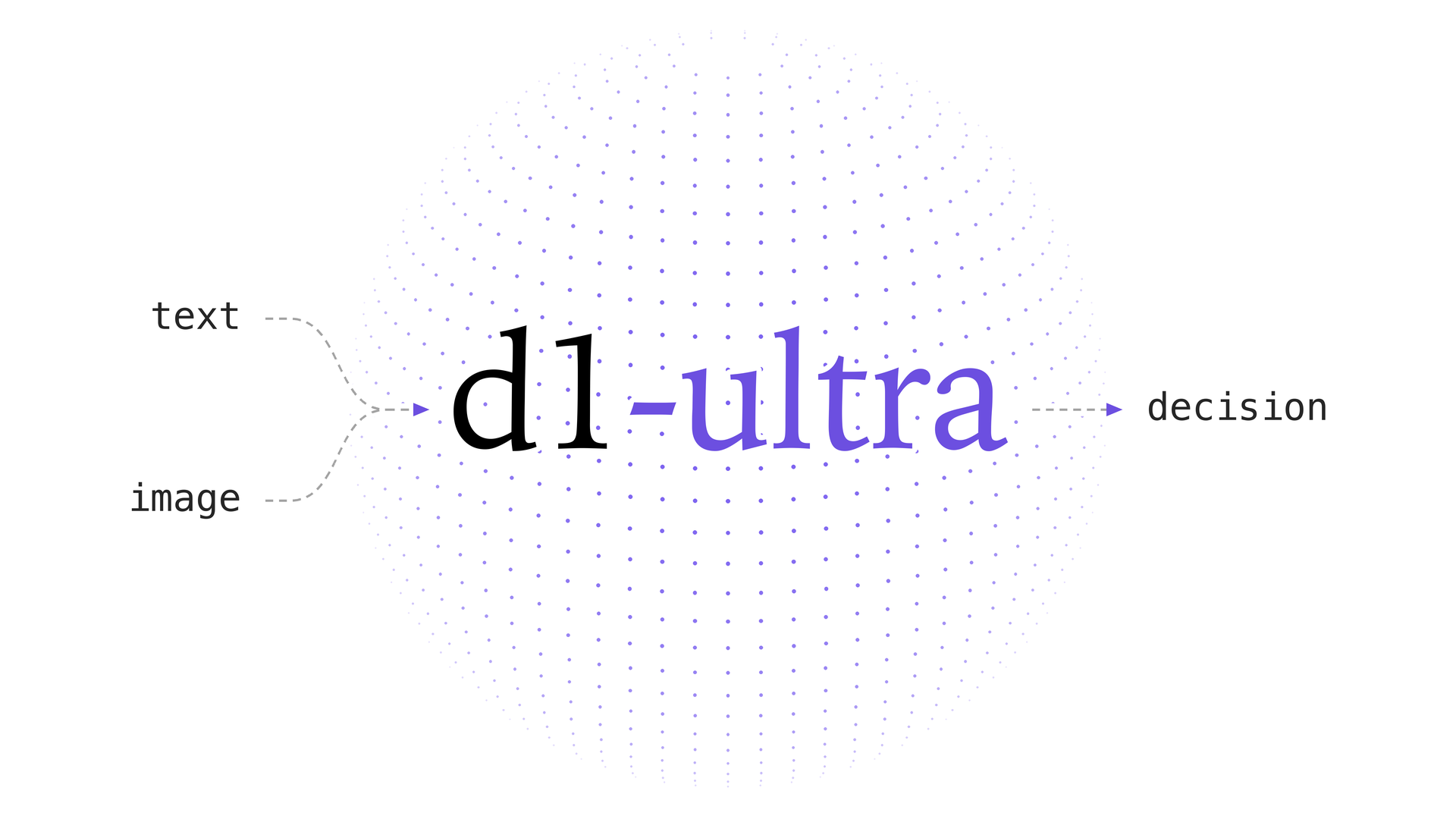
Liquid AI, a Boston-based startup spun out of MIT, released d1-ultra on October 15, 2026 — its largest multimodal "decision-making model." It takes a situation description (text, image, or both) and a set of typed questions as input, and in a single pass returns the probability of each answer option without generating a single token. According to the company, on its own set of 112 evaluations, d1-ultra outperformed the previous d1 model and TypeSafe AI's Jev 1.14 in all tasks, and leads other participants by an average of 8 points on the Artificial Analysis Decision Index; the key differentiator is refined calibration, ensuring that a stated probability of 80% means approximately 80% accuracy.
!image-mh23DVnFm2EDs4US6gJskniHIMwVY4.png)
!image-BzWyvgejrC9dj6l1CBcjB84wn7MTbK.png&w=3840&q=75)
What happened
The model operates under a contract different from that of conversational systems: a single call takes a situation description and a set of typed questions, and the response is the probability for each option, not generated text. Three question types are supported: binary yes/no (type noul), selecting one label from a list, and position on a scale. The working context is 32,768 tokens, which should be sufficient for a situation description plus all questions simultaneously. The model is available via the Liquid AI API, OpenRouter, and Vercel AI Gateway. Only input tokens are billed at $0.042 per 1 million, and there are effectively no output tokens — the model does not decode free text, so payment is required only for the situation description and the questions themselves.
Context
A "decision-making model" is not a chatbot, but a function with a fixed answer space: it does not reason in text, but evaluates given questions and returns probabilities for the options. This explains the pricing scheme with zero output cost: free text is not decoded, so there is nothing to generate. Liquid AI cites calibration — the correspondence between stated probability and actual accuracy — as the main differentiator of d1-ultra. Standard LLMs poorly calibrate "verbalized" confidence: their stated 80% rarely means 80% actual accuracy, which means production trigger thresholds have to be set blindly. The niche for structural decision models is already forming: Liquid AI itself has the previous d1 model, TypeSafe AI has Jev 1.14, and Artificial Analysis maintains a specialized Decision Index that allows comparing such models with each other.
Why this matters for the industry
For the industry, d1-ultra fills a narrow but economically important niche for fast, structured decisions: defect classification, routing of inquiries, insurance claim verification, moderation. Instead of calling an LLM to generate text and then parsing the response, the pipeline gets a node that returns calibrated probabilities in a single pass. This is predictable in cost, as the bill is formed only for input data. Such a primitive turns DIY prompt classification into a cheap standard block, and calibrated probabilities allow setting trigger thresholds and trusting the model's confidence assessment — a property that standard LLMs essentially lack. For startups, this is a ready-made building block for pipelines where they previously had to pay for LLM generation plus response parsing.
Why this matters for users
The model can be tried for free in the d1.liquid.ai sandbox, and if a team is already using OpenRouter or Vercel AI Gateway, integration will not require changing the gateway. A prototype can be built in an evening: it is enough to replace DIY prompt classification in an existing pipeline with typed questions. A rational step is not to take vendor benchmarks at face value, but to run d1-ultra on its own validation set and compare it with the current LLM classifier on three metrics: accuracy, calibration (whether the model's confidence matches actual accuracy), and price. A conceptual shift is also useful: a "decision-making model" is a function that returns probabilities for given questions, and calibration becomes a separate quality criterion for the model on par with accuracy.
What is still unknown / limitations
The materials contain no latency figures: a single pass and the absence of token generation provide predictable but unmeasured latency, and p50 and p95 values will have to be measured independently during a pilot. The benchmark of 112 evaluations is proprietary, vendor-made, without public methodology, sample sizes, or numerical results, so the claim of "outperformed in all tasks" is statistically fragile on such a sample. It is also methodologically questionable to claim that the model improved most on knowledge tasks due to refined calibration: calibration by definition changes the correspondence between stated probability and actual accuracy, but not the accuracy itself. The stated calibration also awaits independent verification, for example through ECE measurements and reliability diagrams.
Sources
- d1-ultra: Introducing the World's Best Decision Model | Blog | Liquid AI
- d1-ultra - API Pricing & Providers | OpenRouter
- Artificial Analysis Decision Index | Artificial Analysis
Author
Look at AI, editorial team