An MIT study published in the journal Nature revealed an unexpectedly dual effect of a high-fat ketogenic diet: in mice with a hereditary model of intestinal tumors, it accelerated tumor growth in the small intestine and reduced survival, but simultaneously suppressed tumors in the colon. The cause turned out to be not ketosis, as commonly believed, but fatty acid oxidation triggered through PPAR signaling pathways. Conclusions cannot be directly transferred to humans, as the work was performed on genetically predisposed mice, but the main lesson is universal: the same diet can act oppositely in adjacent tissues.


What happened
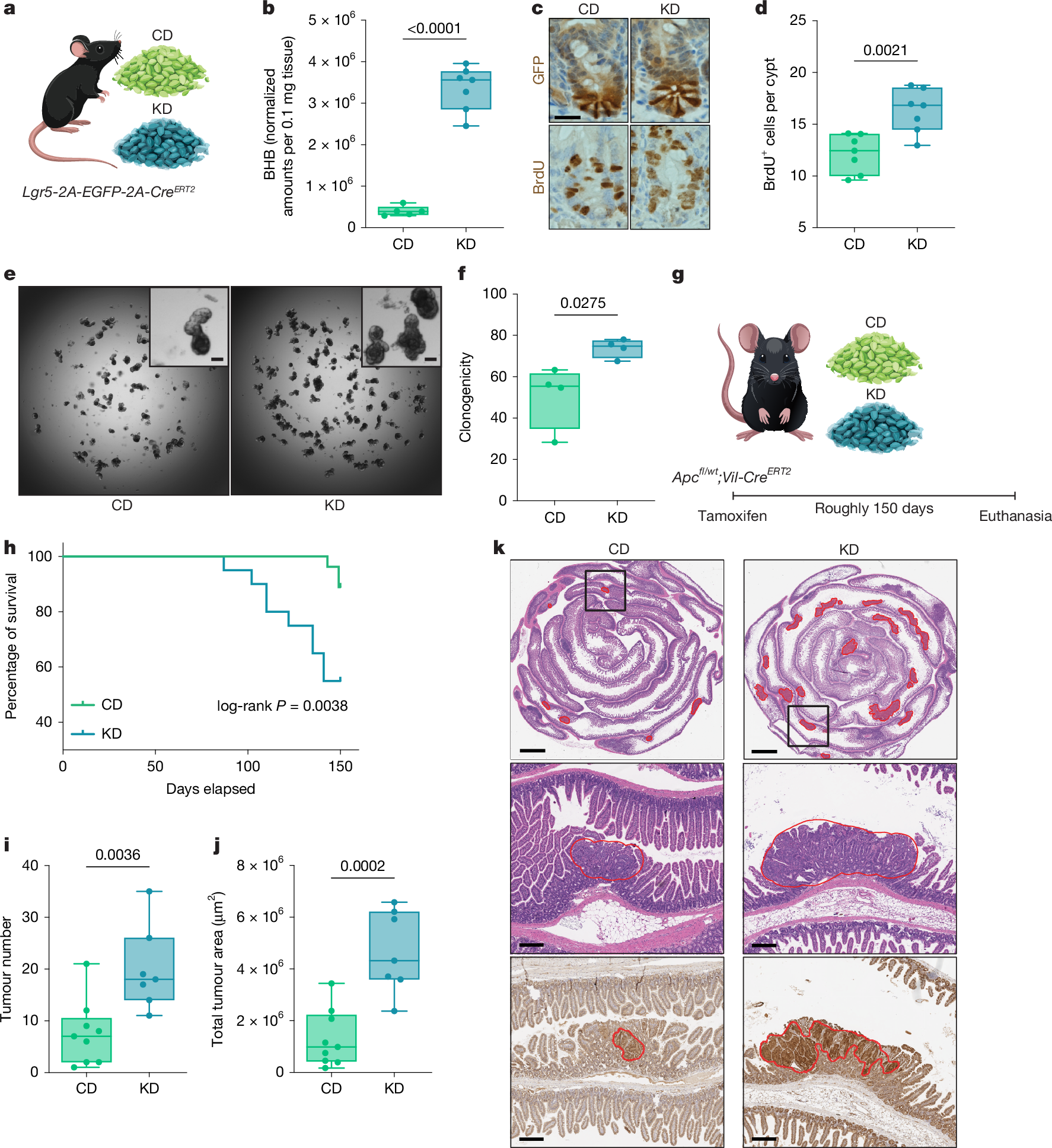
Researchers from MIT — senior author Omer Yilmaz from the MIT Stem Cell Initiative, co-authors Jessica Shay and Fangtao Chi — published in the journal Nature (DOI 10.1038/s41586-026-10779-y) the results of an experiment on mice of the Vil-CreERT2; Apcfl/wt line, modeling familial adenomatous polyposis. The animals were switched to a ketogenic diet in which 80 percent of calories were provided by fats. In the small intestine of such mice, tumors formed faster and survival decreased, while in the colon, the tumor burden decreased. The diet activated PPARα/δ/γ signaling pathways, causing intestinal stem cells to divide more frequently, increasing the risk of tumors. Tumor burden correlated with the level of circulating non-esterified fatty acids, but not with ketones BHB or glucose. Blocking CPT1A, a key enzyme in fatty acid oxidation, suppressed adenomas only on the keto diet, and the authors describe the ketones themselves as "metabolic observers."
Context
The ketogenic diet has long been perceived as an anti-cancer tool: the logic relied on the fact that tumor cells actively consume glucose, and switching the body to ketones supposedly deprives them of fuel. The new work shifts the axis of discussion from "ketones vs. glucose" to lipid metabolism, where the key players become non-esterified fatty acids, PPARα/δ/γ pathways, and the enzyme CPT1A. The familial adenomatous polyposis model was not chosen by chance: this is a rare hereditary condition in which mutations in the Apc gene lead to multiple polyps in the intestine and an increased risk of cancer. A strong point of the experimental design is the internal control: in the same animals, adjacent sections of the intestine were compared, so the effect is difficult to attribute to any general dietary artifact.
Why this matters for the industry
For biotech companies and research groups, specific targets are emerging: CPT1A inhibition and PPAR modulation could become the basis of a therapeutic direction for people with a high hereditary oncological risk, if the mechanism is confirmed in independent models and clinical cohorts. The next expected stage is a wave of follow-up works: clarification of the dominant PPAR isoform, direct separation of the effects of ketones and lipids with ketosis control at a fixed lipid profile, checks on other gastrointestinal tumor models. For the supplement and keto-product market, the news is already reputational: selling a keto diet and keto drinks as an "anti-cancer" strategy is risky even with mouse data, and money will likely shift from universal retail to personalized nutrition. For automatic news summary services, this is a stress test for the quality of retelling: shortened versions without context easily distort the result in any direction.
Why this matters for users
If you follow a ketogenic diet, there is no reason to quit it because of this publication: the experiment was performed on mice with a genetically predetermined predisposition to intestinal tumors, not on humans, so a direct transfer of conclusions to a healthy person is impossible. The result is most relevant to people with hereditary risks, especially those who have dealt with familial adenomatous polyposis: for them, it makes sense to discuss diet choice with a doctor taking the new data into account. When encountering headlines like "keto causes cancer," it is useful to check the original source, as the original work is significantly more nuanced. The general lesson for the reader is that promises of one universally beneficial diet scheme do not withstand scrutiny, and marketing claims of cancer protection should be met with skepticism.
What is still unknown / limitations
Conclusions were obtained only in a mouse model with an Apc gene mutation and currently lack human data, validated protocols, or safety thresholds. The attribution of ketones as "observers" relies on correlations and the CPT1A blocking experiment: a decisive direct test — adding ketones while maintaining the diet's lipid profile — is not described in the published materials, so the mechanistic picture is not finally closed. PPARα/δ/γ activation is claimed for all isoforms at once, and it is unclear from the materials which one dominates and whether specificity has been tested. Non-esterified fatty acids exist as a risk biomarker only in mouse correlations. No information is provided in the materials about the timing of clinical checks or therapeutic decisions based on these targets.
Sources
- A reason to eat carbs — MIT Technology Review
- Ketogenic diets may increase cancer risk in the small intestine — MIT News
- Ketogenic diet mediates intestinal tumorigenesis through lipids not ketones — Nature
Author
Look at AI, editorial team