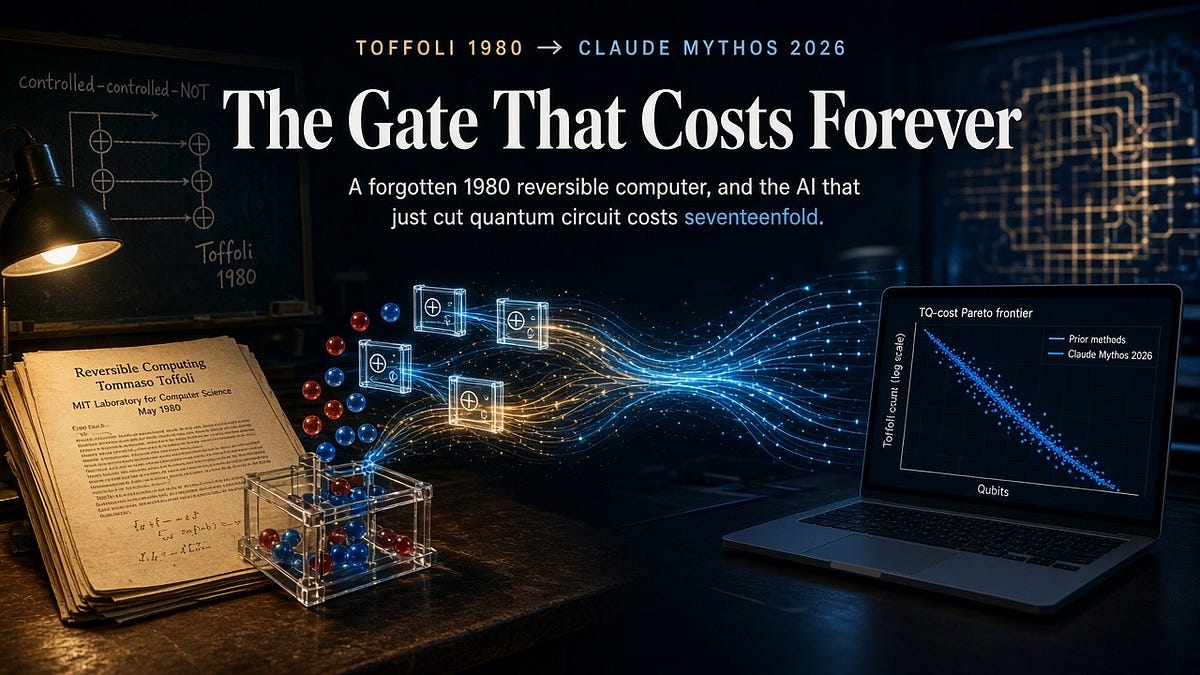
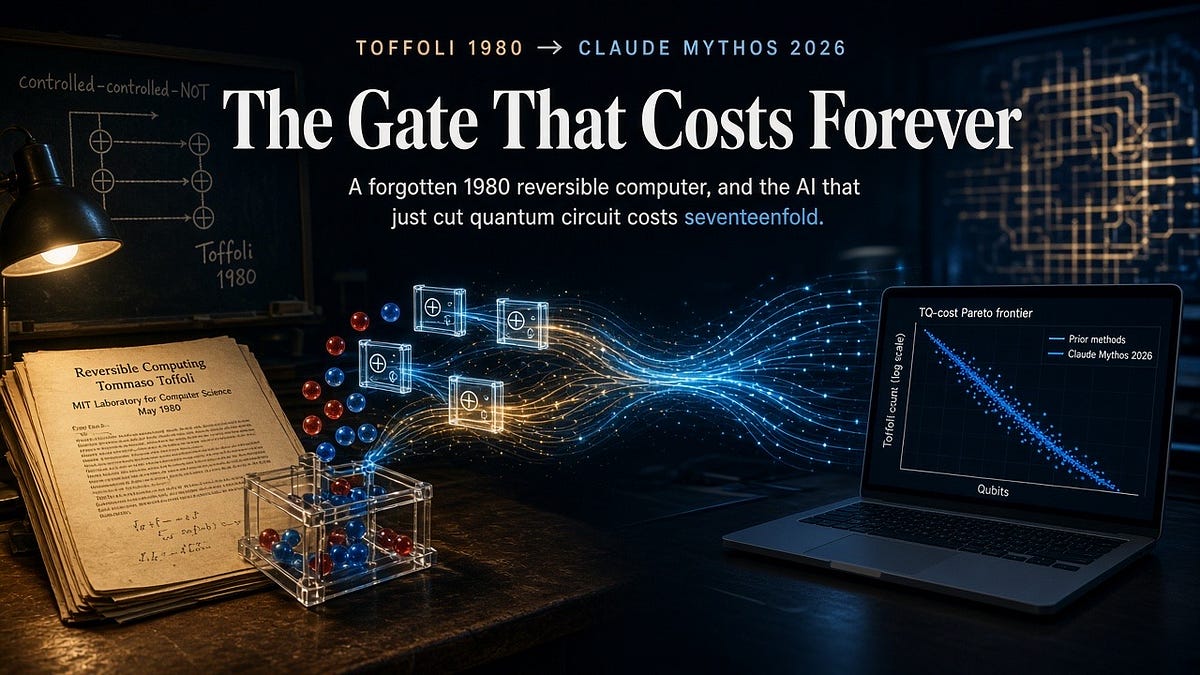
A team from Harvard and Anthropic (Andi Gu, Alek H. Kemeny, Susanne F. Yelin, Mikhail D. Lukin) published preprint arXiv:2610.22367: the language model Claude Mythos 5, within an evolutionary cycle with independent classical verification, found quantum circuits that are cheaper than the best known ones on most test tasks and reduced the gate count by 17 times for elliptic curve point addition. So far, the gain has only been demonstrated at the level of logic circuits: the results have not been verified on real quantum hardware.


What happened
The preprint “Discovering state-of-the-art quantum circuits with large language models” was published on arXiv on October 15, 2026. It is 46 pages long and is distributed under the CC BY-NC-SA 4.0 license. The working mechanics are set up as follows: Claude Mythos 5 proposes variants of quantum circuits, an independent classical evaluator checks each variant for correctness and calculates the TQ-Cost metric (i.e., the number of Toffoli gates multiplied by the peak number of qubits), and the OpenEvolve and MAP-Elites combination drives evolutionary selection and restarts the model. On 7 out of 8 tasks in the set, the found circuits significantly reduced both the number of Toffoli gates and the number of qubits compared to the best known solutions. On the remaining task, modular inverse in a prime field, the search discovered a new reversible architecture. The key number in the work: elliptic curve point addition became 17 times cheaper in terms of gate count, while the search run itself took 53 hours.
Context
This story has a long prehistory, which Brian Roemmele reconstructs in detail. In 1961, Rolf Landauer formulated the principle of information erasure: deleting a bit costs energy, so it is beneficial to build computation reversibly, without information loss. In 1980, Tommaso Toffoli described reversible computing in the MIT memorandum “Reversible Computing” (MIT/LCS/TM-151), and from this line grew the Toffoli gate, the number of which is today the first part of the TQ-Cost metric. The operations found in the new preprint were not chosen by chance: elliptic curve point addition and modular inverse are critical for quantum cryptanalysis of elliptic cryptography, where the cost of basic operations determines the final threshold for qubits and attack time. For decades, minimal reversible circuits were searched for manually by narrow experts, so transferring this process to automated search became the main plot of Roemmele's analysis of the 45-year history of reversible computing. Market reaction so far has been restrained: discussion on Hacker News counts 1 point and 0 comments.
Why this matters for the industry
For the industry, the main asset here is not the circuits themselves, but the reproducible automation architecture. For the first time, an LLM in a closed loop of “proposal — independent verification — evolutionary selection” (OpenEvolve + MAP-Elites) improved the resource characteristics of basic quantum primitives, rather than simply generating code, and independent classical verification of each circuit and selection by a formal metric remove the main risk of generative models, i.e., confidently looking but incorrect solutions. If the 17-fold result on elliptic addition holds up under independent replication, it will directly update the resource estimates for quantum cryptanalysis of ECC, from which the threshold for practical attacks depends. The economics of the profession are also changing: years of manual circuit optimization by narrow experts is turning into a computational experiment that fit into a single 53-hour run, and in the future, by analogy with how compilers displaced manual assembly, automated circuit search may become a standard stage in preparing quantum algorithms. Builders outside the quantum field will find the workflow pattern “LLM proposes a variant — independent verifier calculates a cheap objective metric — evolution selects the best” useful: it is transferable to tasks where the quality of the solution is checked automatically and cheaply, although this is an interpretation of transferability; in the sources, the framework is tied to quantum circuits. In the coming months, judging by the described pattern, we can expect independent replications, other task sets, other generator models, and open-source pipelines based on OpenEvolve and MAP-Elites.
Why this matters for users
Readers have access to both primary sources immediately: the 46-page preprint arXiv:2610.22367 is open under the CC BY-NC-SA 4.0 license, and Roemmele's analysis “The Gate That Costs Forever” shows how the new result fits into the history of reversible computing from Landauer's principle to the forgotten 1980 computer. For developers, the template is more useful than ready-made circuits: the cycle “propose a variant — run it through a cheap automatic verifier — keep the best via evolution” is applicable to their own optimization tasks where the correctness of the solution is checked objectively and cheaply, and the cost of such runs is usually small. One should not build inflated expectations: there is no API, product, or pricing, the gain on real quantum hardware has not been shown, so for a typical ML stack, the news does not yet provide a direct effect.
What is still unknown / limitations
The acceleration has only been shown at the level of logic circuits: the gain has not been demonstrated on real quantum hardware, and it is unclear when it will be possible to link it to real equipment. Preprint arXiv:2610.22367 has not yet undergone peer review. The set of eight tasks is too small for broad conclusions, and there is no direct comparison with manual optimization in the open materials: the combination of “53 hours versus years of expert work” is a rhetorical move in Roemmele's article, not a result of the preprint. The closed loop itself requires rare and expensive expertise at the stage of problem formulation and verifier setup. Finally, it is unknown whether the result is reproducible on cheaper and open models.
Sources
- Discovering state-of-the-art quantum circuits with large language models (preprint arXiv:2610.22367v1, Gu, Kemeny, Yelin, Lukin)
- The Gate That Costs Forever: A Forgotten 1980 Reversible Computer, And The AI That Just Cut Quantum Circuit Costs Seventeenfold (Brian Roemmele)
- Reversible Computing (MIT/LCS/TM-151, Tommaso Toffoli, 1980)
- The Gate That Costs Forever (version of Brian Roemmele's article on X)
- Thread on Hacker News (A Forgotten 1980 Reversible Computer, and the AI That Just Cut Quantum Costs 17x)
Author
Look at AI, editorial team