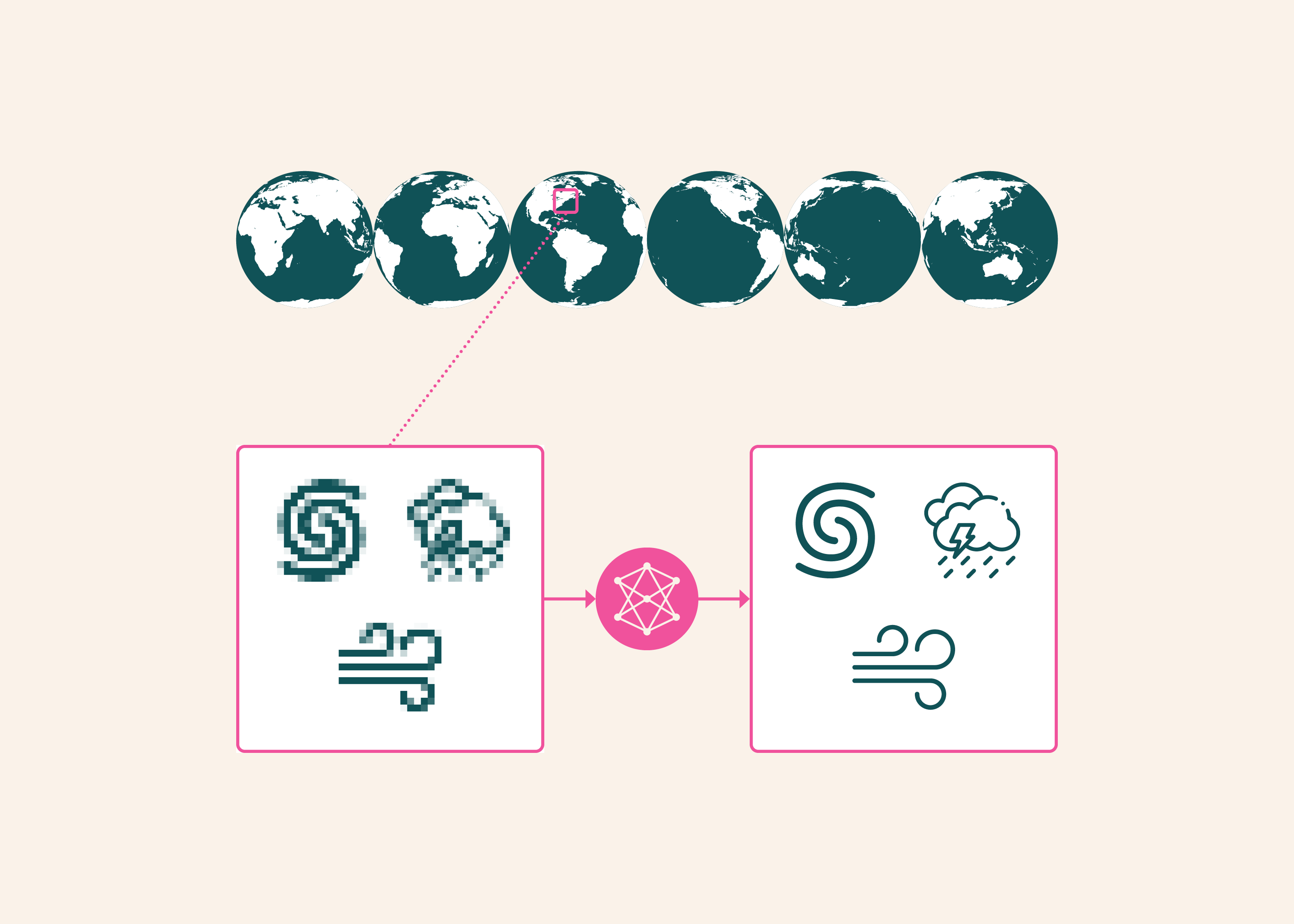
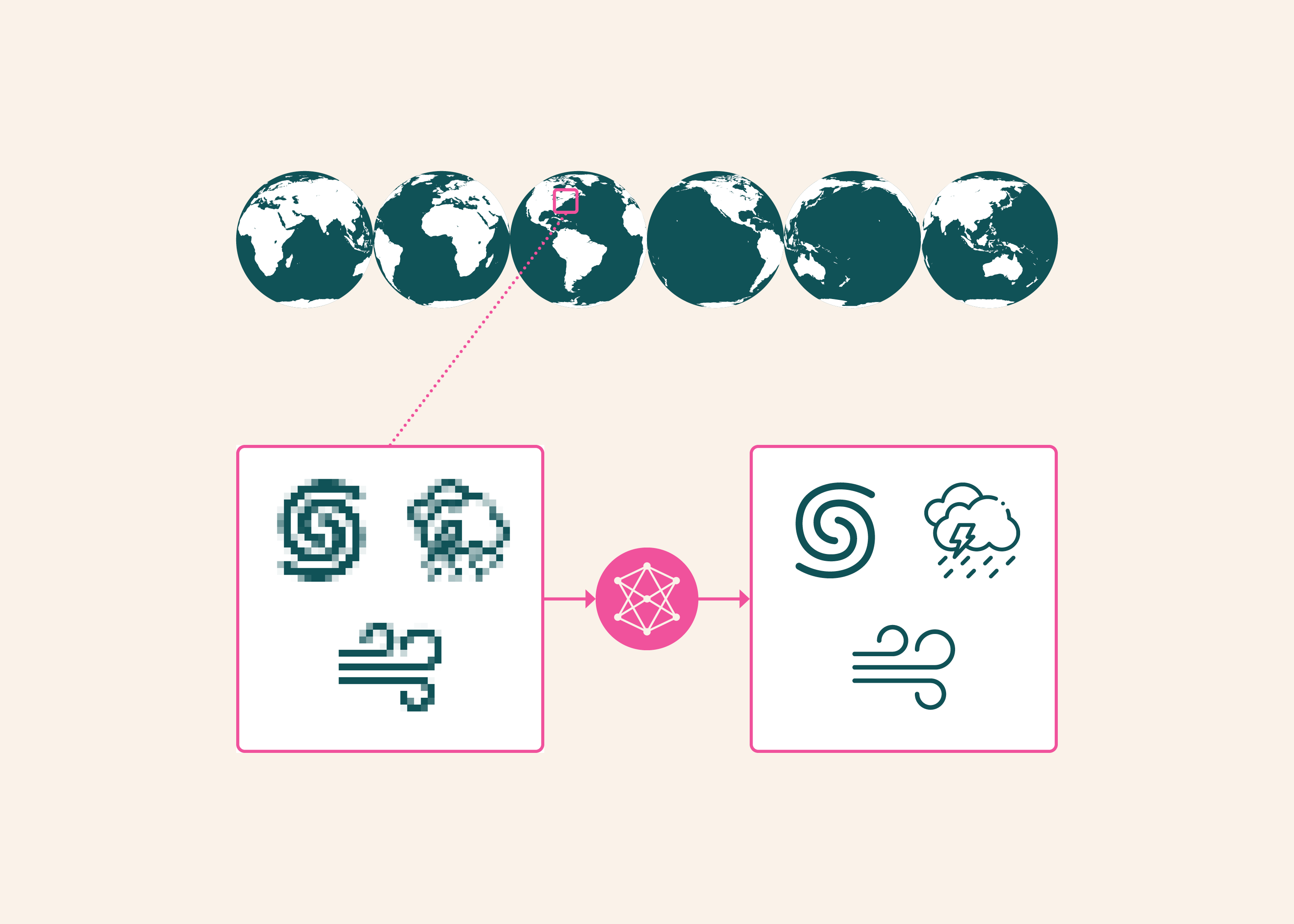
The Allen Institute (Ai2) has released HiRO-ACEv2 — an open-source AI climate emulation system that generates global precipitation, wind, and sea-level pressure fields at a 3 km resolution approximately 300 times cheaper than the storm-resolving physical model X-SHiELD from NOAA. The system is built on a combination of two neural networks: the coarse atmospheric engine ACE calculates atmospheric physics on a 100 km grid, while the HiROv2 diffusion model paints in the missing details down to three kilometers. The emulator reproduces the statistics of extreme events from the reference physical model, including the rarest storm events, and the weights, code, and web demo are fully published.

What happened
The Allen Institute (Ai2) has published the entire system: weights are uploaded to Hugging Face (allenai/HiRO-ACEv2) under the Apache 2.0 license, code and training notebooks are available in the ai2cm/ace repository on GitHub, an interactive demo is running at ace.allen.ai, and the methodology and results are described in the technical report arXiv:2610.17693. The updated HiROv2 diffusion model now refines multiple fields simultaneously — precipitation, wind at 10 meters height, and sea-level pressure, whereas the first version only painted in precipitation. Quality was checked based on the statistics of detailed fields, not pixel-by-pixel: coarse X-SHiELD data was fed as input, and the statistics after downscaling matched the original with an accuracy of up to 3%, including events with a frequency of once in a million points; the total energy of tropical cyclones is estimated accurately, including storms not encountered in the training data. The stated savings for a specific region compared to a physical X-SHiELD run exceed 100 times.
Context
A resolution of about three kilometers is the scale at which global models begin to resolve individual storms; it is at this scale that downpours, hurricanes, and atmospheric rivers form. Previously, such fields were provided only by the physical storm-resolving model X-SHiELD from the US agency NOAA: its runs require supercomputer resources, so long-term detailed simulations were unaffordable for most research groups. HiRO-ACEv2 is trained to reproduce the climate of X-SHiELD: the cheap coarse engine carries the global circulation, while the generative model builds up the small scale according to the same principle by which diffusion models work with images. For scientific simulations, this is a new template: instead of running expensive physics on a supercomputer, the missing detail is painted in by a neural network.
Why this matters for the industry
For the industry, this is a shift in pricing for climate data: 3 km resolution fields, which previously required supercomputer physics, are now generated orders of magnitude cheaper and openly. Groups without a supercomputer budget can now access the generation of long, up to multi-year and decade-long, series of detailed fields for climate and regional research, which were previously unaffordable for them. For product teams, this is a new type of raw material: on cheap detailed climate fields, one can build analytical products, regional risk dashboards, precipitation and wind report generators, integrations from simulation to BI and maps, as well as agentic workflows. Since the model is open, protecting the model itself is meaningless — anyone can fork it, so value shifts to the layer of integration, verification, and user experience. A wave of independent replications and comparative benchmarks is expected: third-party groups will try HiROv2 with coarse fields from other leading models, not just X-SHiELD. If the announced simplified version of HiROv2, which could be more than 10 times faster, is released and confirmed, the barrier to entry will drop even further, and regional ensembles will become realistic for teams with modest GPU budgets.
Why this matters for users
It can be used now and for free: the allenai/HiRO-ACEv2 weights can be downloaded from Hugging Face, the code and training notebooks are in the ai2cm/ace repository on GitHub, so the model can be run on one's own infrastructure, and the web demo at ace.allen.ai shows ready-made visualizations of precipitation, wind, and pressure without any deployment. The model outputs detailed fields every 6 hours, globally or for a specific region, and in long scenarios; a group of a few people can run multi-year simulations on a regular server with a GPU instead of booking supercomputer time. For the reader, this is a clear example of how generative models are moving beyond image generation into scientific simulations: the data can be embedded into one's own research pipeline or educational course, or one can simply explore the picture of the world in the demo.
What is currently unknown / limitations
The savings figures are Ai2's own estimate, calculated relative to the specific teacher model X-SHiELD; there is no independent verification yet, so they should be transferred to other simulators and scenarios with caution. The geography of the emulation is limited to the band from 66 degrees south latitude to 70 degrees north latitude, and the climate is fixed: only the climate of X-SHiELD is reproduced, without warming scenarios and without compatibility with the ERA5 archive. The system is not suitable for weather forecasting — it emulates climate with realistic statistics, not the weather of a specific day. The promise of a simplified version of HiROv2, which could work more than 10 times faster, remains a claim: it is in development, so product promises going beyond the listed boundaries are premature.
Sources
- HiRO-ACEv2: Simulating extreme weather at 3 km resolution for a fraction of the cost (Ai2 Blog)
- Extreme events and statistics in an AI emulator of a global storm-resolving model (arXiv:2610.17693)
- allenai/HiRO-ACEv2 — model and documentation (Hugging Face)
- ai2cm/ace — code and training notebooks (GitHub, Allen Institute for Climate Modeling)
- Interactive HiRO-ACEv2 demo and its visualizations
Author
Look at AI, editorial team