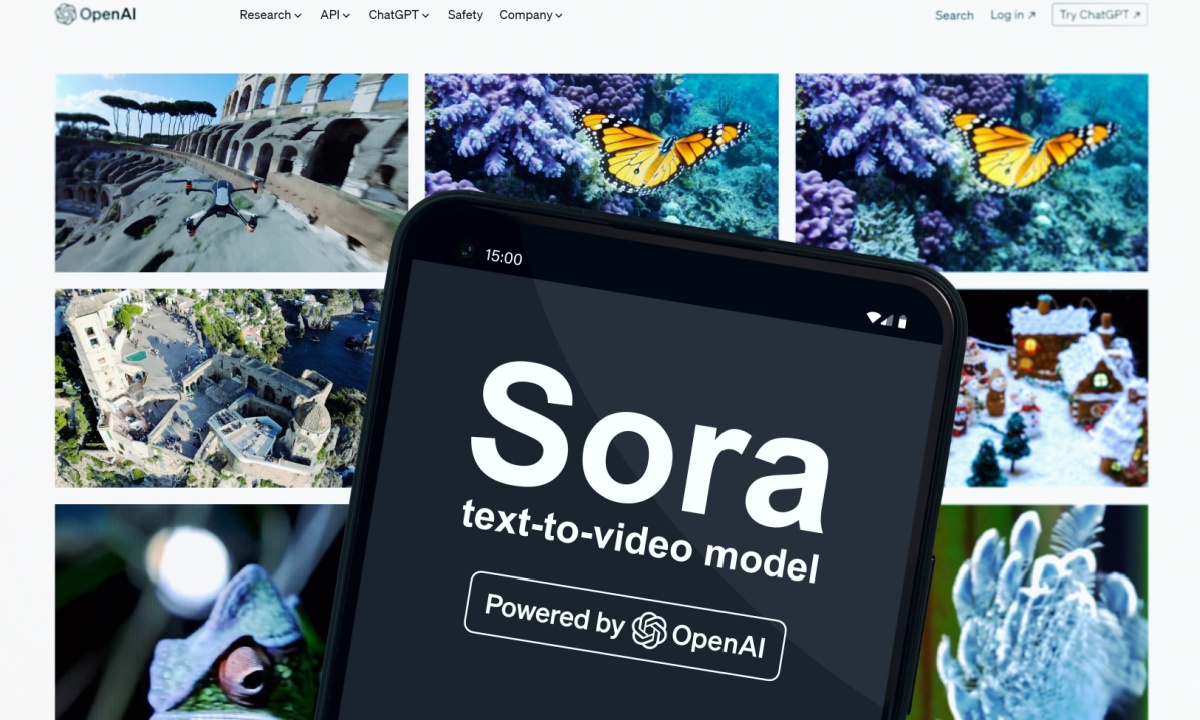
According to The Information (October 12, 2026), OpenAI is discussing the transfer of access to its Sora video model with a startup: the new company intends to adapt the technology and sell professional tools to filmmakers. There is no official confirmation yet: the deal has not been signed, the startup's name is not disclosed, and details about the level of access are known only through the publication's account—referring to deep integration for significant model customization.

What happened
On October 12, 2026, The Information reported that OpenAI is in negotiations with a startup regarding the transfer of access to the Sora video model. The new company was founded by Jeffrey Katzenberg, known for DreamWorks and as a co-founder of Quibi; Bill Peebles, who previously led Sora research at OpenAI; and Sujay Jaswa, former CFO of Dropbox. The company's name is not disclosed, and its stated goal is to adapt the model and release professional tools for filmmaking. According to the publication, "sufficiently deep access for significant customization" is being discussed, however, the transfer of model weights is not confirmed, and this is currently a negotiation rather than a signed agreement. The funding round recap mentions interest from a16z, but terms and timelines are not specified, and the negotiations have not been officially confirmed by either party.
Context
This event should be read against the backdrop of OpenAI's pivot: in 2026, the company scaled back the consumer-facing Sora direction, focused on corporate products ahead of an IPO, and has not announced a return of the application for general users. The fate of the model after the closure of the consumer product thus becomes a separate storyline. In the industry, frontier models are usually hidden behind APIs: labs do not release weights, and external teams are offered a ready-made service. The format being discussed is deeper than standard licensing, and its final form—full transfer of weights, a license for fine-tuning, or only hosted access—would determine fundamentally different scenarios for adaptation and independent evaluation of the model. The fact that one of the startup's founders is from the team that created Sora increases the plausibility of a genuine technical transfer, although in publications this is an interpretation based on the founders' composition, not a confirmed fact.
Why this matters for the industry
If the negotiations result in a deal, it will set a precedent for OpenAI's transition from a consumer application to licensing a frontier model to a vertical partner under a "frontier model plus distribution in a target industry" scheme, which has not yet existed in video. With truly deep access, a closed video model would be embedded in B2B pipelines: from pre-visualization and storyboard tools to connectors for editing systems, and the community would for the first time have the opportunity to evaluate a model that was previously known only through vendor demos. In the long term, such an outcome could form a market for vertical products based on a licensed frontier model: specialization for studio styles, custom checkpoints, and integrator competition—this is currently speculation, entirely dependent on the terms. Even without a deal, the signal to the market is significant: OpenAI is showing a willingness for deep partnerships and a course on corporate products, and competitors, partners, and founders in video generation should consider such a scenario in their own licensing plans.
Why this matters for users
For the average reader, the key takeaway is: the consumer Sora application will most likely not return in its previous form, and it is not advisable to count on its return—the future of the technology is shifting toward professional tools for film. A public product based on Sora, if it appears at all, will come only through the new startup's products, but no statements have been made yet regarding consumer features. A practical benchmark for observation is the official announcement: the disclosed company name, access terms to the model, and timelines will show whether users will ever get access to Sora and in what form. If the level of access allows third parties to test the model independently, readers will see more honest assessments of its actual capabilities than closed promotional demos, although there are no such guarantees today.
What is still unknown / limitations
There is much uncertainty here. The negotiations have not been officially confirmed, and there are no recorded deal terms in the publications. The level of access to the model is not disclosed—this determines what can actually be reproduced, tested, or customized. The version of Sora is also not named, so it is impossible to assess how competitive the model is at the time of a possible signing: the value of deep access directly depends on the quality of the base model, and there are no metrics or benchmarks in the sources. The company name, round details, and timelines, including the participation of specific investors, have not been disclosed. Finally, the plausibility of a weight transfer in this story is an interpretation based on the founders' composition, not a confirmed fact, so any conclusions about a precedent should be postponed until an official announcement.
Sources
- OpenAI's Video Model Sora Could Get a Second Act — PYMNTS
- A Quibi co-founder and the former boss of Sora are launching an AI video startup — The Verge
- Jeffrey Katzenberg Teams Up with Former OpenAI Sora Head on New AI Video Startup — The Information
Author
Look at AI, editorial team