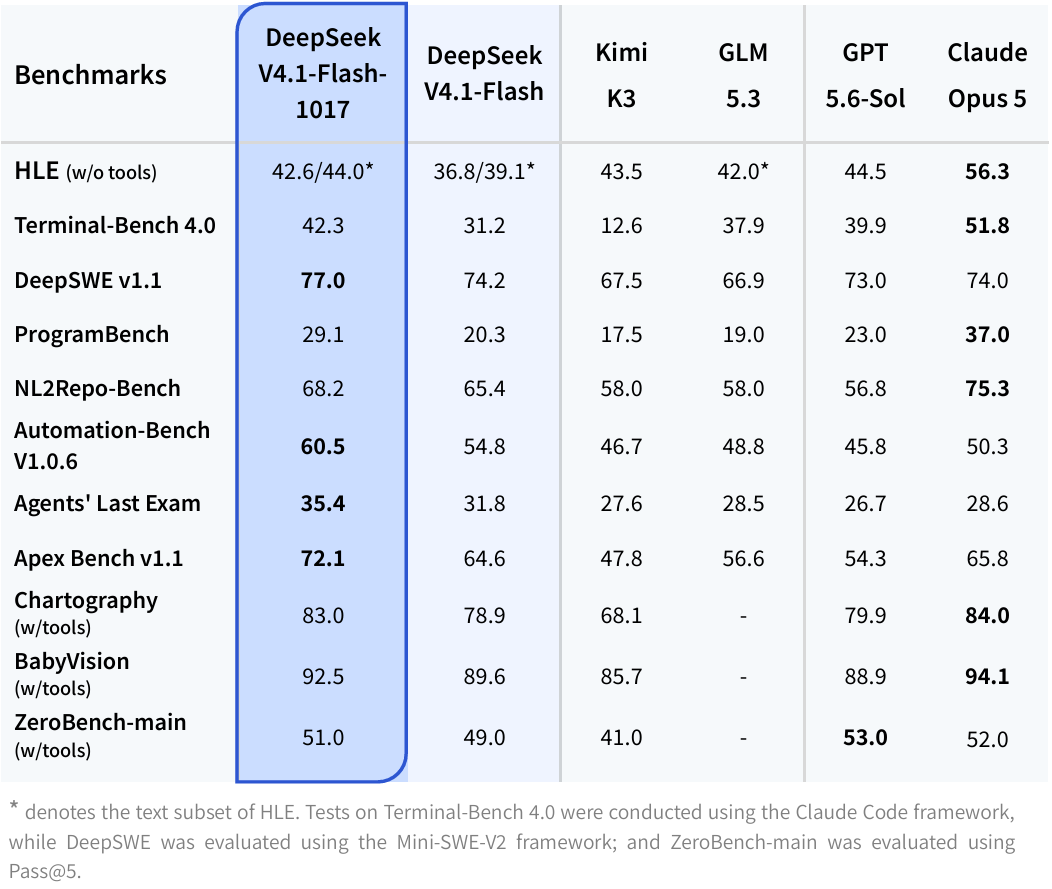
DeepSeek has updated its open model V4.1-Flash: the DeepSeek-V4.1-Flash-1017 checkpoint has been released, showing improvements on agentic benchmarks compared to the previous Flash version and responding more concisely and quickly. The weights are open under the MIT license. Simultaneously, the company has exposed its own search engine for the first time: Search and Fetch API are available to third-party developers at a fixed price — a ready-made web tool for agents and RAG applications.
What happened
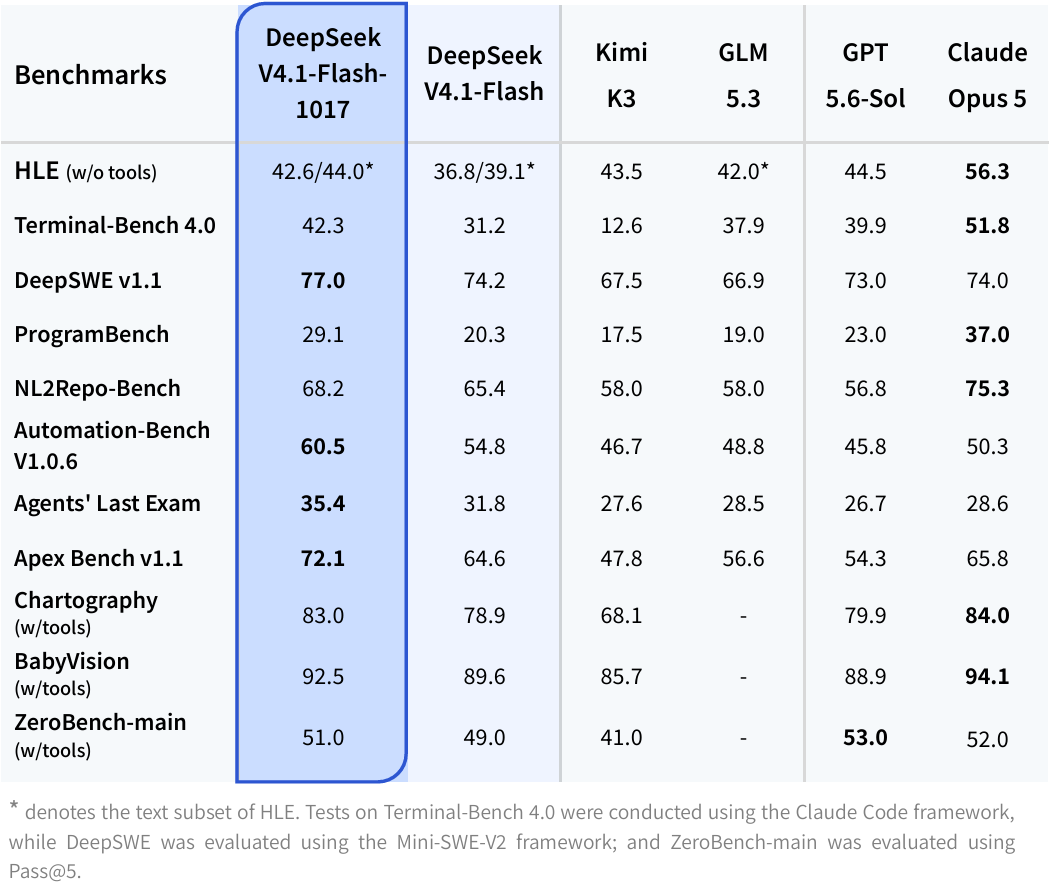
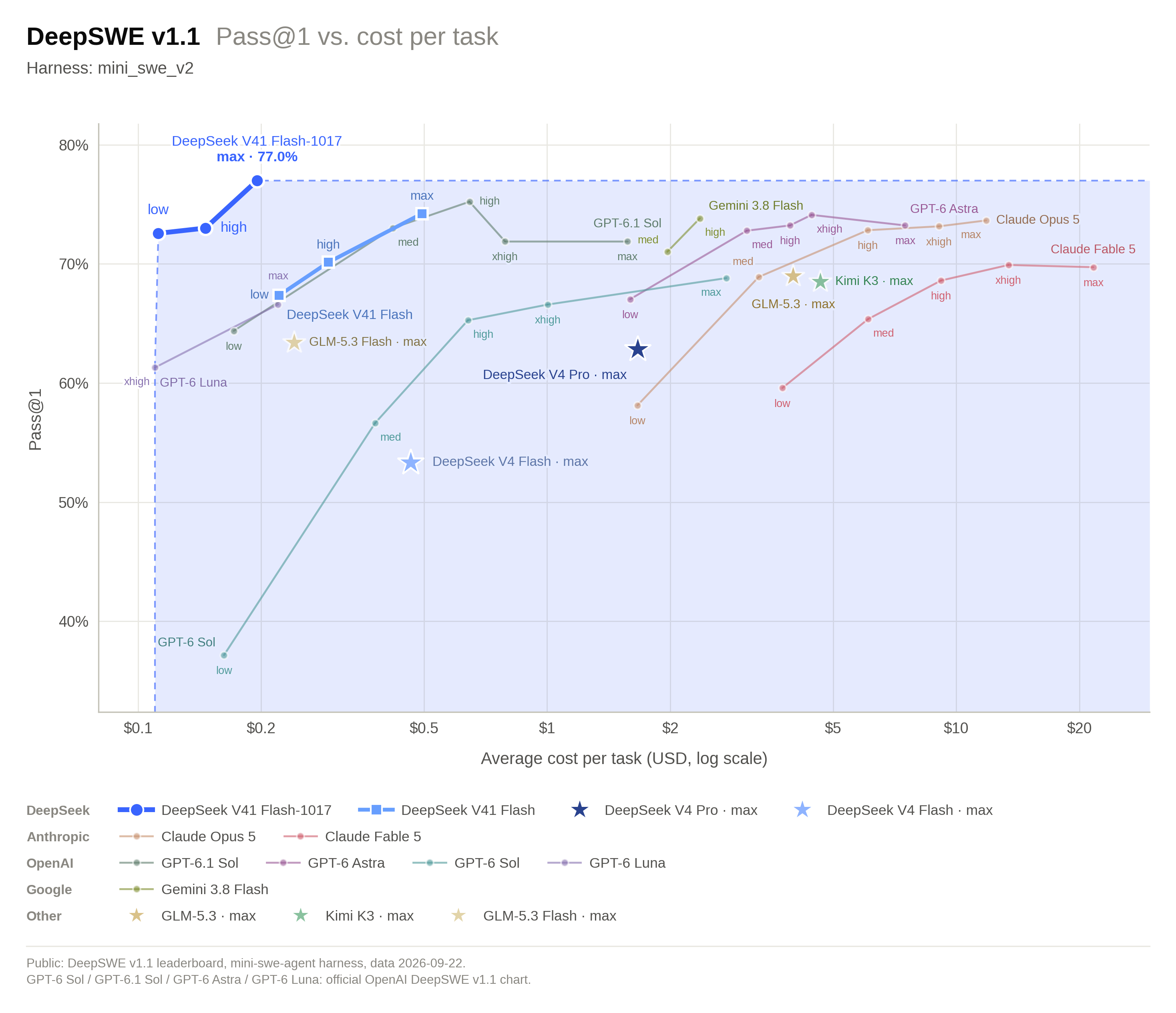
The minor checkpoint DeepSeek-V4.1-Flash-1017 is dated October 17, 2026. The updated model is available on the company's website, in the app, and via API under the name deepseek-flash, with weights published on Hugging Face under the MIT license. According to DeepSeek, the new version outperforms the previous Flash on all 11 reported benchmarks: Terminal-Bench 4.0 increased from 31.2 to 42.3, and ProgramBench from 20.3 to 29.1. In comparison with competitors, the results are mixed: DeepSWE v1.1 scored 77.0 compared to 74.0 for Claude Opus 5 and 73.0 for GPT-5.6-Sol; Automation-Bench scored 60.5 compared to 50.3 for Opus 5; and Agents' Last Exam scored 35.4 compared to 28.6. However, Claude Opus 5 still leads on HLE (56.3), Terminal-Bench 4.0 (51.8), and NL2Repo-Bench (75.3). In parallel, the Search and Fetch API on DeepSeek's own search engine have been opened: $0.75 per 1,000 successful calls on each of the POST /v1/tools/search and /v1/tools/fetch endpoints. The peak price for the model itself via API is $0.30 per 1 million input tokens and $1.20 per 1 million output tokens.
Context
Releasing minor checkpoints has become a familiar iteration format for DeepSeek: the architecture remains unchanged, while the model's behavior is improved in specific areas. V4.1-Flash-1017 retains the characteristics of the previous version — 763B parameters and a context of up to 1 million tokens. The strong product signal is related not only to the model: the company's search engine previously processed hundreds of millions of requests per day but operated exclusively within its own services; it is now open to third-party developers for the first time. This fits a notable recent pattern — vendors are monetizing not only the model itself but also vertical APIs around it: search, page extraction, and code execution.
Why this matters for the industry
For the industry, two layers of the agentic stack are becoming cheaper. The "brain" — deepseek-flash: with an MIT license and commodity-level pricing, the open model becomes a candidate for frontier-level agentic tasks, and the weights can be downloaded to run custom evals, providing higher verifiability than closed alternatives. The "hands" — Search and Fetch API: for the industry, this is a direct blow to third-party web-search tools that have served as intermediaries in agentic pipelines, and a way to reduce the cost of live data for LLM agents. If the combination of "open weights, cheap API, and native web search" proves its quality in production, it could become the default baseline for agentic and RAG applications, forcing closed-model teams to justify their price premium. Competitive pressure is shifting from one-time leadership in leaderboards to iteration speed and the end-to-end cost of solving a task.
Why this matters for users
Everything from the announcement is available immediately: the model is already working on the website and in the app, can be called via API under the name deepseek-flash, or the weights can be downloaded from Hugging Face and run on your own infrastructure. A practical first step is not to trust the table but to run two or three of your own tasks in your harness and compare them with the previous Flash and the current favorite. Search and Fetch can be tested for free: calls via DeepSeek Harness, Claude Code, and Codex are not charged until October 31, 2026, which is enough to build and test an "agent plus live data" setup without cost. Shorter responses reduce the volume of output tokens, which are billed separately, a factor that is particularly noticeable in multi-step scenarios with a large number of calls.
What is still unknown / limitations
All benchmark figures are self-reported by DeepSeek, and comparison methodologies differ: agentic evals are sensitive to harness configuration, number of attempts, and tool versions, so a difference like 77.0 vs. 74.0 cannot be distinguished from differences in test conditions without published protocols. The phrasing "stronger on all 11 reported benchmarks" describes progress relative to its own previous Flash version, not superiority over competitors: against Claude Opus 5, the result is mixed, with a loss on at least three metrics. There is no technical report for the checkpoint, so the source of the improvement — new data, RL post-training, or specialization for test formats — is unknown and will require independent reproductions.
Sources
- DeepSeek: DeepSeek-V4.1-Flash-1017 announcement (Wish-Driven Programming Made Real)
- deepseek-ai/DeepSeek-V4.1-Flash-1017 — model card and open weights on Hugging Face
- Search & Fetch — DeepSeek API documentation
Author
Look at AI, editorial team