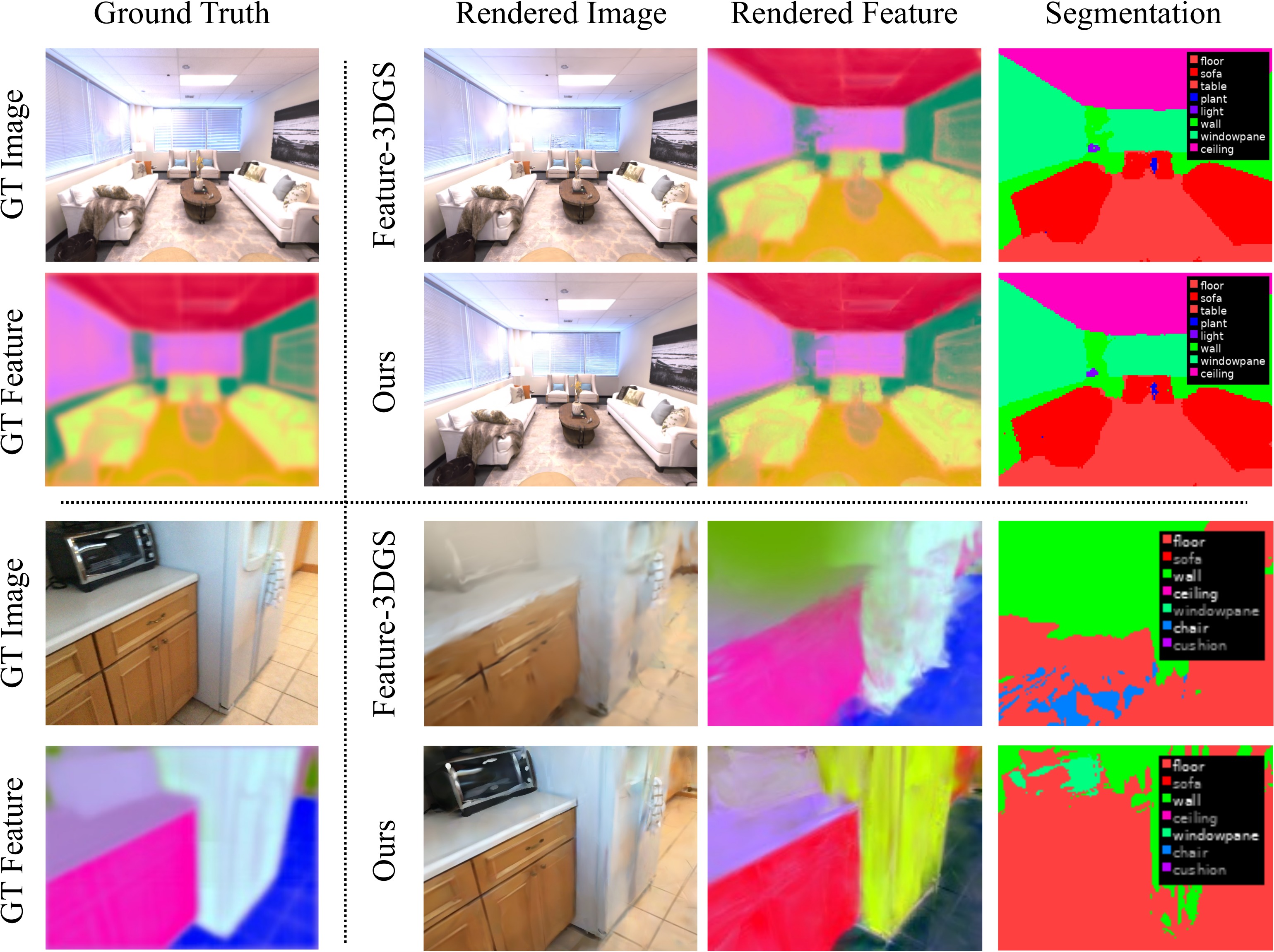
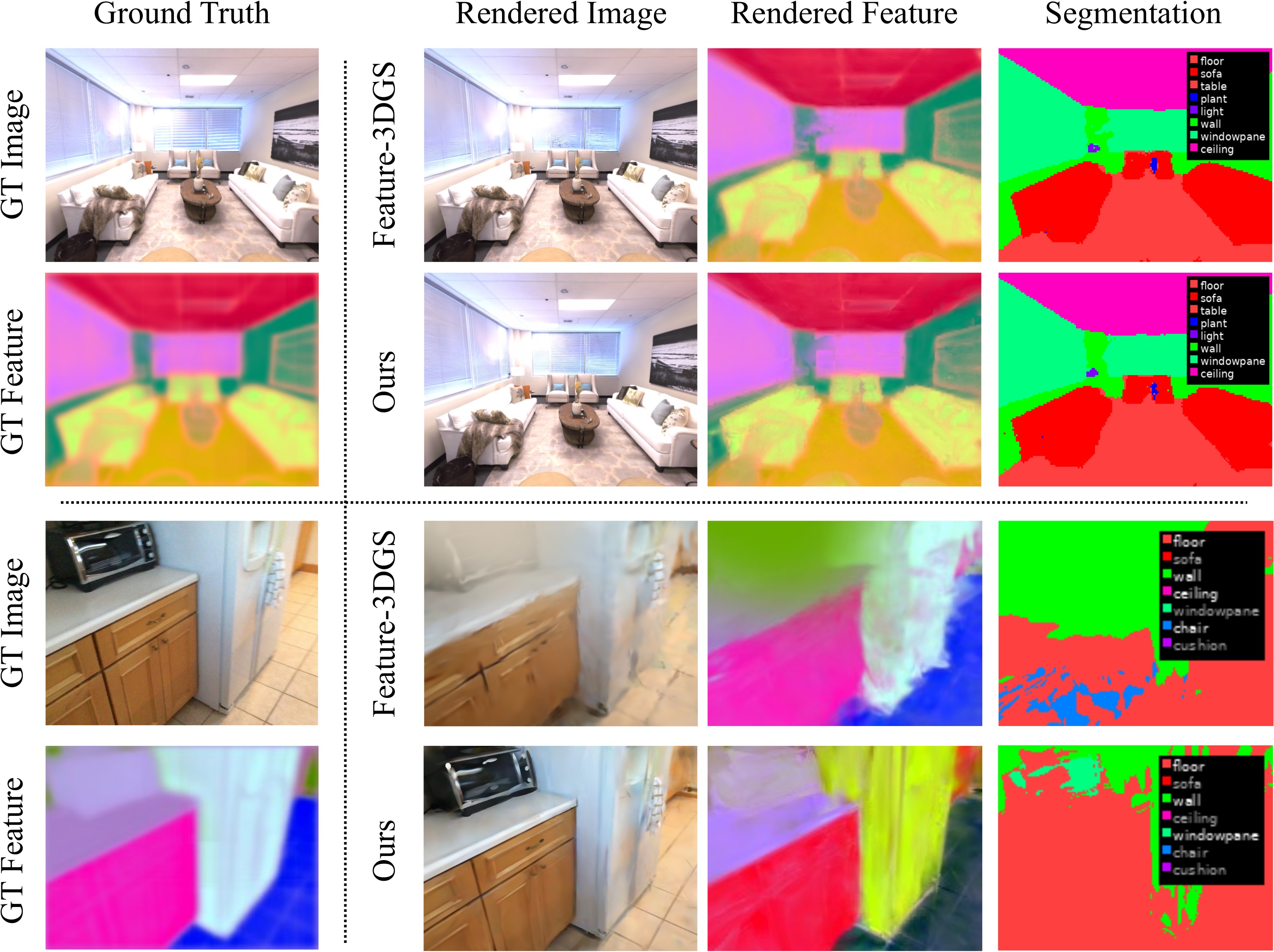
MLP Splatting (Object-Centric Neural Fields), a 3D scene representation method, was accepted at the ECCV 2026 conference. Its primitives are independent compact MLPs that, with supervision only from RGB, align themselves to objects and their parts, so the scene can be edited directly: objects can be shifted and recolored without a separate segmentation stage. In rendering quality, the method is comparable to Feature-3DGS on Replica and outperforms it on ScanNet, while using 63 times fewer primitives and 6 times less memory. The code is open under the MIT license.

What happened
The MLP Splatting: Object-Centric Neural Fields preprint appeared on arXiv on June 2, 2026 under number 2606.03877, and on October 13, 2026 the camera-ready version was accepted at ECCV 2026. The work is by a Cambridge group: Shinjeong Kim, Yuzhou Cheng, Xin Kong, Paul H. J. Kelly, and Andrew J. Davison. Each scene primitive here is an independent compact MLP with local support, weighted by an anisotropic Gaussian: it predicts radiance and opacity, and the final image is assembled by sparse volumetric compositing over ray-primitive intersections. Optional distillation of 512D LSeg features adds open-vocabulary segmentation and object removal. Quality numbers: on Replica PSNR 36.25 versus 36.18 for Feature-3DGS, on ScanNet 25.35 versus 23.32.
Context
Standard 3D Gaussian Splatting operates with millions of Gaussians that are not tied to objects, so any object-level action — selecting, moving, recoloring, or removing — requires a separate segmentation or grouping module on top of the representation. MLP Splatting changes the basic unit of scene manipulation: instead of a million small particles — hundreds of semantic primitives, and this “primitive–object” binding emerges from RGB supervision rather than being imposed by an external editor. It is important to distinguish two results of the work: interactive editing follows from the architecture itself, while open-vocabulary segmentation and object removal are a separate, optional mechanism through LSeg feature distillation.
Why this matters for industry
For those building 3D tools, the main effect is structural simplification of the pipeline: the segmentation or grouping stage disappears as a separate module because the object structure is already encoded in the representation. The economics are also different: 63 times fewer primitives, 6 times less memory, and 2 times faster rendering relative to Feature-3DGS lower the cost of the infrastructure layer for interactive applications, semantic scene editing, and robotics, where a ready-made scene structure and memory matter. The open MIT implementation with tile-based CUDA and Replica and ScanNet configs makes reproduction realistic and gives teams a ready baseline for object-centric representations to compare their own pipelines against.
Why this matters for users
The code is published in the kxhit/mlp-splatting repository under the MIT license: this is tile-based CUDA with Replica and ScanNet configs, and the requirements are fixed — a GPU with compute capability 8.0+ (for example, Ampere or newer), Python 3.10+, and torch>=2.10.0. You can train a model on Replica and ScanNet scenes, reproduce the authors’ numbers, and compare them with your current 3DGS pipeline on your own data. An object is selected by a pair or trio of primitives, after which it can be moved with an SE(3) shift or recolored; the project page has an interactive demo with language-guided segmentation and object removal, and the preprint is available on arXiv — in practice, a scene editor prototype can be assembled in days without in-house research development.
What is not yet known / limitations
All efficiency numbers are relative: they were calculated only against one baseline, Feature-3DGS, and only on indoor datasets Replica and ScanNet, so presenting them as a ready-made cost model for product solutions is premature. The gap on Replica (36.25 versus 36.18) is within the margin of error, and a fair comparison requires variances and comparable-quality measurements. The robustness of the emergent grouping across different initializations and numbers of primitives has not yet been ablated, and outside Replica and ScanNet the method has not been independently rechecked. The “63 times—6 times—2 times” pairs are not accompanied by absolute latency and memory metrics, there is no server API, and the CUDA pipeline complicates porting to other hardware and stacks. Open-vocabulary segmentation depends on the optional LSeg module and is not a consequence of the main architecture.
Sources
- MLP Splatting: Object-Centric Neural Fields — official project page
- kxhit/mlp-splatting — official code repository (MIT, ECCV 2026)
- MLP Splatting: Object-Centric Neural Fields (arXiv:2606.03877, ECCV 2026)
Author
Look at AI, editorial team