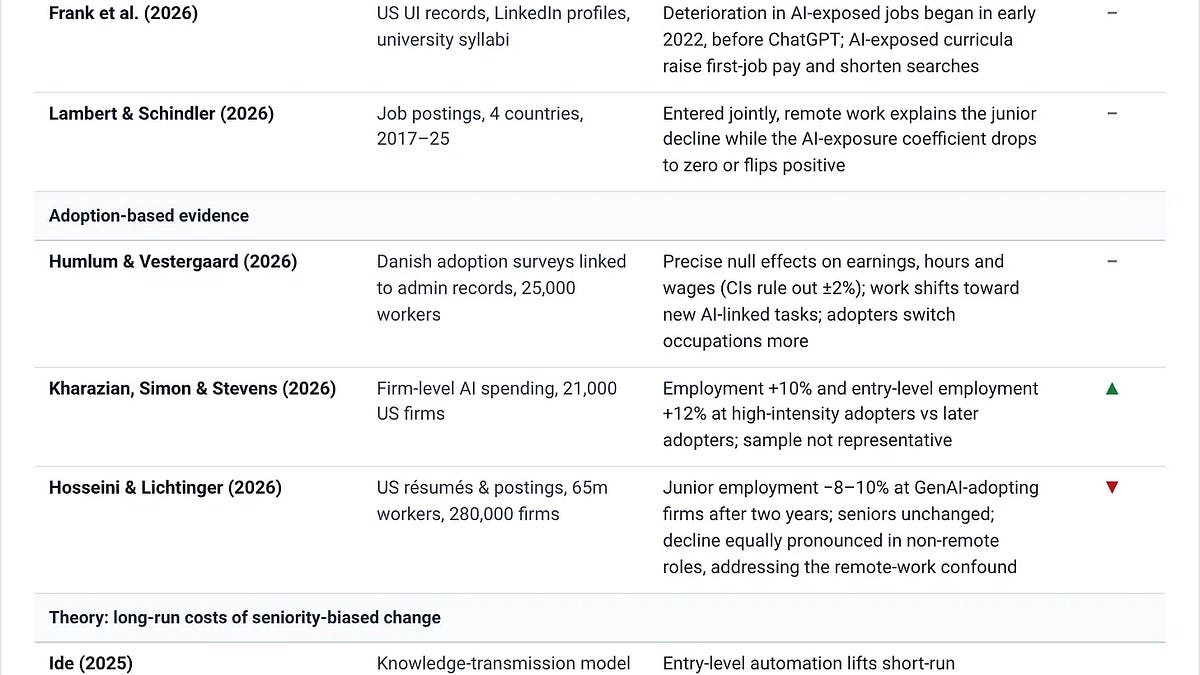
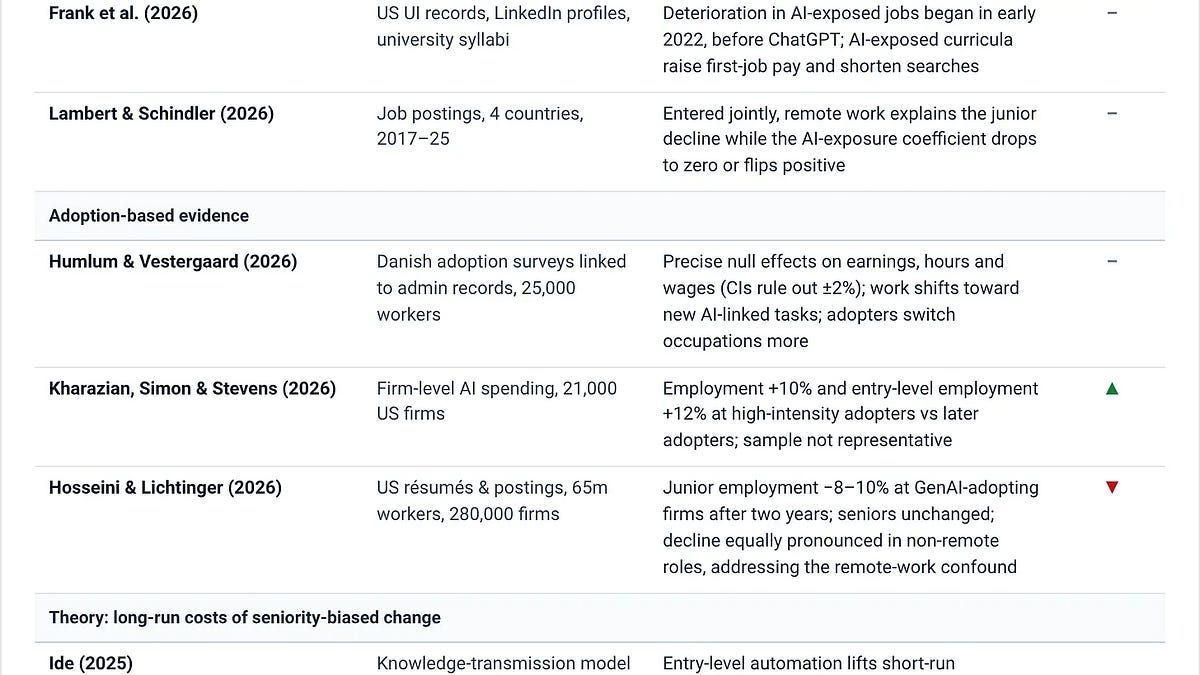
Economists Alex Imas from the University of Chicago and Jacob Schaal published a 'living' review 'Has AI impacted the labor market yet?' on Substack Ghosts of Electricity — a summary of approximately 25 studies on the impact of AI on the labor market, which has already been supplemented with six new works. The main picture is twofold: unemployment and mass layoffs do not yet show a noticeable impact of AI, however in microdata pressure is recorded on entry-level positions in the most AI-exposed professions. The authors are cautious about causality and continue to update the summary, turning it into a living map of risks for the industry and young specialists.
What happened
On September 29, 2026, Alex Imas, an economist at the University of Chicago and author of the Substack Ghosts of Electricity, together with Jacob Schaal, published the review 'Has AI impacted the labor market yet?', formatted as a 'living' document: a summary of approximately 25 studies, which has already been updated with six new works. The key conclusion of the summary: basic labor market indicators, unemployment and mass layoffs, do not yet demonstrate a noticeable impact of AI. However, entry-level positions are sagging. Brynjolfsson, Chandar and Chen, based on ADP data, estimate the employment of 22–25-year-olds in the most AI-exposed professions in the US by June 2026 to be 19% below the counterfactual level, and Orr, Tucker and Warren show that graduates of the most exposed specialties, primarily computer science, are 5 percentage points less likely to find a job and lose about 13% of their starting income, which is comparable to entering the market during a recession.
Context
Individual studies on the impact of AI on employment have so far been released inconsistently and on different data: ADP payroll records, Census statistics, LinkedIn profiles, European CEDEFOP data, as well as registers from Switzerland and Sweden. The value of the new summary is that it consolidates these microdata into a single map and allows checking whether estimates are reproduced on different sources, rather than relying on a single result. The 'living review' format strengthens the check: six fresh additions immediately after publication already give a view on the stability of the picture. The general background complicates interpretation: remote work 'containerized' office labor and prepared the ground for automation, as Deming notes, therefore the same labor market aggregates may reflect both the spread of remote work and post-pandemic normalization, and the dynamics of rates, and not only AI.
Why this is important for the industry
For the industry, the summary means that AI is not yet rebuilding the entire market, but its 'entry'. In practice, this is already visible in organizational design: teams that have implemented assistants and agents for draft code, tickets and primary support are in fact closing junior tasks without junior hiring, and companies are reducing the hiring of newcomers in exposed professions due to uncertainty. For startups, the signal is twofold: the production of a product by small AI-oriented teams is becoming cheaper, so it is more profitable to buy compactness, through tools and agents, than to reproduce the classic personnel pyramid, and junior-level candidates are becoming cheaper as a resource. Deming formulates the structural risk: an equilibrium in which only juniors are washed out is unstable with the continuing growth of model capabilities, the funnel of future seniors is depleted, and a shortage of experienced engineers can hit project deadlines before the effect is manifested higher up the career ladder. In parallel, demand for career navigation, skill verification and onboarding automation is emerging, but since the effect is descriptive and not strictly causal, it is worth building products on it as a hypothesis with early and cheap checks.
Why this is important for users
For young specialists, the review provides a specific map of risks. Entry into the profession has become noticeably more difficult in the most exposed specialties, primarily in computer science: hiring is less frequent, starting salaries are lower, underemployment is higher, and when choosing a specialization or first employers, it is reasonable to take into account the profession's exposure to AI. This does not create grounds for panic: unemployment and mass layoffs due to AI are not visible in the aggregates, the general labor market is still calm. A shift in hiring towards test assignments and portfolios instead of formal signals is also expected, so actual work and verifiable skills become the main argument when entering the profession. The best way to track the turning point is to follow the updates to the 'living' review, which has already shown the ability to quickly absorb new studies.
What is still unknown / limitations
The causal relationship remains controversial: the authors themselves note that part of the effect may be explained by remote work, post-pandemic stabilization and rates, and the 'without AI' counterfactuals do not yet isolate the contribution of the models themselves, so the result is descriptive and not strictly causal. Neither the review nor the incoming studies measure the mechanics of redistribution, for example the transfer of junior tasks to existing teams and contractors or the win for solo builders with AI workflows, so such plots are currently speculation on top of descriptive correlation. Aggregated forecasts of Metaculus and NBER participants, the decrease in US labor force participation from 62% to 58% by 2050 and the increase in underemployment of recent graduates from 41% to 55% by 2035, are expectations, not measurements, and cannot be cited as data. Finally, the review is 'living': estimates such as 19% and 13% will be rechecked and refined as works with stricter causal designs are added.
Sources
- Ghosts of Electricity (Alex Imas & Jacob Schaal): 'Has AI impacted the labor market yet?' — a living review of labor market data
- Discussion of the review 'Has AI impacted the labor market yet?' on Hacker News
Author
Look at AI, editorial team