
OpenAI reset usage limits on all paid ChatGPT plans on the evening of October 2 as an apology for the failed launch of the flagship model GPT-6.1 Sol: due to an influx of requests, the new model's processing speed dropped in the first few days. The company claims that performance has already returned to normal, but there are no independent measurements to confirm this yet.
What happened
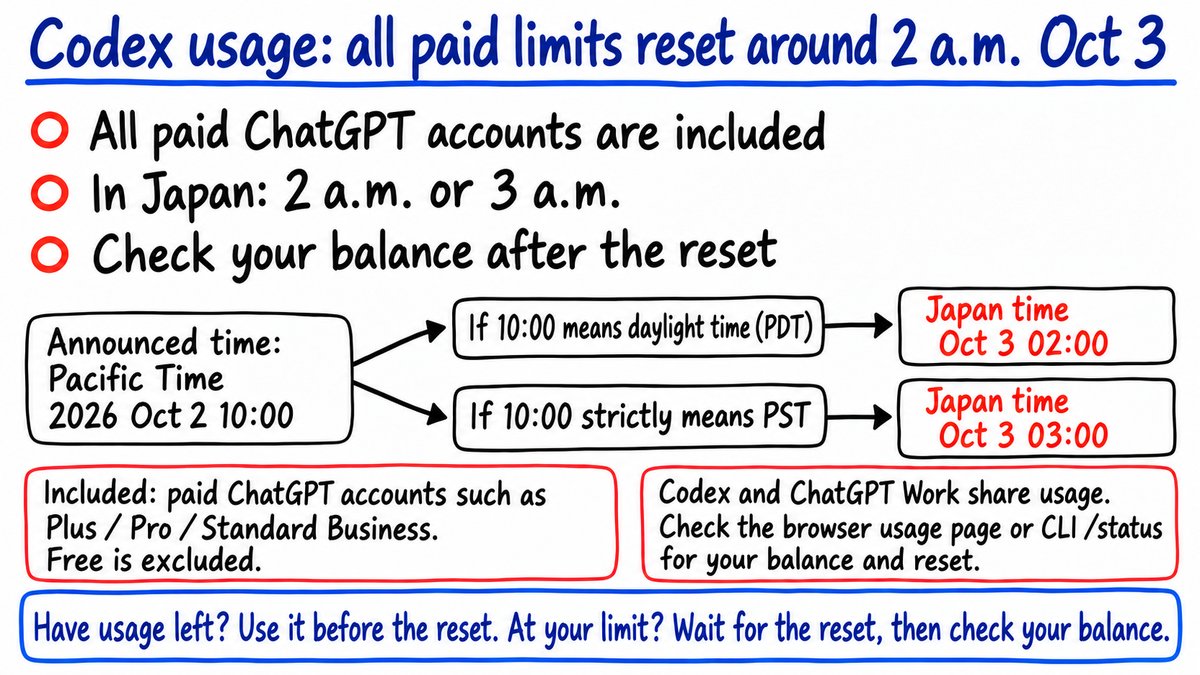
The reset was announced by OpenAI's Codex head, Thibault Sottiaux, in his X account (@thsottiaux): at 8:00 PM Moscow time, which corresponds to 10:00 AM Pacific Time on October 2, usage limit counters are reset on Plus, Pro, Business, as well as in ChatGPT Work and Codex, and the free plan is not affected by the gesture. Sottiaux directly linked the move to the unsuccessful start of the GPT-6.1 Sol model, released on September 29, 2026: in the first two days after the release, due to a sharp influx of requests, processing speed fell below expected levels. By the time of the announcement, according to Sottiaux, the speed had returned to normal.
Context
For OpenAI, this is a recurring practice, not a one-off gesture: the company has already reset paid limits on August 11 and 29, and September 26, 2026. Usage limits are structured as message counters with a 5-hour recovery window, and a reset returns the subscriber's full plan quota of requests. Previous compensatory resets also followed load incidents on new releases, when an influx of requests to a new senior model caused speed to drop below expected levels.
Why this matters for the industry
The recurrence of resets shows that the bottleneck in OpenAI's flagship launches lies in inference capacity and service stability, not in model quality: quota compensation is becoming a built-in element of the release cycle and a tool for retaining the paid audience while a new release fails to meet the promised speed. For teams building products on ChatGPT Work and Codex, the reset is a surge of free capacity with a known start time, which can be used for deferred tasks and batch runs. However, this is a gesture of goodwill, not a contract: OpenAI has no public SLAs or mandatory compensations, so building hard dependencies on such windows is risky. If the pattern of "flagship launch, then speed drop, then compensatory reset" persists, teams will have to factor release dates into on-call schedules and load planning, and pressure for open inference telemetry and formalized SLAs will grow.
Why this matters for users
After 8:00 PM Moscow time on October 2, subscribers to all paid plans received reset counters: accumulated deferred tasks in ChatGPT Work and Codex can be run without purchasing credits, and buying limits before the reset was pointless. Remaining messages can be checked on the chatgpt.com/codex/settings/usage page or with the /status command in Codex CLI. Volume benchmark: GPT-6.1 Sol limits on Plus and standard Business plans range from 15 to 160 messages in a 5-hour window. It is better to check the actual model speed in your own scenarios with your own measurements, rather than relying solely on the developer's statements.
What is still unknown / limitations
The statement about the restoration of normal GPT-6.1 Sol speed is currently confirmed only by the words of the Codex head: there are no independent measurements, latency percentiles, error rates, or queue statistics available publicly, and the methodology has not been published. The conclusion that quota distribution has become established in OpenAI's release cycle is based on four cases in two months — a small sample, and it is unknown how many launches passed without resets and how the load was distributed across days. It is also unclear whether OpenAI will announce future compensatory windows in advance: for now, the mechanism remains a gesture of goodwill without public SLAs.
Sources
- Thibault Sottiaux (@thsottiaux) on X: usage limits reset for all paid ChatGPT accounts
- ChatGPTの“利用制限”リセットへ 有料ユーザー向け — ITmedia AI+
- Codex: Usage Reset Time Announced by Tibo for All Paid Plans — SmartScope
Author
Look at AI, editorial team