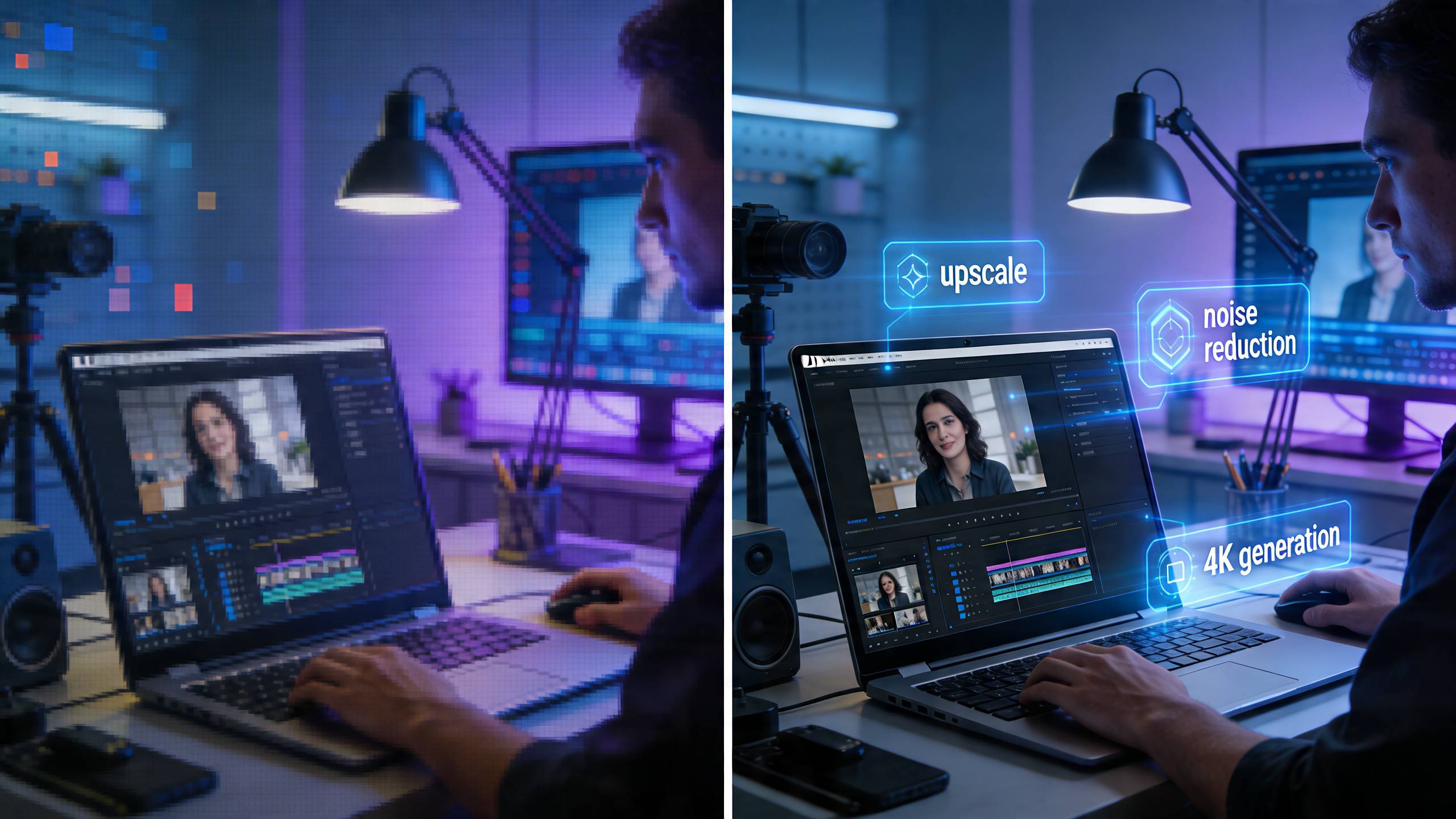
Dreamina — ByteDance's service for generating images and videos — has introduced a Preview mode for the Seedance 2.5 video model in its web version: a 480p draft is first created and compared cheaply, and only the selected result is rendered into a final video in native 1080p. A similar scheme called Draft Mode has been opened in parallel via the BytePlus API. The scheme brings the familiar VFX logic of previsualization to generative video: expensive quality is paid for only for the selected variant.
What happened
A Preview mode for Seedance 2.5 has appeared in the web version of Dreamina: a 480p draft is generated first, it can be compared and iterated on, and then the selected variant is rendered into a final video in native 1080p while maintaining the connection with the preview. The official Dreamina guide confirms the two-stage scheme of "first a cheap test of the idea, then a paid final render"; according to the announcement, the 480p preview costs 8 times less than full 1080p generation. In parallel, BytePlus opened Draft Mode for Seedance 2.5 via API with a claimed savings of up to 77%. The formal parameters of the model are confirmed by the official BytePlus page: videos 4–30 seconds long in 480p/720p/1080p resolutions at 24 FPS in MP4 or MOV formats.
Context
The cost of failed attempts has long remained the main economic problem of generative video: full generation in high resolution is expensive, and creative iteration of ideas by definition requires multiple runs. Hence the interest in two-stage draft pipelines that separate the cheap idea stage from the expensive finalization stage — similar to previsualization in VFX production, where a scene is first checked in a rough form and only approved plans go to the expensive final render. Similar logic has already become the norm in image generation, where draft modes took root earlier; now the pattern has reached video models. Notably, ByteDance opened the scheme immediately on two independent entry points — in the Dreamina web interface and via the BytePlus API — which speaks to a deliberate product decision, not a one-off experiment.
Why this matters for the industry
Two-stage draft pipelines hit the central cost item of generative video: idea iteration no longer has to be paid at the full rate of the final render, and the price of failed attempts is structurally reduced. The most technically significant vendor claim is that the 480p draft works as a structural condition for the native 1080p render, not as a post-facto upscale: if this is the case, composition and movement are preserved between stages, and the scheme truly brings the familiar VFX logic of previsualization to AI video. For teams already working with Seedance 2.5, Draft Mode via the BytePlus API allows embedding the "cheap draft → selection → expensive render" cascade into their own pipelines. If the combination confirms consistency between stages on real scenes, the draft stage will with high probability become a standard element of video model pricing, and competitors will have to respond with similar modes.
Why this matters for users
The benefit is available immediately and without local hardware: in the browser, on the web version of Dreamina, you can repeatedly and cheaply iterate on composition, hero movement, and scene rhythm in 480p, paying for the expensive final render in 1080p only for the selected variants. This is a ready-made workflow for previs, storyboards, and selecting staging solutions, which previously required either a budget for full iteration at full price or your own GPU. Via the BytePlus API, the same scheme can be embedded into your own services and pipelines. The budget for a series of runs is better planned based on the fact of the first sessions: the exact amount in advance is not disclosed in the interface.
What is still unknown / limitations
The central technical claim — that the 480p draft serves as a structural condition for the native 1080p render, not an upscale — currently relies only on the vendor's wording: there is no technical report or methodology for the connection between stages, and this is a working hypothesis. There are also no consistency metrics: it is unknown how well the 1080p render reproduces the selected 480p draft, how the quality of the drafts is distributed, and how the combination looks in terms of quality/cost ratio against the naive scenario of "generate directly in 1080p" on a representative sample of scenes. The economic figures do not add up to a single picture: the "8 times cheaper" ratio on the web version describes the price of a single step (approximately 87.5% savings on the draft), and "up to 77%" via the API is the total savings, depending on the usage pattern; these are different metrics and cannot be compared directly. In addition, the exact number of credits for a specific run in the Dreamina interface is not yet published — the cost is shown only after selecting the model.
Sources
- Dreamina — Learn How to Improve Video Quality With AI Tools Fast (official guide, describes Preview mode for Seedance 2.5)
- BytePlus — Seedance 2.5: AI Video Generation (official model page: 4–30 seconds, 480p/720p/1080p, 24 FPS, MP4/MOV)
- AICrier — BytePlus launches Draft Mode for Seedance 2.5 (two-stage workflow via API, savings up to 77%)
Author
Look at AI, editorial team