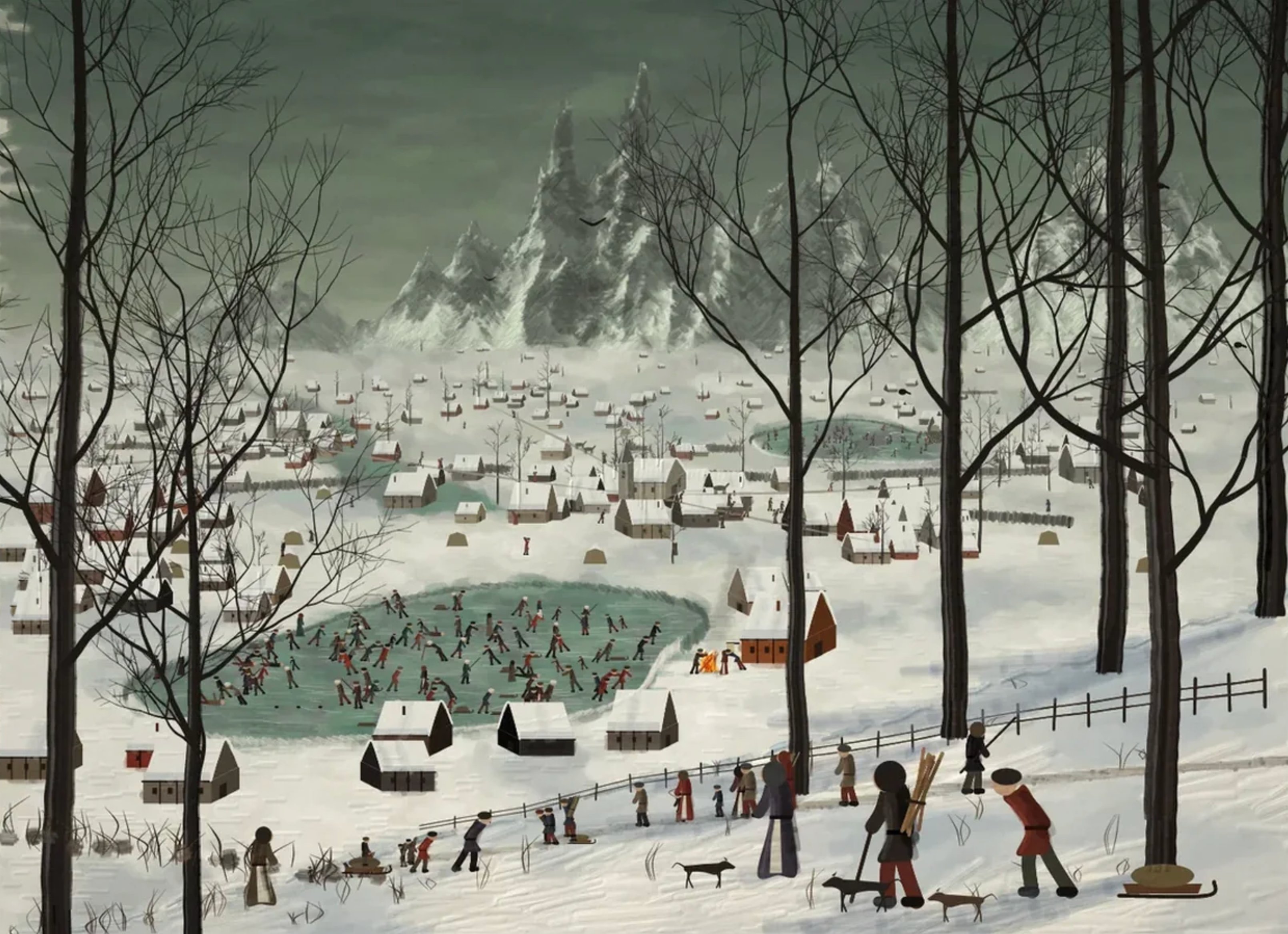
Anthropic employee Jake Eaton showed paintings 'painted' by the Claude Opus 5.5 model: it does not use an image generator, but creates Python programs of about 7500 lines, pixel-by-pixel imitating brush strokes, relying only on its own 'knowledge' about each artist. The demo was published on September 22, 2026, 23 minutes after the announcement of the new flagship model, and an open analog AI-Painter-Harness has already appeared on GitHub, repeating the 'LLM-artist + procedural paint engine' scheme.

What happened
On September 22, 2026, Anthropic employee Jake Eaton (@jkeatn) published a thread with paintings created by Claude Opus 5.5. 'Every image here is a python program generated pixel by pixel,' he explained: the model itself designs the composition, palette, and sequence of strokes, and then outputs a program of about 7500 lines of Python using standard libraries. The code pixel-by-pixel emulates painting techniques — bristle grooves, wet paint, and impasto relief — without reference images. The demo came out 23 minutes after the announcement of Claude Opus 5.5, the first model of the Claude 5.5 family: it works at the level of Fable 5.1 for most tasks and costs 40% less than Opus 5. Eaton's post gathered about 448 thousand views, the model announcement — 18.7 million.
Context
The 'image as program' format is arranged differently from diffusion generation. Diffusion generates a result in latent space, from which a picture cannot be read and accurately reproduced, while a Python program is inspectable: it can be read, edited, and restarted, each time getting an identical result. The mechanism is confirmed by the open project AI-Painter-Harness: this is a NumPy 'oil' painting engine in which an LLM — from Anthropic, OpenAI, or Gemini to OpenRouter and an offline stub — controls strokes in five phases. The entire rendering is performed on an ordinary CPU without specialized accelerators, so the scheme is realistic in terms of computational budget and available to any developer.
Why this is important for the industry
For the industry, an alternative to diffusion generators has been demonstrated: an LLM does not 'draw' itself, but writes deterministic rendering code, and for pictures a separate image generator or image-API is no longer needed. Value shifts to frontier models, strong in generating long procedural code, and the 'drawing engines' layer is instantly commoditized — an open analog appeared within a day after the tweet. For Anthropic, the demo is a way to show the coding capabilities of the new flagship without launching a separate image product; at the same time, no one has shown buyers, revenue, or unit economics. If interest is maintained, a wave of open 'LLM + procedural engine' implementations, amateur benchmarks for long graphical code generation output, and products like parametric editing or marketplaces of style presets are likely — but these are scenarios, not accomplished facts.
Why this is important for users
It will not be possible to repeat the original experiment: Eaton's code has not been published. A working path has already been opened — AI-Painter-Harness is installed via pip install, provides the aipainter CLI and a local web studio on FastAPI, including an offline mode with a built-in mock artist that does not require an API key. Ten ready-made styles are available: Van Gogh, Monet, Rembrandt, Vermeer, Turner, Cézanne, Seurat, Renoir, Munch, and Caravaggio. Rendering one canvas of 5000–15000 strokes takes 5–15 seconds on CPU, so in the evening you can compare different models in the role of 'artist-composer', practically understand what 'LLM as programmer-painter' means, and use the result as demonstration content.
What is not yet known / limitations
The evidence base is still weak. The demo is a showcase of capabilities, not a benchmark: the sources have no quality metrics, blind comparison with diffusion models, and data on how many attempts the model made and how the best results were selected. The source code of the original experiment has not been published, and AI-Painter-Harness is an independent implementation of the same idea, not a replication of Eaton's demo. The 'image as code' approach has not yet been shown as a competitor to diffusion generators: beautiful pictures without a selection protocol prove nothing, and forecasts about hybrid pipelines and long-term niches remain interpretations.
Sources
- Jake Eaton (@jkeatn, Anthropic employee) — thread with paintings created by Claude Opus 5.5 Python programs
- Claude (@claudeai, official Anthropic account) — Claude Opus 5.5 announcement
- GitHub — alby13/AI-Painter-Harness: procedural painting engine controlled by an LLM
Author
Look at AI, editorial team