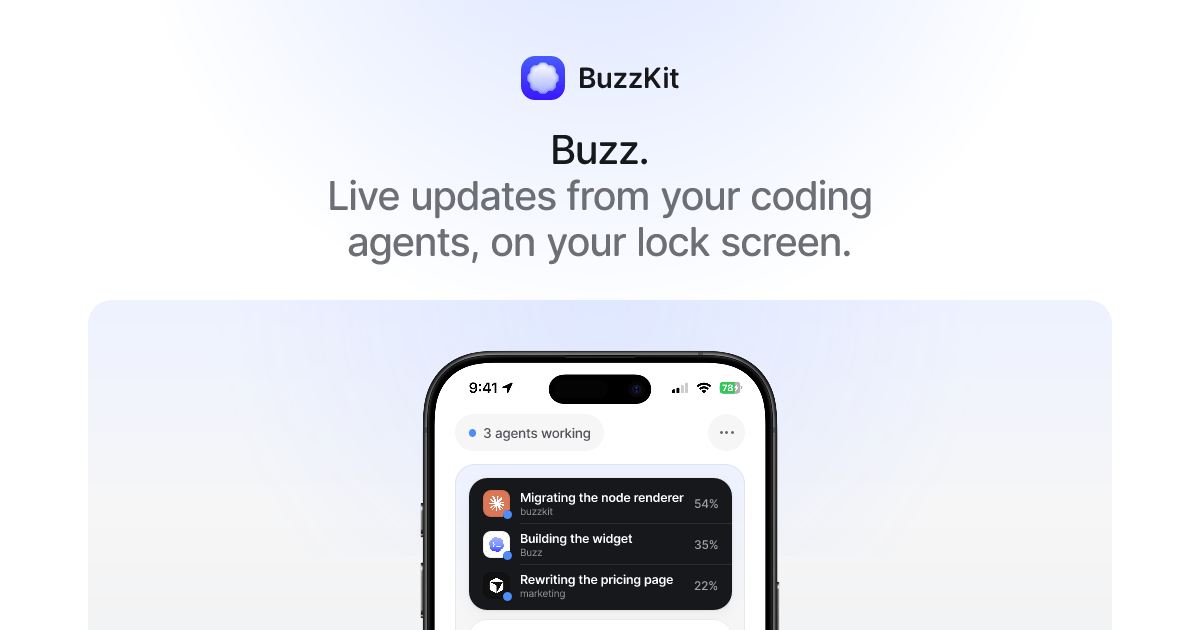
CLI agents like Claude Code, Codex, and Cursor now have a simple way to report their work to humans: the BuzzKit project has released Buzz — an open-source iOS app that displays their statuses as system notifications on your iPhone. Task completion arrives as a push notification, progress is shown in a Live Activity on the lock screen, and approval requests are marked with a separate "Waiting on you" card. The app is open-source under the MIT license and is available in beta via TestFlight.


What Happened
On September 7, 2026, the buzzkit-dev/Buzz repository was made publicly available — an iOS app called Buzz under the MIT license, through which CLI agents like Claude Code, Codex, and Cursor can send notifications to your iPhone. All the agent needs to do is send a POST to a single HTTPS endpoint, ping.buzzkit.dev/YOUR_KEY: task completion arrives as a push notification, the session field renders a Live Activity with a progress bar and status on the lock screen and in the Dynamic Island, and status:"waiting" brings a "Waiting on you" card to the top when the agent needs an approval or response. Pairing is done via a six-digit code from the app: the /pair/claim endpoint returns {key, endpoint, mcp}, Claude Code connects the endpoint as a remote MCP server using the command claude mcp add --transport http, and other agents read the instructions at ping.buzzkit.dev/skill.md with settings for presence, attention, finished, and finishedAfter. It works over standard HTTP, so the phone and the machine running the agent don't need to be on the same network; the beta build of the app is distributed via TestFlight.
Context
The problem Buzz solves is chronic: CLI agents run for a long time and silently, and developers have historically built the "agent notified human" channel manually — with custom webhooks, scripts on top of push services, and their own APNs keys. Buzz formalizes this as a reproducible product pattern of "one POST endpoint + skill.md + remote MCP": the push infrastructure is maintained by an open-source framework, while the agent's behavior — when to update progress and what to consider completion — is defined by a declarative instruction file, skill.md, which the model reads. Human-in-the-loop is separately formalized: the "waiting" status is a machine-readable signal that the agent is waiting for a human decision, not just a UI element, making the approval channel a measurable object. From a scientific perspective, there is no novelty here — no models, benchmarks, or evaluation methodologies; this is infrastructure glue between CLI agents and APNs, whose value lies in the engineering pattern.
Why This Matters for the Industry
For the industry, the significance is that notifications from CLI agents are no longer a DIY affair: the open-source framework itself holds the APNs keys and aggregates dozens of parallel agents into a single Live Activity with one push token, reducing the cost of the communication channel with humans to zero for any tool, down to CI tasks and shell scripts. For startups, this is direct savings: weeks of engineering on webhooks and custom push services are replaced by connecting to a ready-made service, and if desired, everything can be self-hosted from the open-source code — the app is distributed under MIT, the framework under AGPLv3, and the APIs are in an open monorepo, so architectural claims can be verified against the code. A significant caveat: it's too early to talk about standard formation, the repository is about a week old, it has 347 stars, and the main unknown is the actual market adoption of the pattern.
Why This Matters for Users
If you run Claude Code, Codex, or other CLI agents on long tasks, you can install the TestFlight beta of Buzz and step away from the terminal: your phone will notify you of completion, errors (timeout, rate limit), or approval requests, and progress will be shown on the lock screen. Setup takes a minute — give the agent the six-digit code from the app and ask it to read skill.md, enable "finished": true, and update progress via the buzz skill. The phone and the machine running the agent don't need to be on the same network: traffic goes over standard HTTPS from any network, so for personal and small team workflows the solution is already working, and if desired, everything can be self-hosted from the open repository.
What Is Still Unknown / Limitations
There are no reliability metrics in the sources: the percentage of lost or false push notifications, the delay from POST to notification delivery, and the channel's behavior under frequent progress updates have not been measured. The repository has been public for about a week and has gathered 347 stars, and the service is in beta status — it's too early to talk about hosting stability and readiness for critical workflows. Agent behavior is defined by the skill.md instruction, not a strict protocol, so the regularity of updates depends on the model and is not guaranteed. Finally, the fate of the standalone app is unclear: Apple and agent IDE vendors may build similar notification channels into their own platforms, devaluing the independent product.
Sources
- Buzz · BuzzKit — Live updates from your coding agents, on your lock screen
- GitHub — buzzkit-dev/Buzz: Live updates from your agents, on your Lock Screen
- TestFlight — Buzz beta build for iOS
Author
Look at AI, editorial team