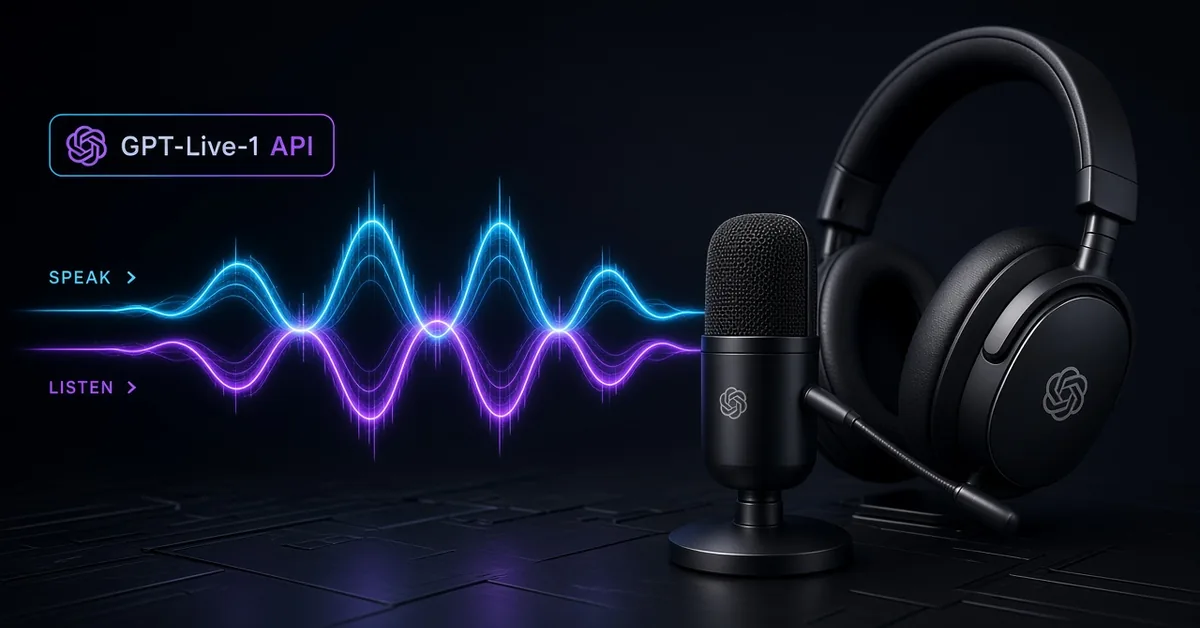
On September 10, 2026, OpenAI opened the API for GPT-Live-1 — a full-duplex voice model that has been operating in ChatGPT's voice mode since July. The frontend listens and speaks simultaneously, handles interruptions and background noise on its own, and passes reasoning and tool calls to a separate backend model, so the conversation continues while that model computes.
What happened
On the day of the release, OpenAI announced that GPT-Live-1 is now available to developers via API. The model's unified speech stack replaces the traditional STT–LLM–TTS cascade, where recognition, the language model, and synthesis worked in turn: now both interruptions and background noise are processed within a single model. The GPT-Live-1 frontend costs $0.05 per minute of conversation, and backend model calls are billed separately. The API supports telephony, 12 new voices, ASR transcripts, and speed and tone adjustments via instructions. Among the early customers are Speak, Yelp Host, Fin from Intercom, and Devin from Cognition. According to OpenAI's measurements, response latency decreased from 1.4 to 0.8 seconds, and at Speak the number of false interruptions decreased by approximately 80%.
Context
GPT-Live-1 did not appear together with the API: the model has been operating in ChatGPT's voice mode since July 2026, meaning that opening the API is the commercialization of an already refined production pipeline, not a new demo. Previously, full-duplex voice interfaces were built on cascades: a recognizer converted speech into text, an LLM formulated a response, a synthesizer voiced it, and pauses and "lost" interruptions were a side effect of such a scheme. In OpenAI's official materials, the new model is compared to its predecessor GPT-Realtime-2.1, and the delegation mechanism to the backend — to GPT-6 Astra or to third-party models via Responses delegation — allows keeping the "speech frontend" and the agent's "brain" as separate components.
Why this matters for the industry
The main thing for the industry is that voice agents are ceasing to be a glued-together pipeline of "recognition + LLM + synthesis": a full-duplex voice frontend, separated from the reasoning model, changes the architecture of telephony and customer service, because the voice line does not break while the backend executes tools. The price of $0.05 per minute and the ability to connect a backend model not from OpenAI make GPT-Live-1 a basic infrastructure API for voice agents. The voice pipeline is turning from a product into infrastructure: launching live voice agents becomes sharply cheaper, and the defensibility of startups shifts from the speech stack to data, workflows, and distribution.
Why this matters for users
For developers, the API is available now: there is a WebRTC quickstart, 12 voices, ASR transcripts, and speed and tone control via system instructions, so a full-duplex voice agent can be assembled without its own STT–LLM–TTS cascade. The cost of launching a voice MVP drops to $0.05 per minute for the frontend plus payment for the backend model. Users of voice bots will get "on-the-fly" interruption and conversation without pauses while the agent thinks and calls tools.
What is still unknown / limitations
Quantitative claims have not yet been confirmed by independent measurements. The advantage of ~30 percentage points over GPT-Realtime-2.1 on Full Duplex Bench is cited without a reference to the methodology: the composition of the test sample, metrics, and comparison conditions are not disclosed in available sources. The reduction in latency from 1.4 to 0.8 seconds and the 80% reduction in false interruptions are OpenAI's own measurements, and the interruption metric is partially cited as an operational indicator of the client Speak, while the measurement protocol and conditions — hardware, load, noise composition — have not been published. Until independent assessments appear, latency and interruption figures should be validated on your own loads, not based on the announcement.
Sources
Author
Look at AI, editorial team