Tencent has open-sourced teamai-cli — a CLI tool that stores team skills, rules, MCP settings, hooks, and AI agent environments in a single git repository and distributes them via teamai init to 11 popular agents: from Claude Code and Codex to Cursor and Hermes. Any configuration edits go through review via merge requests, just like regular code. The stable version 0.23.1 is available on npm under the MIT license as of September 9, 2026.
What Happened
The tool is distributed as an npm package: the stable branch 0.23.1 was released on September 9, 2026, and on September 11, an active beta 0.24.0-beta.8 is already underway in the repository. The teamai init command connects a shared repository to a project and distributes configuration to 11 agents: Claude Code, Codex, Cursor, CodeBuddy, WorkBuddy, OpenCode, Qoder, OpenClaw, Hermes, DeepSeek Harness, and ZCode; the last four have incomplete support — for example, Hermes lacks rules, hooks, and MCP. Edits follow classic code review: a push opens a merge request, and after merging, all participants automatically receive the changes; a repeated push of the same edit updates the already open MR. The SessionStart hook runs teamai pull at the start of each session, and the Stop hook at the end of a session evaluates it using the friction metric — whether the model was interrupted, whether tool calls were rejected, and how many times the agent repeated failing commands. The repository works with six git hosts: GitHub, GitLab, GitCode, CNB, TGit, and any private git.
Context
The tool addresses fragmentation that is already emerging in teams where multiple developers simultaneously work with different agents: settings have to be manually copied between machines as dot-files .claude, .codex, and .cursor. Teamai-cli standardizes this process: configuration becomes a versioned artifact with review instead of a set of local files. In addition to synchronization, the package includes the teamai recall knowledge base — BM25 search with graph-boost over a codebase graph, which is built by a WASM parser tree-sitter for TypeScript, JavaScript, Python, and Go, while a fallback mechanism using regular expressions is used for other languages. Ready-made starter sets with skills, rules, and review agents are published by the teamai-hub organization. The adoption pace is indicated by repository statistics: as of September 11, 2026, 4143 stars, 266 forks, and about 560 new stars per day — these are adoption metrics, not quality metrics.
Why This Matters for the Industry
For the industry, a vendor-agnostic git layer for AI coding agents is emerging: the basic task of config synchronization is commoditized, and value shifts one level up — to observability and team agent management. The MIT license and support for six git hosts allow the pattern to be adopted beyond the Tencent ecosystem, and the friction metric sets a framework for an entire class of session telemetry products. If the adoption pace is maintained, in six months storing agent configuration in git with MR review may become an expected standard for mixed teams, the agent support matrix will become more complete, but competing git layers are likely on the market — a new fragmentation that the tool is trying to eliminate. On a two-year horizon, the layer will either consolidate and become a norm of team AI workflow on par with CI, or die as a pattern; following it, the category of 'agent configuration as code' may emerge, and the validated friction metric may become standard session telemetry.
Why This Matters for Users
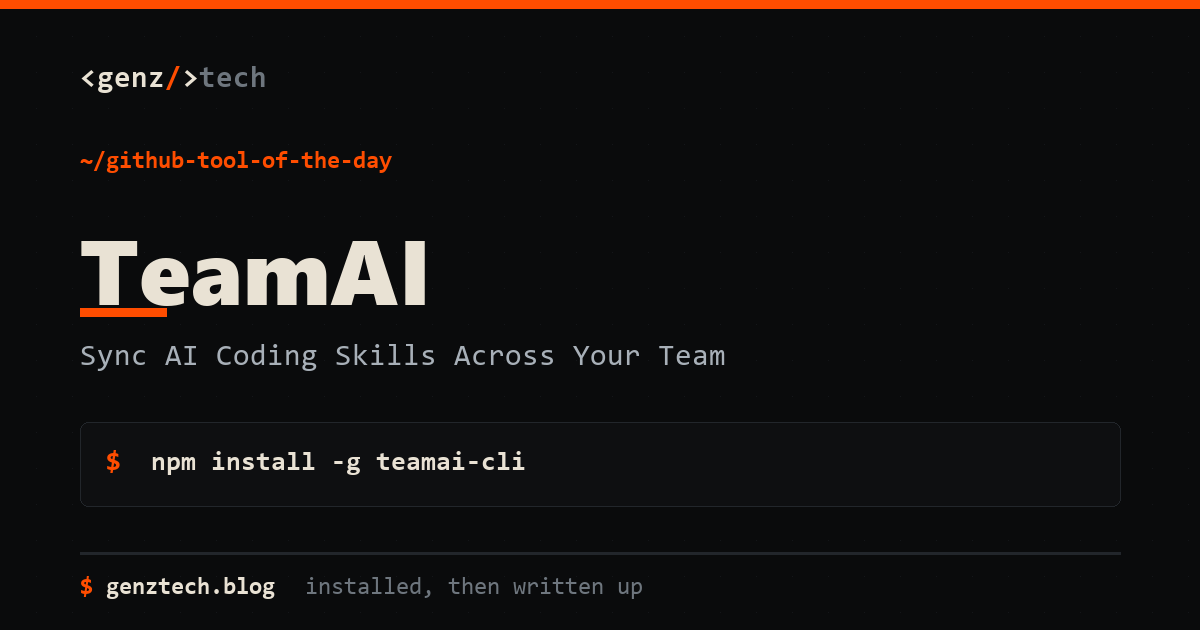
A pilot in an existing project takes about ten minutes: Node.js 20 or newer is required, then npm install -g teamai-cli and teamai init . Single-repo mode works without a separate team repository, and --scope user allows trying the tool solo. Templates from the teamai-hub organization provide ready-made skills, rules, and review agents, so the starter set does not need to be written from scratch. Immediately after connection, the dashboard and weekly digest show how the team spends tokens, which sessions are successful, and where human interventions are frequent — this provides a quick win for teams already working with agents.
What Is Still Unknown / Limitations
The project is in the 0.x stage: the stable branch 0.23.1 coexists with the active beta 0.24.0-beta.8, so production use requires safeguards against breaking changes, and there is no public data on teamai pull time, latency, and scale. Support for four of the 11 agents (OpenClaw, Hermes, DeepSeek Harness, and ZCode) is incomplete. The friction metric is a heuristic proxy signal without ground truth and human labeling: correlation with objective task success has not been shown, and until validation, conclusions about session quality cannot be drawn based on it. The accuracy and completeness of teamai recall search are not disclosed, and for languages outside TypeScript, JavaScript, Python, and Go, search works via a fallback mechanism using regular expressions. Finally, star statistics measure adoption, not quality: the Mango Developer review headline mentions 29 thousand stars, while the snapshot as of September 11 — 4143, and this discrepancy should be checked directly in the repository.
Sources
- Tencent/teamai-cli — Make Every Team AI Native (GitHub, README and LICENSE)
- Tencent's TeamAI CLI Wants to Be the Git Layer for Your AI Coding Agents (Mango Developer, Devon Vance)
- TeamAI Setup: Sync AI Coding Skills Across Your Team (GenzTech, Kore D)
Author
Look at AI, editorial team