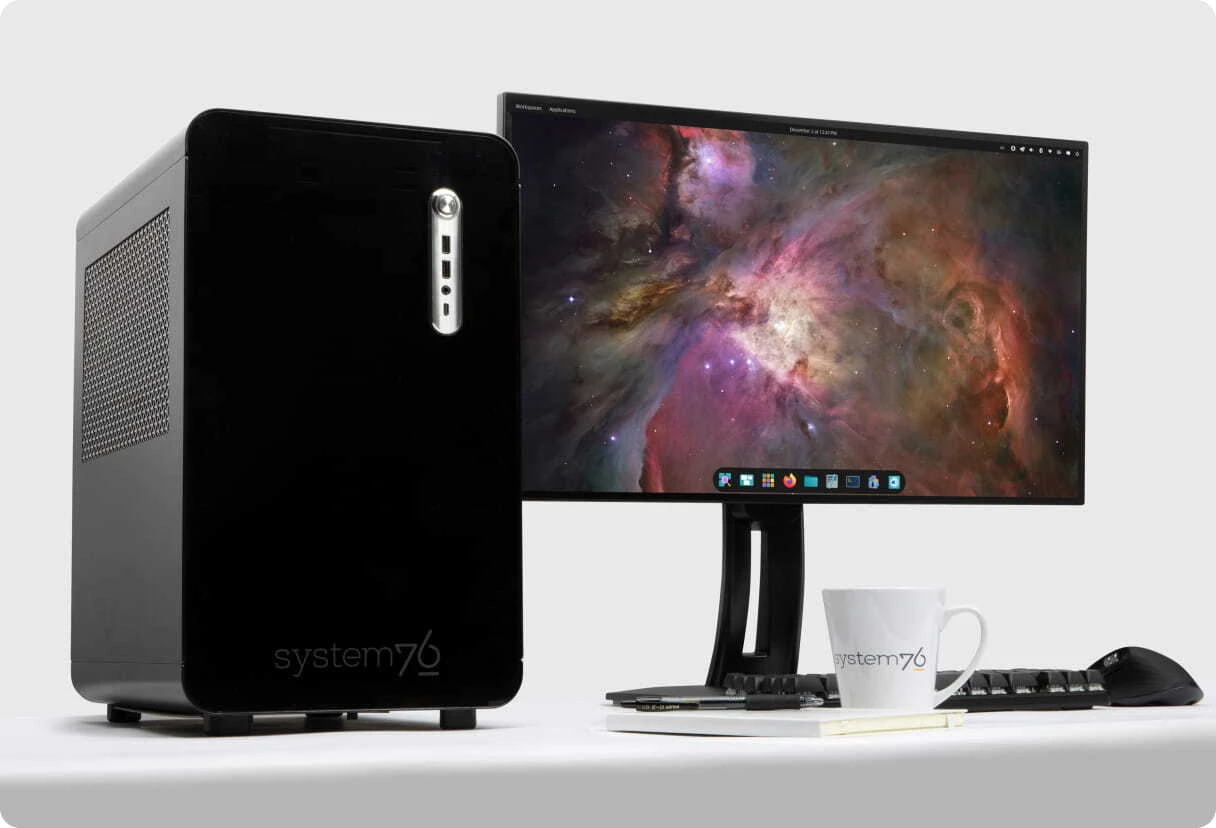
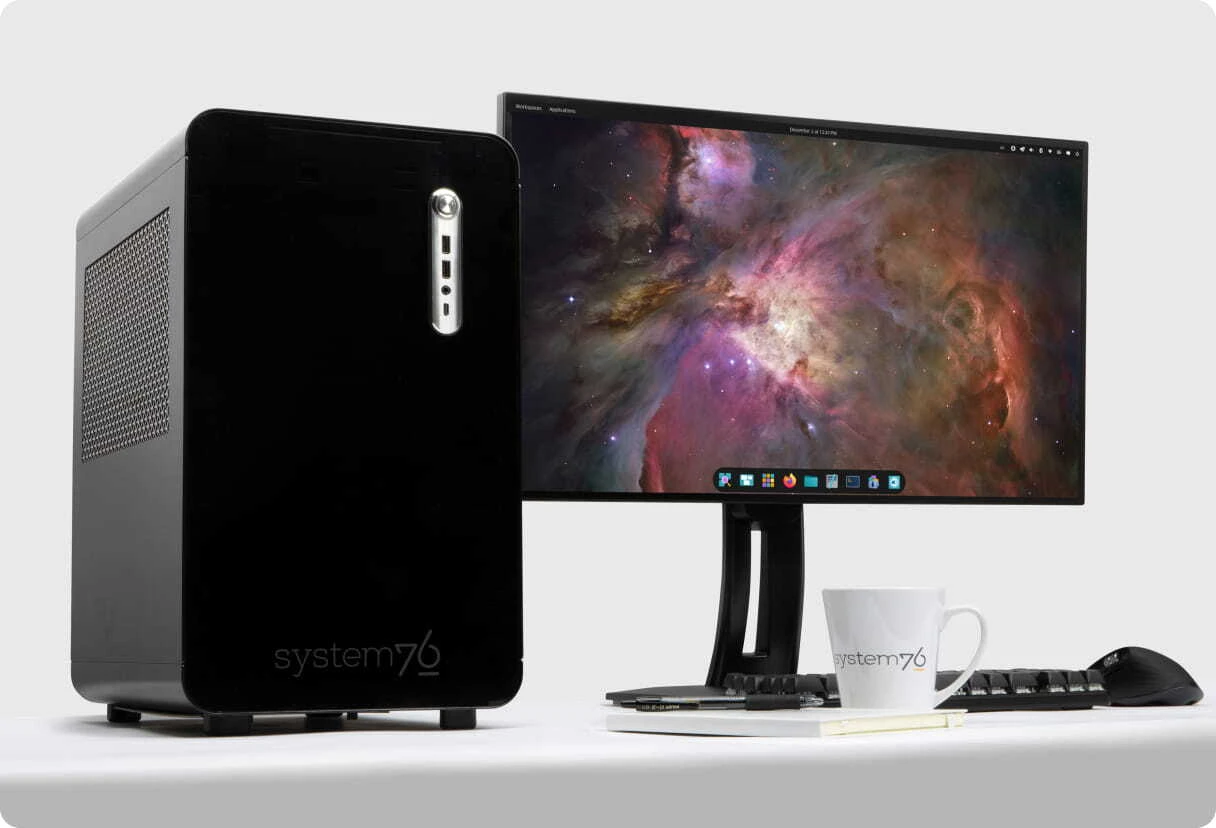
System76 has unveiled the Thelio Mira AI — a desktop Linux workstation based on an AMD Ryzen 9000 CPU (AM5 socket) with the option to install two NVIDIA RTX PRO 6000 Blackwell GPUs, each with 96 GB of ECC GDDR7, for a total of up to 192 GB of VRAM. This capacity allows Llama 3.3 70B in FP8 or Qwen 2.5 32B in FP16 to be kept entirely in VRAM, without offloading weights to disk. The starting price is $3,299, and the launch was announced for September 9, 2026.

What Happened
System76 revealed its configuration lineup alongside the launch announcement. The base version for $3,299 includes a Ryzen 7 9700X processor, an NVIDIA A400 graphics card, 64 GB of DDR5, and a 1 TB M.2 drive; installing two RTX PRO 6000 Blackwell GPUs instead costs approximately $37,239 extra, bringing the full configuration to over $40,000. The stated memory capacity is confirmed by the arithmetic: the weights of a 70B-class model in FP8 occupy about 70 GB, and 32B models in FP16 — about 64 GB, so with this amount of ECC GDDR7, the model is kept entirely in the memory of a single machine, with room to spare for the KV cache and activations.
Context
System76's engineering solution is built on a rejection of the expensive HEDT Threadripper PRO platform, whose processors range from $1,649 for the 16-core 9955WX to $11,699 for the 96-core 9995WX. Instead, an affordable consumer AM5 socket is used, and the roughly $5,000–$12,000 saved is redirected from the motherboard and CPU to the GPUs. There is no scientific novelty in the announcement — no new model, no new training method, no new benchmark; the novelty is purely product-based: two professional 96 GB accelerators are packed into a standard desktop PC case with a consumer processor. As a result, a "local 70B" class configuration is for the first time purchased as a ready-made, pre-configured Linux machine rather than a self-build, and the category of pre-configured ML workstations expands from HEDT platforms to consumer CPUs.
Why This Matters for the Industry
The main architectural limitation for builders is the absence of NVLink: the connection between the two cards goes over PCIe 5.0 x8 with a bandwidth of up to 32 GB/s in one direction, which is equivalent to PCIe 4.0 x16 and significantly lags behind the 900 GB/s of NVLink H100. For tensor-parallel inference, where exchange between accelerators happens for every token, this is a serious latency bottleneck, so real tokens/sec will almost certainly be noticeably lower than in systems with NVLink. Hence the precise positioning of the platform: model-parallel inference and fine-tuning of models around 70B — yes, distributed data-parallel training — no. For companies, the machine serves as a reference design for on-prem RAG, local agents, and internal fine-tuning of 70B-class models, while for existing production pipelines nothing changes: existing cloud inference configurations and single-GPU/H100 stations continue to work as before. If the GDDR7 shortage eases and the price of the RTX PRO 6000 returns to the $8,000–$9,000 level, the "AM5 + 2×96 GB" scheme is highly likely to be copied by other Linux workstation vendors.
Why This Matters for Users
The Thelio Mira AI is a ready-made Linux computer with Pop!_OS 24.04 LTS COSMIC or Ubuntu 24.04/26.04 preinstalled, with NVIDIA drivers and ML libraries pre-configured: large open models run locally, without the cloud and without sending data outside, which is critical for working with sensitive or personal data. TechTimes calculated the economics of the purchase: with GPU rental in the cloud at an average price of about $2.20 per GPU-hour (a sample of more than 36 providers, data as of September 8, 2026), an owned two-card station pays for itself in about 13 months with 24/7 load, and in 3–4 years with about 8 hours of work per day. The practical conclusion is this: the purchase is justified with constant high load on the model, while for episodic tasks, renting cloud GPUs remains cheaper.
What Is Still Unknown / Limitations
The announcement materials contain no benchmarks, and independent measurements of speed (throughput, TTFT with batches) have not yet appeared, so the question of real performance and production-readiness remains open: the stated capacity is verifiable by specifications, but speed is not confirmed by anything. The claim of zero time "from the box to first inference" is not verified in the sources, and the composition of the pre-configured ML libraries — framework versions, CUDA versions, inference engine — is not disclosed, so for now this is a marketing claim, not a confirmed fact. In addition, against the backdrop of the GDDR7 shortage, prices for the RTX PRO 6000 (around $16,000) and the availability of two-card configurations may change, making the payback calculation less predictable.
Sources
- Thelio Mira AI Linux Workstation (System76)
- System76 Thelio Mira AI Fits 192 GB ECC GPU Memory Into Consumer Desktop Chassis — TechTimes
- System76 Introduces Thelio Mira AI Workstation — TechPowerUp
Author
Look at AI, editorial team