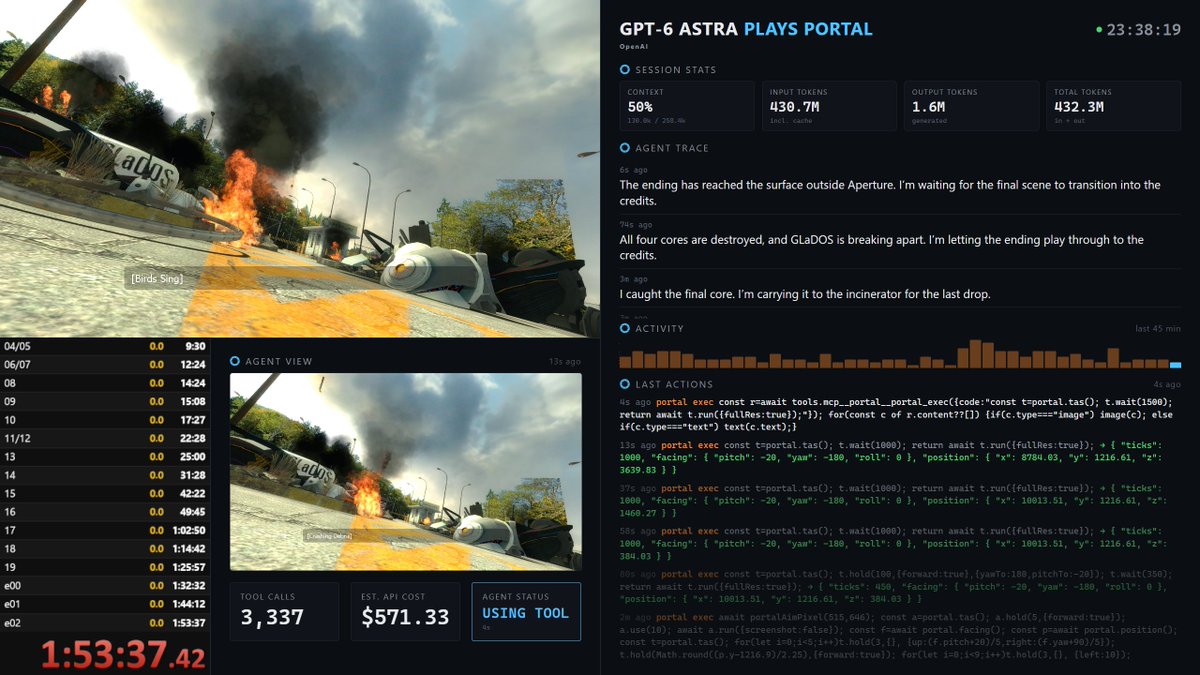
User @cozyblazex published an experiment on X in which the GPT-6 Astra (gpt-6-astra) model in maximum reasoning mode fully completed the original Portal: according to the published log, 23 hours, 42 minutes, and 34 seconds passed from start to credits. Every step of the run, the entire token accounting, and the cost breakdown are open for verification, and the completion itself was recorded on video.
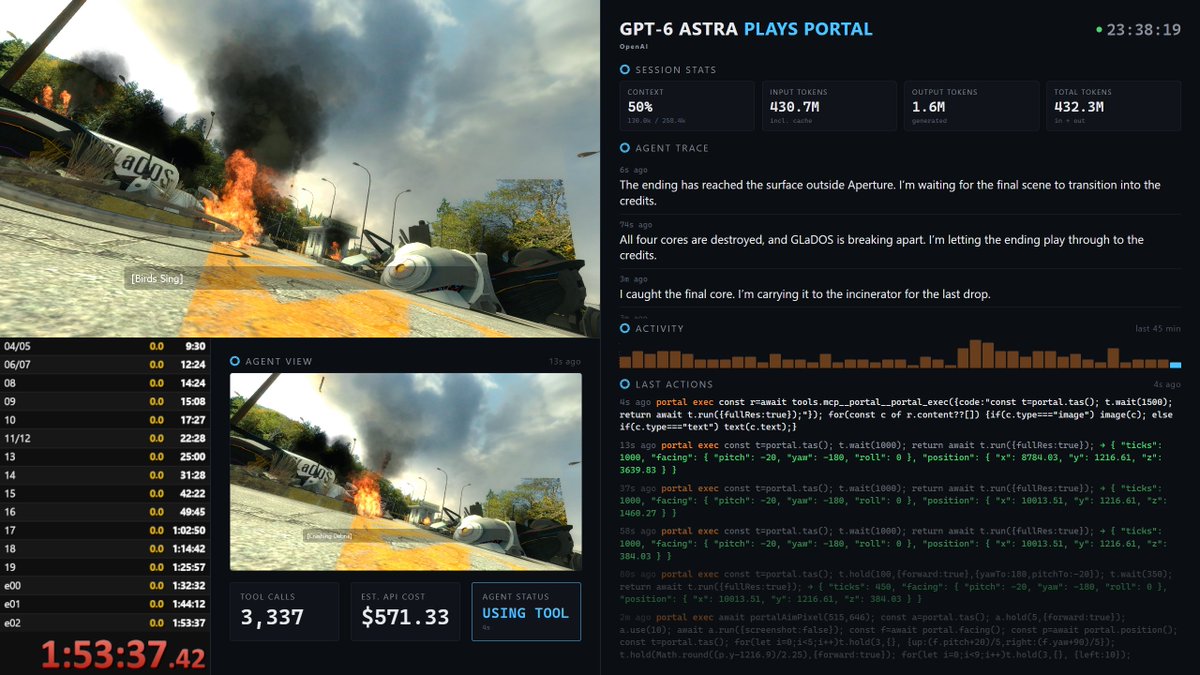
What happened
The start of the experiment was recorded on September 4, 2026, at 17:00 PDT, and the credits on September 5 at 16:43 PDT; the timing includes switches after capacity errors, and the author restarted the session and finished playing in Fast mode. The model controlled Chell via an MCP server and a modified build of SourcePauseTool, and for each move it received a screenshot, the character's position, and the camera angle. Out of 3,300 tool calls, 3,210 were portal_exec commands, meaning the model mostly acted rather than describing intentions. According to the sanitized log, the run required 434.8 million tokens: 433.2 million input, of which 426.4 million (about 98%) went into the cache, and 1.6 million output, of which 1.18 million (about 74%) were reasoning tokens.
Context
Portal is the original 2007 puzzle game, and its interactive 3D world is convenient as an environment with an objective final goal: to complete the game to the credits. At the same time, the model does not have access to the full internal state of the game and relies only on what is shown to it through tools. MCP is the protocol by which a frontier model calls external tools and receives data from the environment; in the experiment, it connects Astra to the gameplay. The decisive detail of the setup is the modified build of SourcePauseTool, which paused the game while Astra was reasoning: the real-time constraint was removed, and the agent had virtually unlimited time for each move. What is being tested here is long-horizon agency — the ability to maintain a single goal for hours in a cycle of "observation — planning — command" — and not reaction speed.
Why this matters for the industry
For the industry, this is the first widely publicized case in which a frontier model autonomously maintained a single goal for almost a day in an interactive 3D environment with an open log and precise token accounting, and not a marketing video. The main benchmark is economics: according to the API pricing ($10/million input, $50/million output, $1/million cached), the hypothetical cost of the run without cache is about $4,400, and with input token caching — about $574, a reduction of about 8 times, and the entire run fits into a $200/month Codex subscription without paying at the API rate. For teams, this is a ready-made order of magnitude for agent budgets, and the open repository provides a reusable architecture — an MCP controller, a SourcePauseTool patch, and a "screenshot — command" cycle that can be transferred to other environments.
Why this matters for users
Users have something to watch and something to repeat: the completion video, the sanitized log of each step, and the full setup — the controller, the SourcePauseTool patch, and instructions for Windows. A practical conclusion applicable to their own projects: input token caching is the main factor that makes multi-hour agent runs profitable, and subscription plans can replace payment at the API rate. To reproduce, the published repository and a Windows machine are enough, and according to the sanitized log, you can analyze exactly what the model did at each step.
What is still unknown / limitations
This is a single run (N=1) in one environment without repetitions, without comparison with other models, and without error statistics, so this is a demonstration, not a valid benchmark. The $574 estimate is a hypothetical cost according to the public API pricing, not an actual payment. The run is not real-time work: the environment was paused during reasoning, and the timing includes switches after capacity errors, a session restart, and finishing in Fast mode. This is a user experiment, not a release, an API change, or a production-ready system.
Sources
- cozyblazex on X: original post and thread about the GPT-6 Astra completion
- cozyblaze/portal-agent repository: controller, SourcePauseTool patch, sanitized log, and evidence/summary.json
- GPT-6 Astra Plays Portal — completion video on YouTube
Author
Look at AI, editorial team