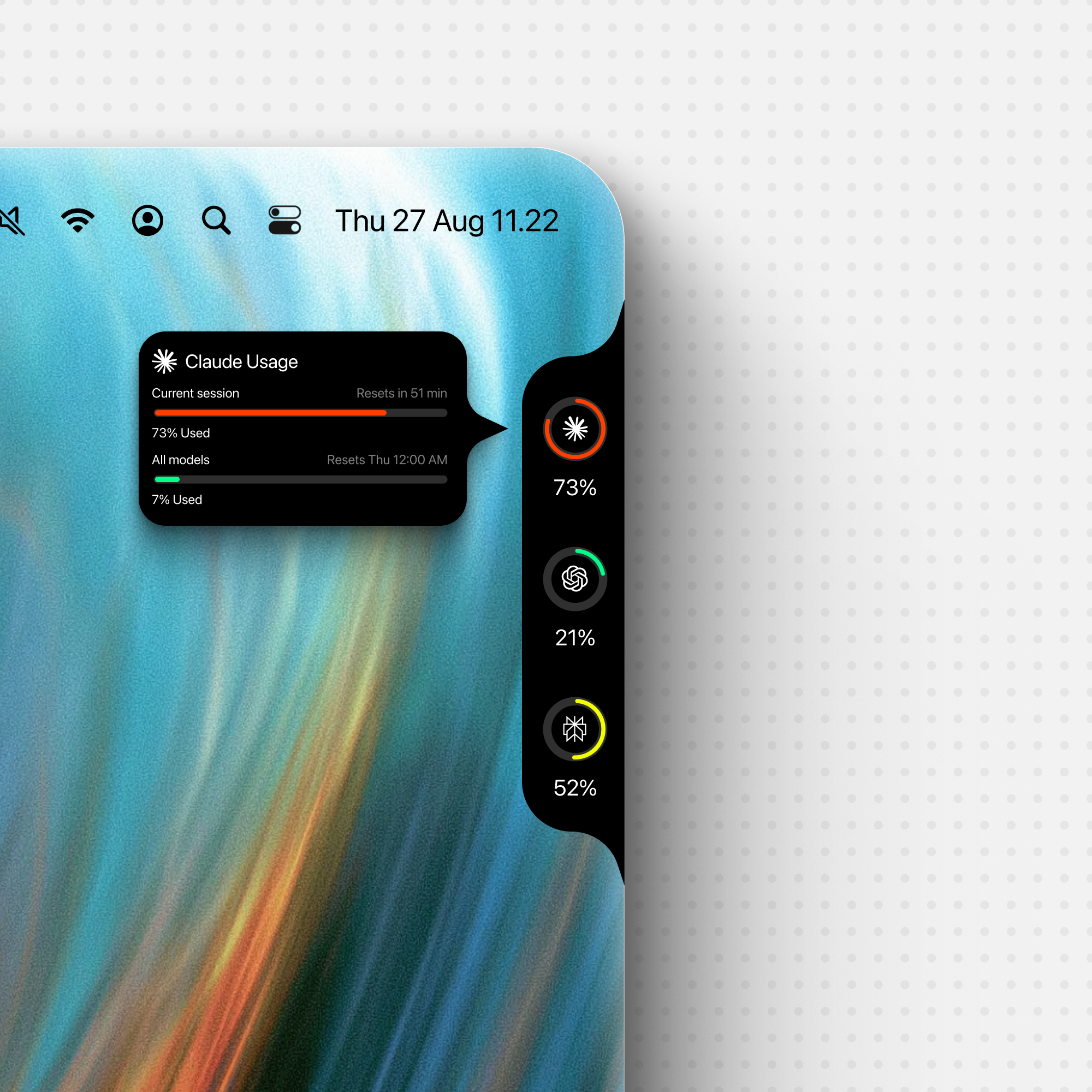
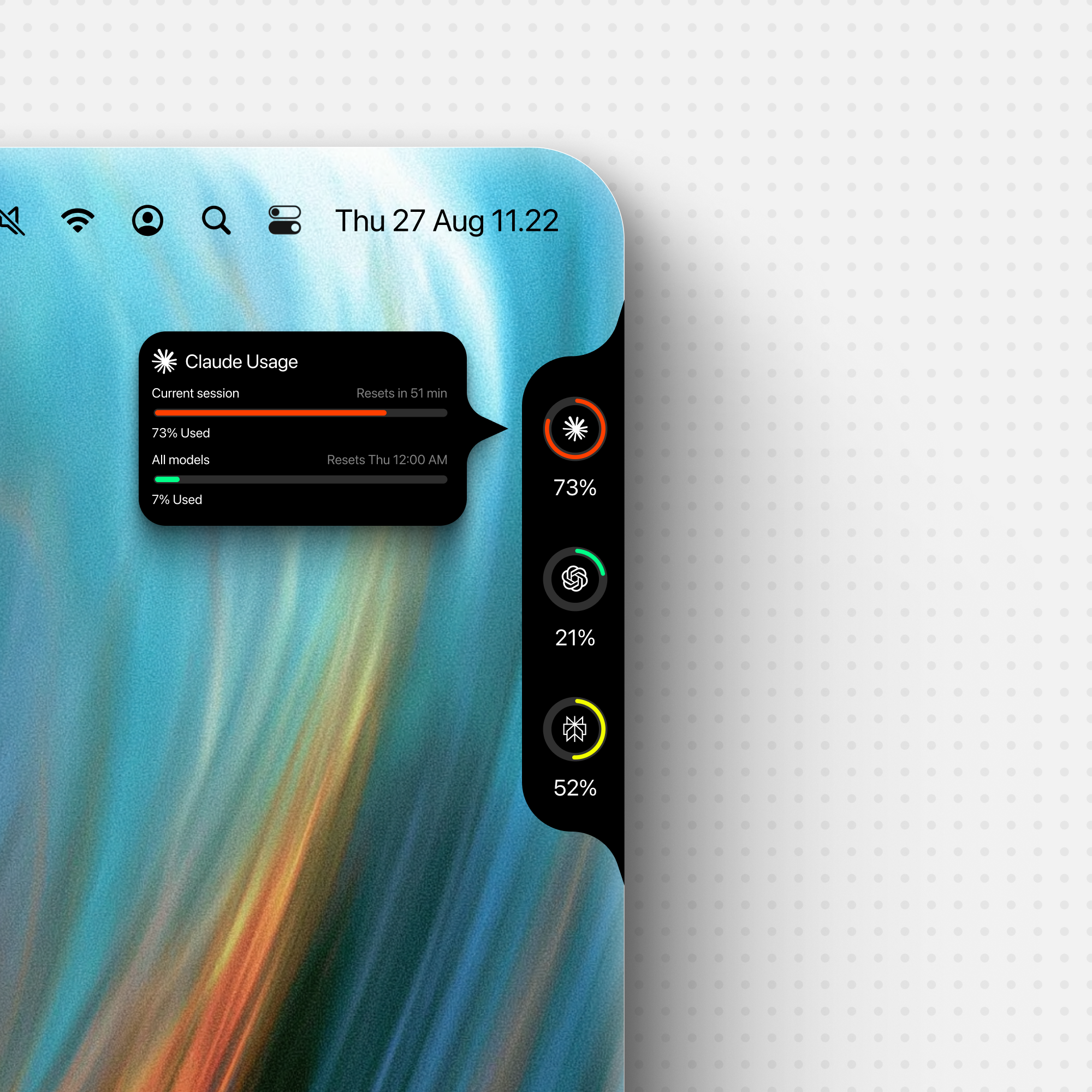
Codenotch is a free open-source app under the MIT license by developer vinzdg: a compact "notch" (pill element) on the edge of the screen shows how much limit has been used for each paid AI assistant, when it will reset, and whether a session is currently active. Data is read from internal endpoints and local sessions of the tools themselves, without a separate login.
What happened
The vinzdg/codenotch repository was created on September 5, 2026, and in three days gathered approximately 1050 stars and 170 forks. Initially, the app was released for macOS: the "notch" is pinned to the edge of the screen and displays for each supported AI tool — Claude Code, Cursor, Codex, Antigravity, GLM, Grok, OpenCode, and GitHub Copilot — the volume of used limit, time until its reset, and the state of the current session: working, finished, or waiting for a response. Limits are read via internal endpoints (api.anthropic.com/api/oauth/usage, chatgpt.com/backend-api/wham/usage) and local sessions and databases of the tools themselves, so a separate login is not needed; multiple Claude accounts, separated by the CLAUDE_CONFIG_DIR variable, are displayed as separate rings. On September 8, 2026, update 1.6.0 was released with a port to Windows on Rust/Tauri 2, the development of which is being carried out in the Im-Midi/codenotch-windows repository. The app can show the remaining limit in a timecode, send alerts at 80% and 100% usage, and place the "notch" on any of the four edges of the screen.
Context
Paid subscriptions for AI assistants work on quotas: each tool has a limited volume of usage that is periodically reset, but none of the vendors in the sources has a clean public API that allows asking "what percentage of the limit has been exhausted." Therefore, third-party tools are forced to read the same internal endpoints and local storage as the applications themselves. Codenotch does not interfere with the operation of the assistants and does not add costs or latency to the inference pipeline: it is an external observer that only reads the state of quotas. The project does not contain a scientific component — no new models, benchmarks, or training methods, it is an engineering open-source utility for monitoring.
Why this is important for the industry
The appearance of Codenotch — Swift on macOS and Rust/Tauri 2 on Windows, MIT license, cross-platform in three days — records the formation of an independent layer of third-party utilities around paid subscription limits of AI assistants: "quota awareness" (quota-aware UI) is being formed into a separate category of tools. For developers, this layer sets a noticeable reliability pattern: each adaptation in case of failure degrades into a visible status stale, needsAuth, or error, and not into an interpolated percentage, which does not pass unmeasured as measured. The key technical dependency of the entire category is the stability of vendors' internal endpoints: if they release an official usage API, the adapter layer of competitors will have to be rewritten, and some third-party tools may dissolve into official means.
Why this is important for users
For everyone who works daily with paid subscriptions for AI assistants, the project is ready for use right now: it is enough to clone the vinzdg/codenotch repository and build the app with the make run command on macOS or cargo build --release on Windows with Rust/MSVC and WebView2. As a result, in real time you can see the remaining limit for each tool, time until reset, and which agents are currently active, and alerts at 80% and 100% allow you not to miss the moment when the quota runs out. Configuration is minimal: the position of the "notch" is chosen by four edges of the screen, login is not required.
What is still unknown / limitations
The declared facts are reproducible in an engineering sense — there is a repository, license, and build commands — but there is no independent verification in the sources: no articles, external tests, or benchmarks of accuracy and latency of reading limits. Data is read from undocumented internal endpoints and local sessions, so changes in formats or updates of tools by vendors can break adapters without warning. The speed of growth of the repository, about 1050 stars and 170 forks in three days, is a weak proxy for mass demand, and claims about the "commercial" base layer and "de facto API ecosystem" remain a product interpretation, and not a verified fact.
Sources
- Codenotch — official vinzdg/codenotch repository on GitHub
- Codenotch for Windows — windows/README.md (port to Rust/Tauri 2, v1.6.0)
Author
Look at AI, editorial team