On August 13, 2026, the FireRed team released FireRedTTS3, a speech synthesis system whose code and weights are published under the Apache-2.0 license. A single model combines zero-shot voice cloning in 24 languages, including Russian and Ukrainian, text-instruction voice design, and local editing of already generated speech.

What happened
The release comes in two variants. FireRedTTS3-Base performs zero-shot voice cloning in 24 languages, including Russian and Ukrainian, as well as 21 Chinese dialects. FireRedTTS3-Instruct is a unified model that adds two capabilities to cloning: text-instruction voice design and speech editing — word insertion, replacement, and deletion, speed changes in the range of 0.5x to 2.0x, pitch by ±6 steps, and volume without re-recording the entire clip. A technical report (arXiv:2608.17492) was published along with the weights.
Context
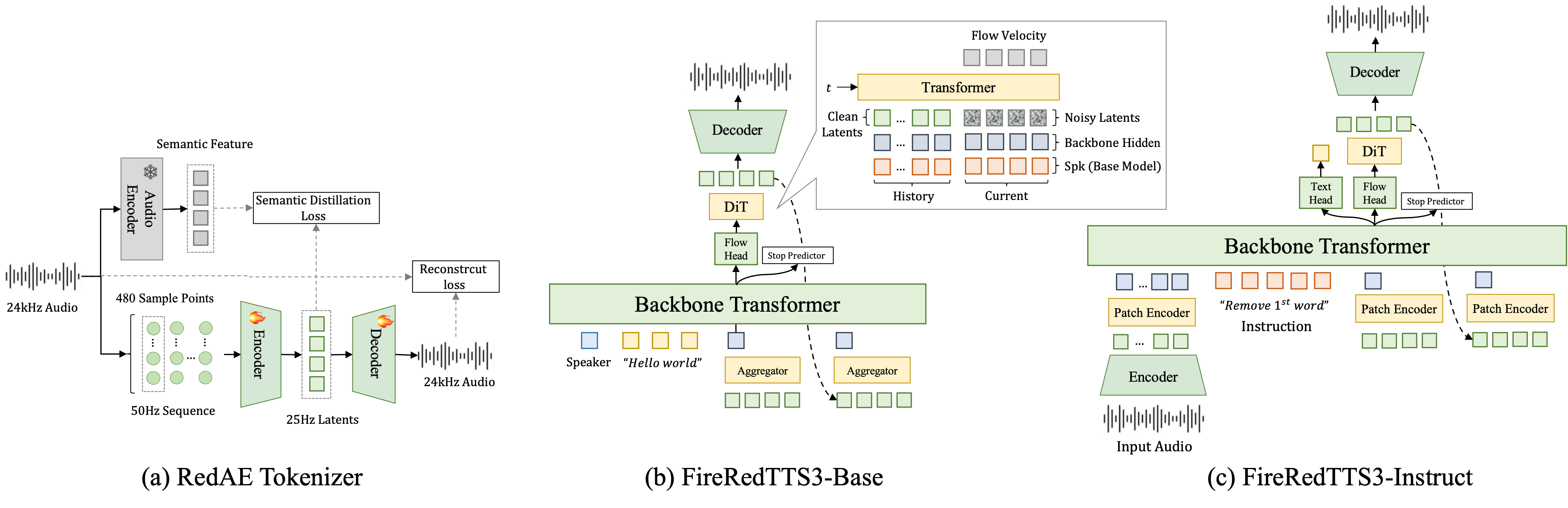
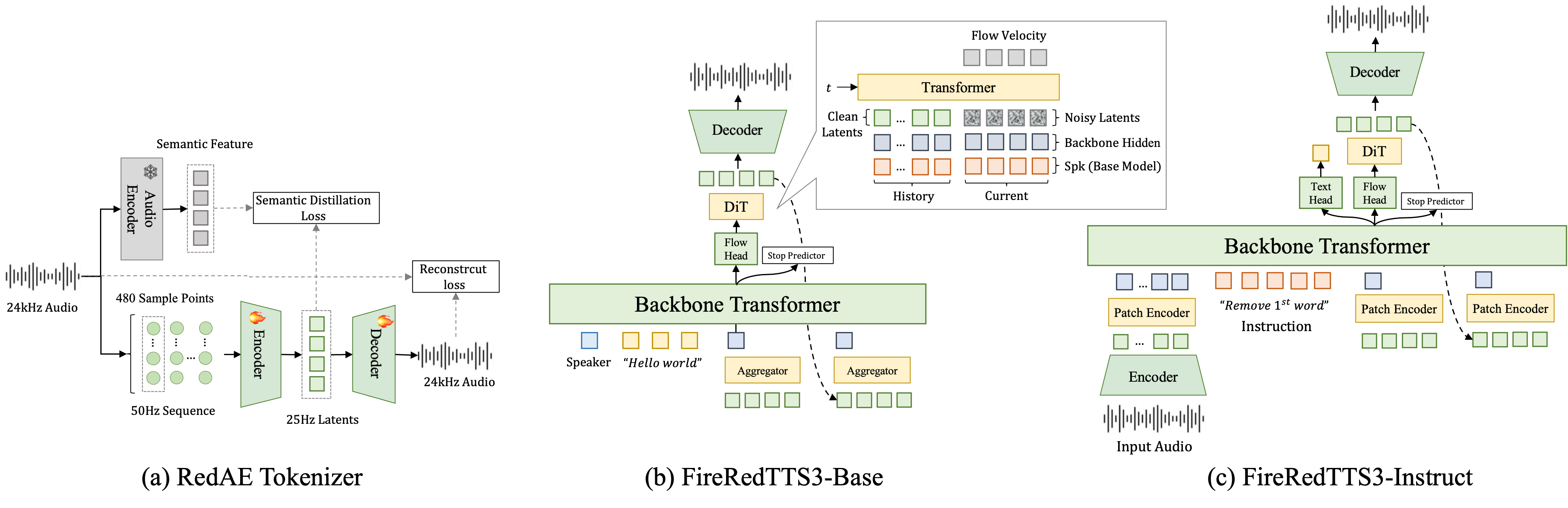
Technically, FireRedTTS3 is a continuous autoregressive model operating on semantically enriched speech representations generated by the RedAE tokenizer. The team's key bet is on regularization rather than complexity: a frozen audio encoder acts as a "semantic teacher" and stabilizes the representation space, which should suppress the accumulation of errors in autoregressive generation without multi-stage tokenizer training and a cumbersome architecture. The unification of features also deserves attention: voice cloning, text-instruction voice design, and local speech editing were previously implemented in different systems and commercial APIs, while FireRedTTS3 brings them together in a single open model.
Why this matters for the industry
The team claims that FireRedTTS3-Base shows the best average results among the compared systems: on the Seed-TTS-eval benchmark — WER/CER 3.04% and voice similarity 78.8, on MiniMax-MLS-Test — WER/CER 3.754% and similarity 84.8. The comparison includes CosyVoice3-1.5B, Qwen3-TTS, Seed-TTS, VoxCPM2, dots.tts, and the closed ElevenLabs. The main signal for the industry is the combination of open weights with a full feature set: the basic layer of speech synthesis is getting closer to a commodity, and for product teams FireRedTTS3 is a self-hosted alternative to closed TTS APIs. The "cloning + design + editing in one model" pattern may become the standard interface for voice products, and if the community confirms the quality and fine-tuning recipes appear, the release could exert sustained price pressure on closed APIs.
Why this matters for users
Russian is included in the list of 24 supported languages, so quality can be evaluated right now, without contracts: the online demo allows listening to the results, and the weights are available on Hugging Face and ModelScope, making it possible to build a comparison with the current provider. The barrier to entry for voice products is reduced to the level of a single GPU and integration work; specific scenarios include cloning a brand character's voice from a few seconds of audio and generating an oral version of text content. For a Russian-language pipeline, there is an important caveat: built-in text normalization (numbers, dates, currencies) works only for Chinese and English, so for full quality in Russian, LLM-based text normalization must be connected via any OpenAI-compatible API — this is an additional dependency, latency, and cost.
What is still unknown / limitations
All the metrics provided are self-reported by the team in their own report: the conditions of comparability — model versions, reference speech length, configurations — are not detailed in the available materials, so the outperformance of ElevenLabs should be considered a claimed result, not an independent verification. Independent reproductions and community benchmarks have not yet appeared. There is no published data on the model's latency and RTF, so before production use, performance will have to be measured on your own hardware and the full pipeline from text to speech run. In addition, speech editing only understands rigid command templates of the form "adjust the speed to 1.5x", not free-form phrasing, which narrows the range of production scenarios.
Sources
- Official FireRedTTS3 project page and demo
- FireRedTeam/FireRedTTS3 — official repository (GitHub)
- FireRedTTS3: Unified Speech Generation and Editing with Semantically Enriched Speech Representations (arXiv:2608.17492)
- FireRedTeam/FireRedTTS3 — model card (Hugging Face)
Author
Look at AI, editorial team