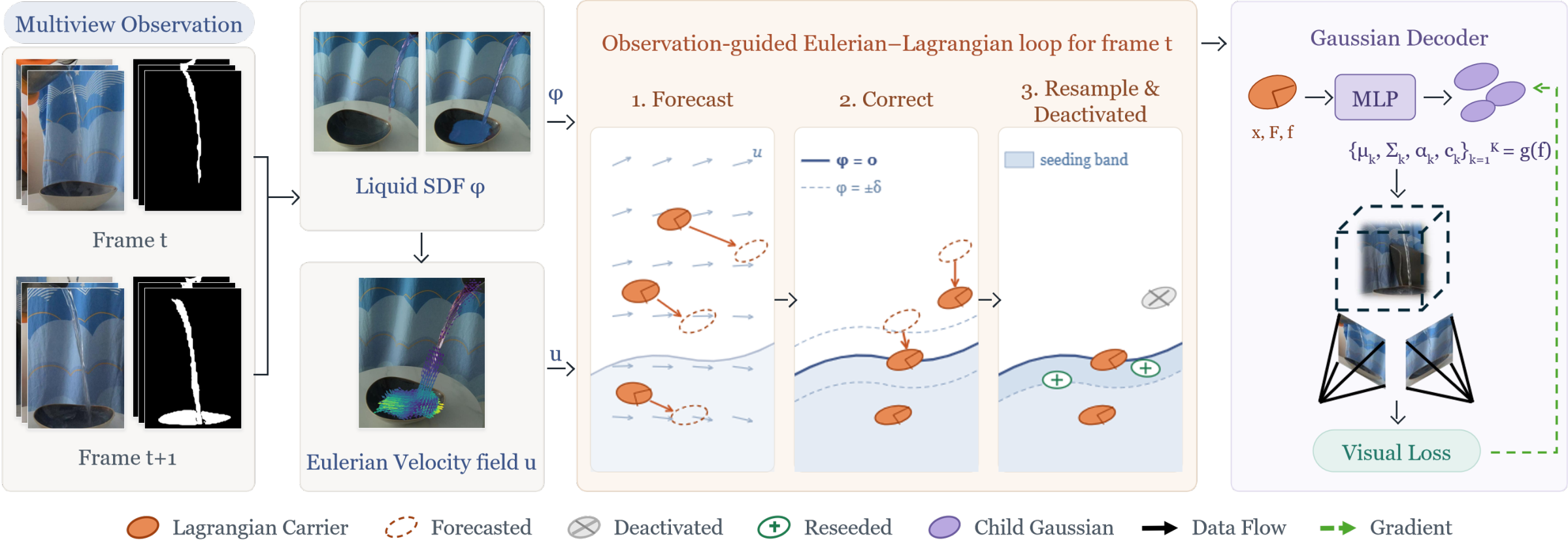
A team from EPFL, ETH Zurich, Google, and Microsoft (Peiyu Liu, Dingxi Zhang, Federico Tombari, Marc Pollefeys, Christina Tsalicoglou, Daniel Barath) published on arXiv (2609.20818, September 17, 2026) the SplashSplat method for reconstructing splashing liquids from real multi-view videos and the first benchmark for synchronized multi-camera capture of such scenes. The dataset and benchmark are already open under the CC BY 4.0 license, with reconstruction code promised later under MIT. This is a release of evaluation infrastructure, not a finished product: a common standard for comparing dynamic liquid reconstruction has appeared for the first time.


What happened
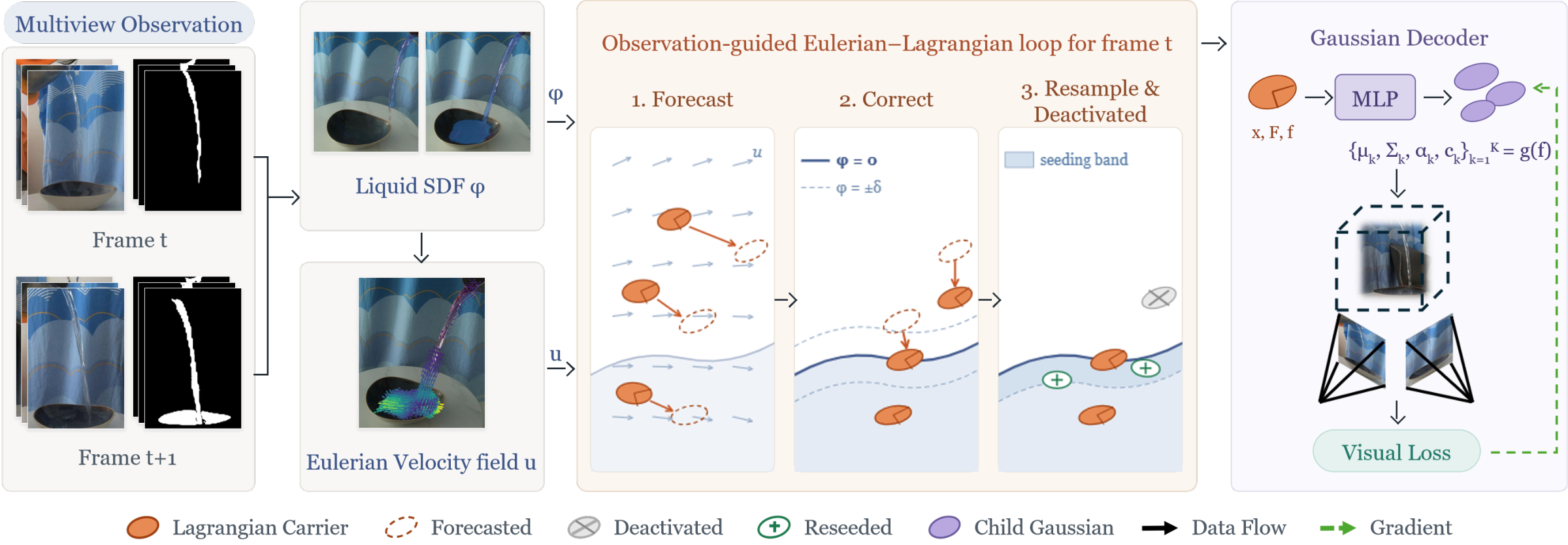
On September 17, 2026, the paper “SplashSplat: Reconstructing Splashing Liquids from Real-World Multi-View Videos” (2609.20818) appeared on arXiv. Along with the method, the authors published a benchmark: 20 real scenes of splashing liquids (bowl_001–bowl_017 and tank_001–tank_003), captured by seven synchronized calibrated 4K cameras at 60 fps, with manually refined liquid masks and fixed splits for evaluation. In the method itself, geometry is defined by SDF surfaces of the liquid, fused from masks of each frame; level-set transport between neighboring SDFs gives a coarse velocity field, along which Lagrangian carriers move — they are corrected by new observations, reseeded where coverage is lost, and decoded into local Gaussians for differentiable rendering. The authors report that SplashSplat outperforms dynamic Gaussian methods Deformable-3DGS, Spacetime Gaussians, and 4D-Scaffold-GS on real and synthetic scenes with more physically plausible motion and lower training cost, and that the same representation, without retraining, in their words, yields new viewpoints, temporal interpolation, and color style transfer for the liquid. The dataset and benchmark are already available on Google Drive under CC BY 4.0; reconstruction code in the repository is marked “coming soon” under MIT.
Context
The reason for such work had long been absent precisely because there was no data: a synchronized multi-view dataset of splashing liquids did not exist until now, and reconstruction of fast media was limited to smoke, synthetic scenes, and smooth deformations. Liquids in real videos destroy tracking within fractions of a second, so this class of scenes remained outside the zone of fair comparisons: each research team selected its own data. Manual mask annotation and fixed splits in the new benchmark reduce the room for cherry-picking when comparing methods. The methodological idea is also background but important: the physical structure — SDF surface plus velocity field — the authors impose only where observations actually constrain it, instead of full physical simulation, which is more expensive and fragile.
Why this matters for industry
For industry, the evaluation infrastructure turned out to be more significant than the method: the first open benchmark with fixed splits makes the niche of dynamic liquid reconstruction measurable, and the approach itself suggests that physically plausible reconstruction may cost less than full physical simulation. Already now, teams can compare their dynamic Gaussian methods on common data, fine-tune them, and build evaluation pipelines. Obvious points for derivative work — reseeding Lagrangian carriers and the coarse level-set velocity field. If the code is released as promised under MIT, expect a wave of independent reproductions on fixed splits, attempts to get by with fewer cameras, integration into existing 3DGS toolchains, and the first prototypes of “reconstruction-as-a-service”: multi-view video in, editable 4D Gaussian asset out. On a two-year horizon, if the trajectory holds, physically informed dynamic splatting may spread to other fast media — smoke, powders, destruction.
Why this matters for users
The practical effect for readers arrives immediately and one-sidedly. Today you can download the dataset from Google Drive (CC BY 4.0), run your dynamic reconstruction methods on 20 scenes, and compare on fixed splits — for researchers in dynamic Gaussian reconstruction and 4D representations, this is the first fair stand for a class of scenes where previous methods were objectively not tested. The project page and paper provide material for planning your own experiments and assessing how the proposed architecture will fit into existing pipelines. Integrating SplashSplat itself into a product is not yet possible: reconstruction code is not published, so product UX patterns around post-hoc capabilities of the representation should be postponed until the code appears and independent verification of claims.
What is still unknown / limitations
The main caveats concern the authors' claims, not the fact of publication. Post-hoc capabilities of the representation are claims about their own work, not results verified by independent checks, and the boldest among them is temporal interpolation: capture for reconstruction was at 10 fps with cameras at 60 fps, meaning the method allegedly captures fast splash dynamics from temporally sparse observations, and this point needs to be verified, not taken on faith. Reconstruction code is not published (“coming soon” under MIT), so reproducing the method, verifying claimed metrics and training cost, or integrating it into a pipeline is currently impossible, and release timelines are not named. Finally, the rig of seven calibrated 4K cameras with manual mask refinement sets a high bar for capture, and it is unclear how it will be simplified or scaled beyond the laboratory.
Sources
- SplashSplat: Reconstructing Splashing Liquids from Real-World Multi-View Videos (arXiv 2609.20818)
- SplashSplat — project page (EPFL / ETH Zurich / Google / Microsoft)
- GitHub: Niko-creater/Splashsplat — benchmark and dataset (code soon)
Author
Look at AI, editorial team