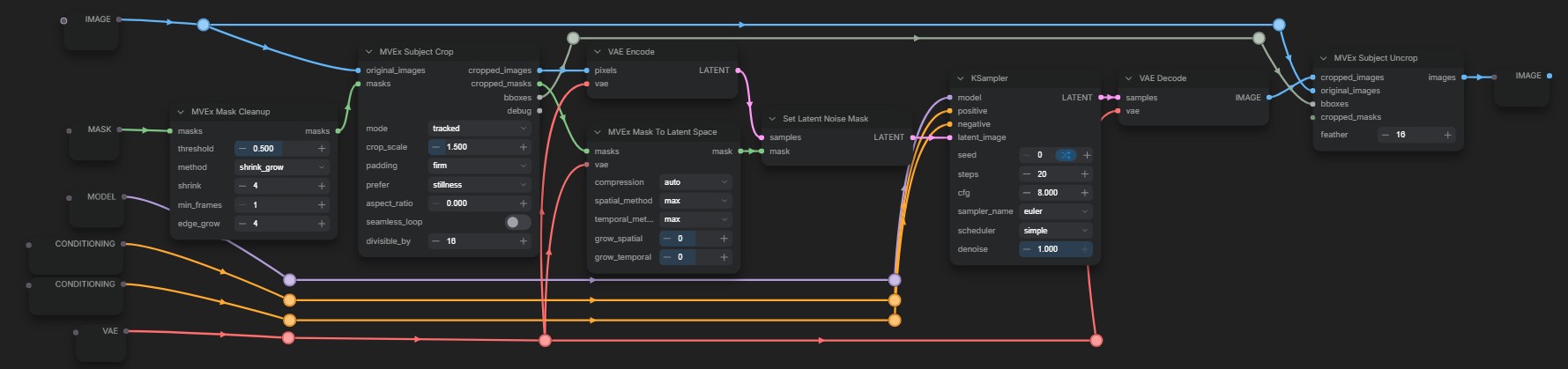
drozbay released MaskVidExperiments, an open-source ComfyUI node pack under the GPL-3.0 license for video inpainting. The key ideas of the pack: a stable crop around a moving object, planned for the entire clip, and the conversion of masks to the model's latent space via its VAE, with an understanding of the chunked VAE of MiniMax H3 and LTX-2 models, including audio latent.

What happened
The drozbay/MaskVidExperiments repository appeared on GitHub. The pack includes the Subject Crop node with combined, tracked, and zoomed modes for building a stable crop around a moving object for the entire clip, Subject Uncrop for returning the inpainting result to the original frame with a soft edge, Mask Cleanup for removing noise and flicker from a video mask, Mask To Latent Space for converting a pixel mask to latent resolution via VAE, Audio Mask To Latent for regenerating selected time segments of audio latent, as well as a soft variant of Differential Diffusion (Soft). The environment requirement is ComfyUI v0.15.0 or newer, installation is performed with a single git clone command into the custom_nodes folder with no third-party dependencies. The repository was created on July 28, 2026, the last commit is dated August 17, 2026, and at the time of the news publication the project has 118 stars and 15 forks. The README includes an example of replacing a car with a dog in a video generated by LTX.
Context
To assess the value of the pack, you need to look at the classic video inpainting workflow in ComfyUI: the operator selects an area around a moving object, crops it, runs it through a video diffusion model, and inserts the result back into the frame. Naive per-file crop jitters in position and size from frame to frame, and video diffusion models interpret this jitter as camera movement, which degrades generation. The second classic problem is visible seams at the boundary of the inserted region. The third, newer problem is that modern audio-video models like MiniMax H3 and LTX-2 use chunked VAE with their own frame cycle and 2x2 token grid, and their latent can include audio; most existing video inpainting workflows do not yet handle this structure. At the same time, the exact conversion of a mask to the resolution at which the model operates is given through the spatial-temporal compression of the VAE, while naive trilinear resize blurs the boundary of the inpainting region.
Why this matters for the industry
The signal for the industry is that the basic infrastructure of video inpainting is becoming a commodity: stable clip-level crop and exact conversion of masks to latent space are solved at the level of a free node pack, not proprietary pipelines. The strongest technical detail is the ready-made support for the structure of chunked VAE of MiniMax H3 and LTX-2 models, closing an integration gap that most existing workflows have not yet filled. For product teams, the pack serves as a reference implementation of the clip-level stable crop pattern in combination with latent masks, it can be used as a basis for their own solutions and as a template for porting to other models. There are no direct business events: no changes in pricing and distribution have occurred, and there is no impact on the serving infrastructure and the cost of inference of basic models. If the pattern becomes established in the ecosystem, in the future the functionality will most likely be absorbed by the ComfyUI core or the official pipelines of the models themselves, and the long-term value of the pack will remain as a reference.
Why this matters for users
For those who do video inpainting in ComfyUI, the pack hits two classic pain points at once: the jittering crop around a moving object and visible seams when returning the result to the frame. Manual per-file retouching of the crop area is no longer necessary, and the nodes are integrated into the existing workflow without changing the rest of the pipeline. In fact, it turns out to be a ready-made pipeline for local inpainting for new audio-video models MiniMax H3 and LTX-2, including the regeneration of selected time segments with sound, without any paid services.
What is still unknown / limitations
The evidence base of the pack is typical for an open-source tool, not a research artifact: README, workflow graph screenshot, and one example without quantitative metrics, ablations, and comparison with alternative pipelines. The statements about pixel-perfect insertion and the absence of visible seams are the author's claims, not measurements: there is no numerical data on the positional shift of the crop and the quality of the seams at the boundary. The repository is about a month old, 118 stars in four weeks is a positive signal, but not yet proof of sustainable support and wide adoption.
Sources
Author
Look at AI, editorial team