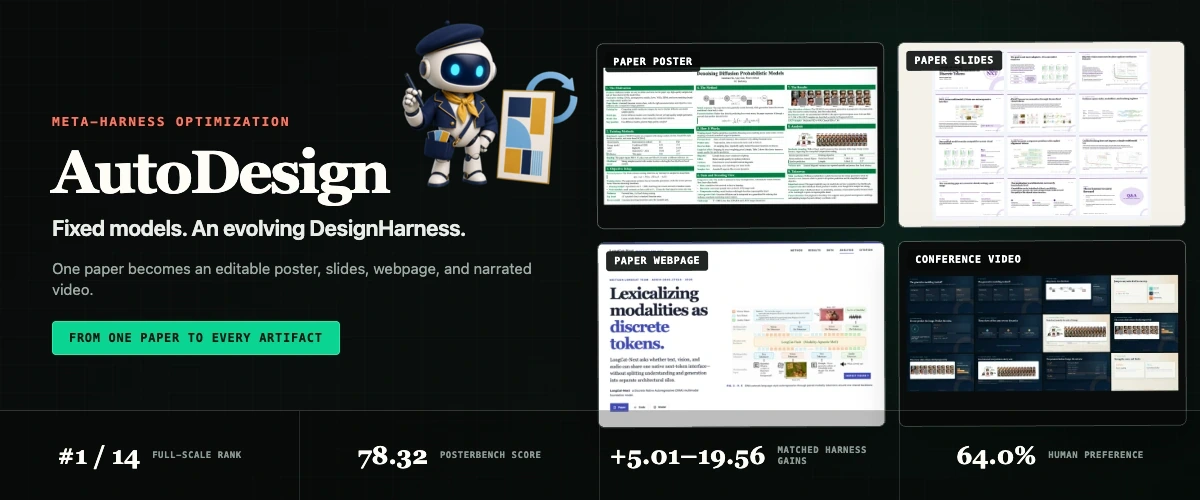
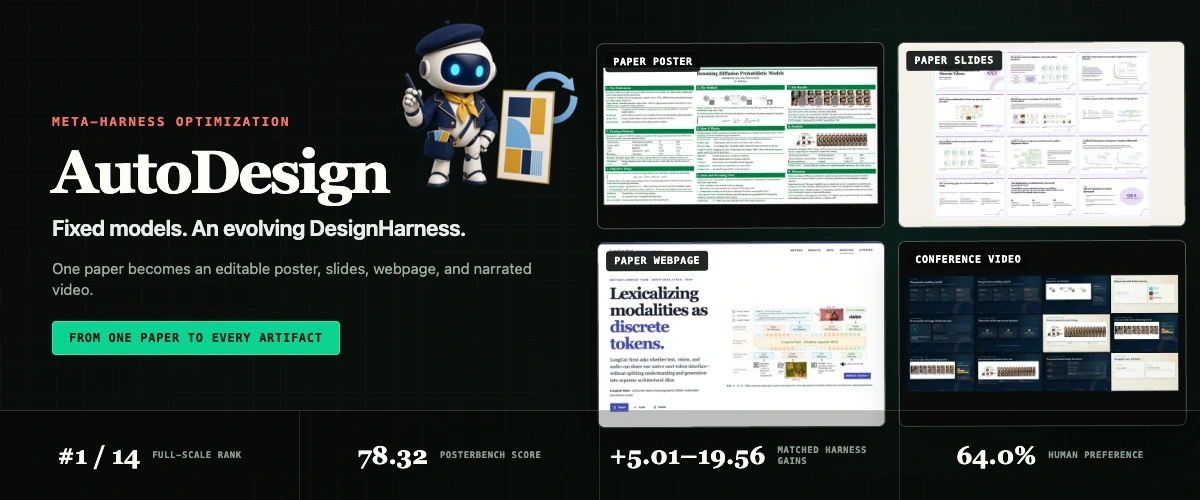
The authors of the Yaxin9Luo/AutoDesign repository released AutoDesign on August 14, 2026 — an open-source agentic tool under the MIT license that automatically assembles a complete set of conference materials from a research paper PDF. The main novelty of the project is not a new model, but the meta-harness optimization method: the prompts, tools, and orchestration around a fixed model are improved, not its weights.

What happened
The first public release of AutoDesign took place on August 14, 2026 under the MIT license. The tool assembles an editable HTML poster, a 24-slide presentation, a research web page, and a 6-minute 1080p video with voiceover and synchronized subtitles from a single research paper PDF. The system works on top of coding agents Claude Code, Codex, and Kimi Code and is built from two loops: the outer meta-harness optimization loop analyzes complete execution trajectories and makes targeted fixes to the DesignHarness wrapper components — context and memory, tools, runtime, orchestration, evaluation — while the inner loop refines the artifact with a Designer/Critic pair with a budget of up to 12 revision iterations per artifact. On the authors' PosterBench benchmark of 100 papers across five disciplines and seven metrics, the Claude Code + Claude 4.8 configuration scores 78.32 points, which is 7.45 higher than Claude Design and 8.87 higher than OpenDesign. A blind human study with 936 responses from 11 experts gives AutoDesign a 64% preference rate in the Bradley-Terry model with a 95% confidence interval of 55.2–77.8%.
Context
The release fits into a steady trend of agentic pipelines improving the system rather than the weights: instead of fine-tuning the model, teams optimize prompts, tools, orchestration, and validators around a fixed model. AutoDesign is a rare open case of this approach, where the outer loop makes targeted fixes to the wrapper based on analysis of complete trajectories, and before this, the pattern had no open reference implementation. Along with the code, the authors published the PosterBench and PosterBench-mini datasets on Hugging Face, and the community for the first time has a reproducible public base for comparing design agents.
Why this matters for the industry
For developers, the release immediately provides two products: a working pipeline from paper to poster, slides, website, and video, and an open reference implementation of the meta-harness optimization pattern. The MIT license allows the DesignHarness architecture to be dissected and the approach transferred to other long agentic tasks — report, presentation, and educational material generation. The cost of a complete conference package is at the level of a single API call, not designer labor, which makes manual assembly uneconomical in the long tail of talks. The measured price/quality curve across engine models shows a spread of more than 37 times in price for comparable results, confirming that the outcome is influenced not only by the wrapper but also by the choice of base model.
Why this matters for users
For researchers, the tool solves the typical task of converting a paper into a poster, slides, and a conference video. It can be installed locally with a single command, requiring Node.js 22+ and ffmpeg, or tried without installation in the browser at designanything.ai. The content is tied to the source: statements and graphs are taken from the paper itself, not invented. According to the authors' measurements, the cost of generating one poster ranges from $0.27 for LongCat 2.0 with a score of 55.13 to $10.02 for GPT-5.5 with a score of 81.46.
What is still unknown / limitations
The PosterBench benchmark and the choice of baselines — commercial products Claude Design and OpenDesign — were constructed by the authors of AutoDesign themselves, so the evaluation may not be independent of the result. The available materials do not disclose the definitions of the seven PosterBench metrics, do not indicate the statistical significance of the differences of 7.45 and 8.87 points, lack ablations isolating the contribution of the outer meta-harness loop from the inner Designer/Critic, and have no data on variability between runs. In addition, AutoDesign is a working CLI tool, not production infrastructure: it has no API and SLA.
Sources
- Yaxin9Luo/AutoDesign GitHub repository
- AutoDesign paper: Meta-Harness Optimization for Long-Horizon Agentic Design, arXiv:2608.13560
- Official AutoDesign project page
Author
Look at AI, editorial team