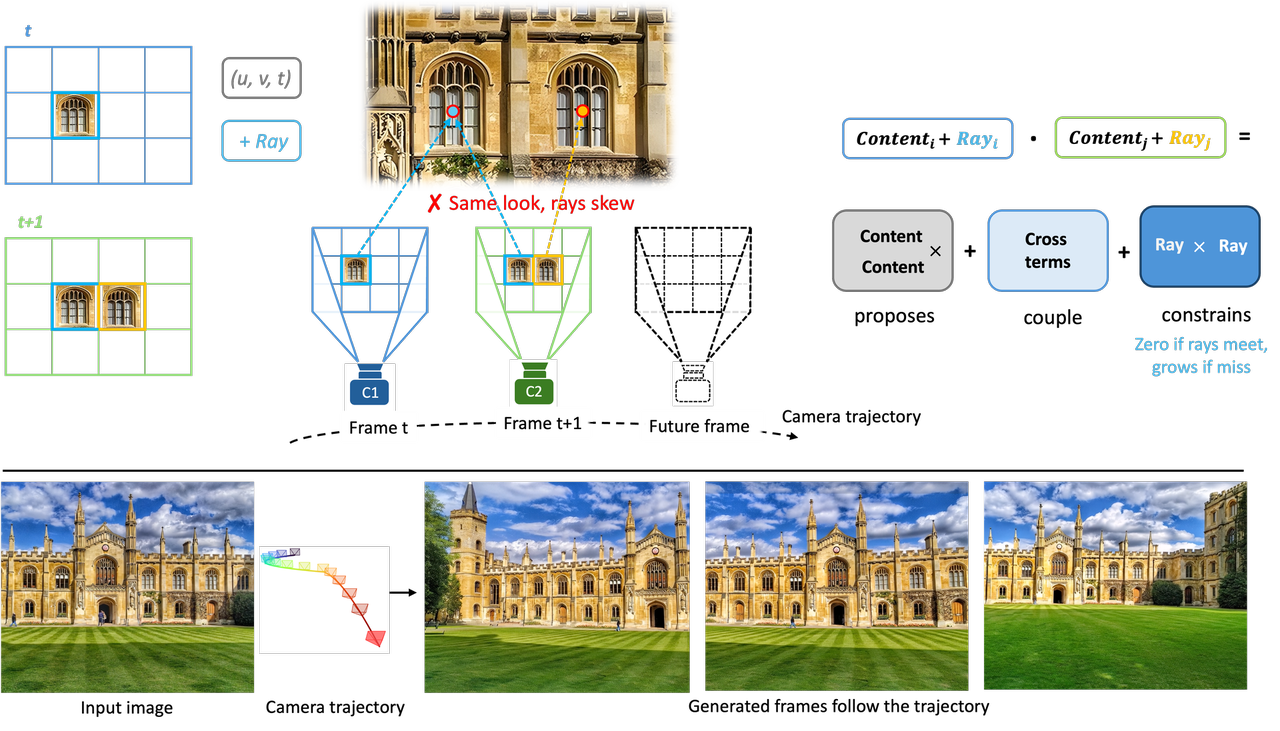
The TencentARC lab has presented SCoPE — an architectural modification to video diffusion models that embeds camera motion control directly into positional encoding. Instead of a separate control module, each video token receives a camera ray as a second coordinate, giving the model an implicit understanding of 3D space while adding less than 0.1 percent of new parameters.


What happened
TencentARC has released SCoPE (Sightline-Coordinate Positional Encoding for Video Diffusion Transformers) — a method that adds camera control to video diffusion models through a modification of positional encoding. Each video token receives a camera ray as a second positional coordinate, and the attention mechanism begins to compare not only the content of frames but also the geometry of the view. On the Wan2.2-I2V-A14B model (14 billion parameters), SCoPE reduces camera rotation error by 29 percent and the FVD (Frechet Video Distance) metric by 43 percent, adding less than 0.1 percent of new parameters. The model is available under the Apache-2.0 license with open code and ready-made weights of approximately 67 GB in size.
Context
Prior to SCoPE, camera control in video diffusion transformers (DiT) was solved by adding separate control modules, which increased architectural complexity and required significant changes to the pipeline. SCoPE offers a fundamentally different approach: the camera becomes not an additional module, but part of the token coordinate system. The Preserve RoPE method ensures bit-for-bit compatibility with the unmodified pre-trained backbone, and the Normalize-Gate-Inject mechanism allows it to work with both metric and approximate depth information sources, eliminating the problem of heterogeneous data.
Why this matters for the industry
SCoPE demonstrates a generalizable "camera as a coordinate system" pattern for any video diffusion transformer. The minimal overhead of 0.1 percent of parameters and bit-for-bit compatibility through Preserve RoPE mean easy integration into existing pipelines without retraining the main model. The Normalize-Gate-Inject mechanism solves the practical problem of working with heterogeneous depth data sources. For products based on Hugging Face Spaces, Replicate, and ComfyUI, SCoPE integration is possible within days. The Apache-2.0 license opens the way to commercialization.
Why this matters for users
The model is available for immediate use: you can download the weights, load a single frame, and set an arbitrary camera trajectory, including WASD-style control. SCoPE supports cinematic push-ins, pull-outs, orbits, crane shots, and arbitrary camera paths. The code is written in Python, and inference requires a GPU with CUDA support. The "one frame plus camera trajectory equals video" pattern is ready for use both for research purposes and as a foundation for products.
What is still unknown / limitations
Claims that the SCoPE pattern can be easily transferred to any video diffusion transformer are not experimentally confirmed — the work was carried out exclusively on the Wan2.2-I2V-A14B model. The lack of cross-model experiments on VideoCrafter, OpenSora, and CogVideoX limits conclusions about generalizability. For production services, independent latency measurements and stress tests on real workloads are necessary.
Sources
- SCoPE: Sightline-Coordinate Positional Encoding for Video Diffusion Transformers — arXiv
- SCoPE Project Page
- TencentARC/SCoPE — GitHub
Author
Look at AI, editorial team