
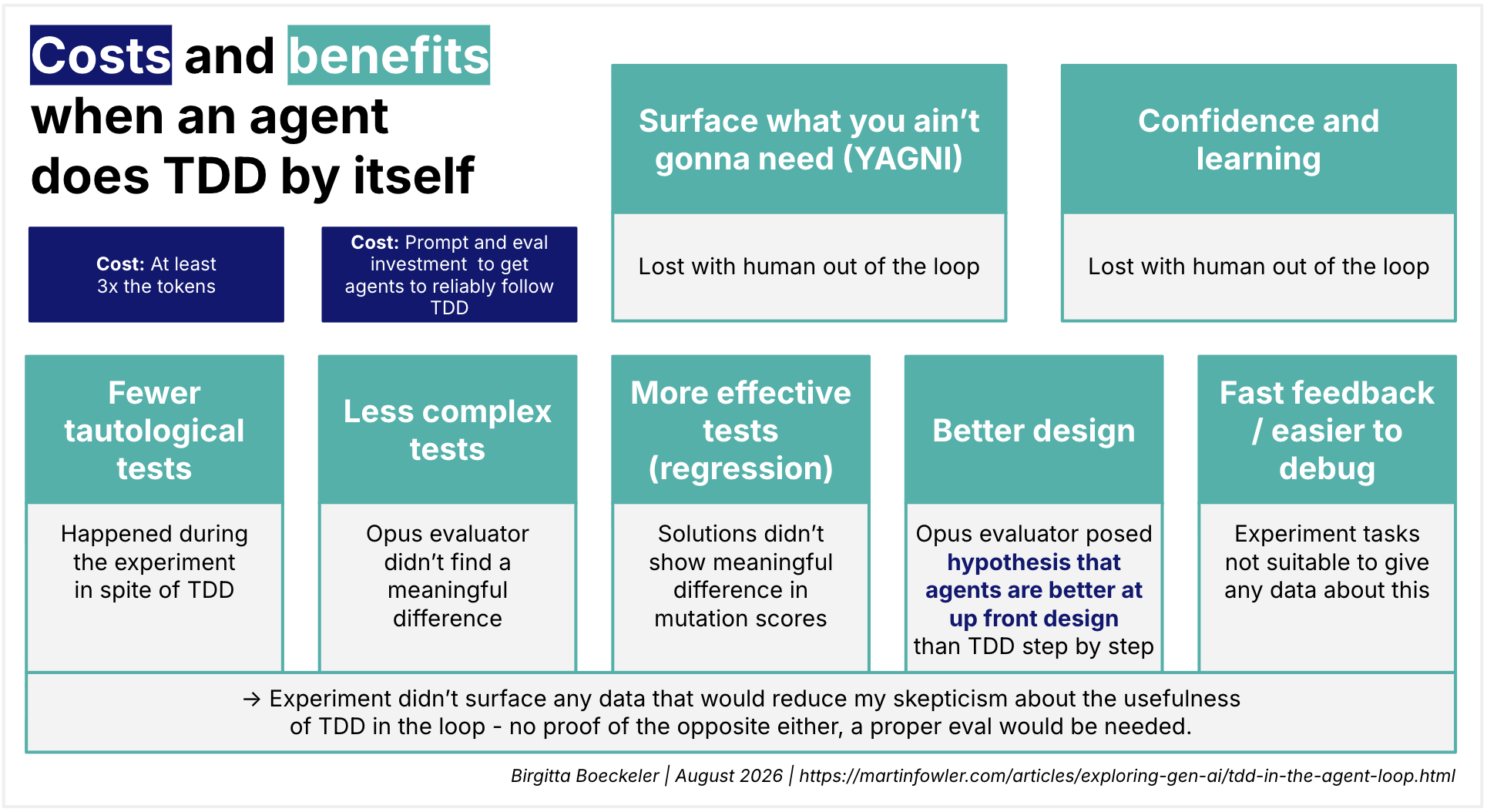
Birgitta Böckeler from Thoughtworks published research on MartinFowler.com showing that enforcing TDD inside an autonomous AI agent does not improve the quality of generated code, but increases token consumption by 3–8.5 times.


What happened
The experiment used Claude Sonnet 4.6 for code generation and Claude Opus 4.8 for blind evaluation of the results. Solutions generated without TDD instructions consistently ranked first in design and test quality. Meanwhile, requests with the instruction to go through the red-green-refactor cycle consumed three to eight and a half times more tokens, without providing a measurable gain in the final product.
Context
TDD as a methodology assumes the cycle “write a test — write code that passes it — refactoring.” The research explains the lack of effect by the fact that LLMs are trained on finished features with descriptions, not on step-by-step TDD transcripts. Their latent space maps requirements directly to code, bypassing the intermediate “test first” process. The article was included in the Exploring Generative AI series on MartinFowler.com, and the Anti-pattern “Prescribing TDD Inside the Agent Loop” was documented on AgentPatterns.ai.
Why this matters for the industry
The research calls into question the prescription of TDD as a best practice for agentic development. Instead of process-driven quality assurance, the industry is offered a transition to measurable outcome metrics: mutation testing as a quality-gate in CI/CD, static analysis, preserving tests written by a human. Teams should keep a human in critical points of the cycle, rather than relying on autonomous red-green-refactor.
Why this matters for users
If you use AI agents with TDD instructions, you can immediately reduce token costs by 70–88% by removing the red-green-refactor cycle prescription from prompts. Product teams are recommended to add a TDD mode toggle with a token consumption metric and turn it off by default.
What is still unknown / limitations
The research used only Anthropic models — Claude Sonnet 4.6 and Opus 4.8. Behavior may differ for GPT-o1, Gemini 2.5 Pro, Llama, and open-source models with a different pre-training structure. Until cross-vendor research appears, confidence in generalizability is limited. This is not a peer-reviewed article, but a publication in the MartinFowler.com blog series.
Sources
- TDD inside the agent loop — Martin Fowler
- Prescribing TDD Inside the Agent Loop (Process Theater) — AgentPatterns.ai
- Exploring Generative AI — Martin Fowler (series index)
Author
Look at AI, editorial team