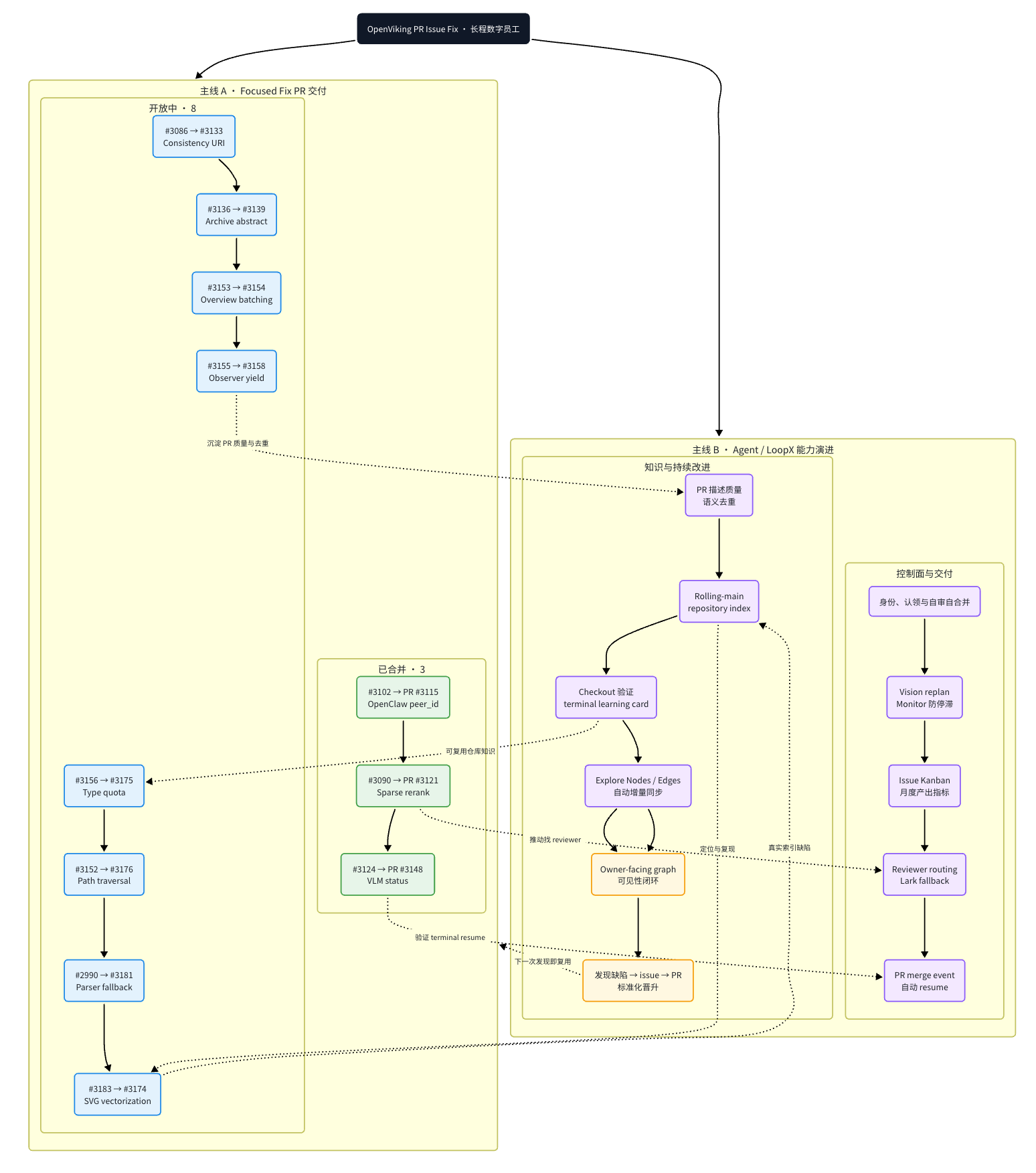
ByteDance engineer Huang Ruiteng, developer of OpenViking, introduced LoopX — a lightweight Python package with no external dependencies for managing the state of AI agents on long-running tasks. Version v0.4.5, released on August 12, closed five security vulnerabilities, and the project is gaining 4.4 thousand stars on GitHub with the participation of 16 external contributors.

What happened
LoopX provides an external state management layer over existing AI runtimes: Codex, Claude Code, Cursor, OpenCode, and others. The package does not run agents on its own — it stores goals, permission boundaries, tasks, evidence, quotas, and human decision points, allowing the agent to work step by step with validation of each step. Version v0.4.5 released fixes for five vulnerabilities: CORS, path traversal, and shell injection, and also added caller-approved task completion validation. The project is distributed under the MIT license, requires Python 3.11+, and has no external dependencies. The author publishes real agent work trajectories lasting more than 200 hours.
Context
The problem that LoopX solves is the limited context window of large language models. In long-running tasks, the agent loses connection with the overall goal, repeats itself, and deviates from the task. Existing frameworks — LangGraph, AutoGen, CrewAI — solve this through internal orchestration mechanisms tied to a specific runtime. LoopX offers a different path: complete separation of state and execution. The package architecturally resonates with the external memory pattern from research literature (Memorizing Transformer, RETRO), but applied to agent systems. Partner projects — OpenViking (ByteDance's context database) and NoKV (distributed file system) — indicate the production origin of the approach.
Why this matters for the industry
LoopX formalizes the concept of loop engineering — managed state for long-running agent tasks, comparable to an agent Kanban board. Each agent step is isolated, passes validation, and the result is recorded in the common state. This allows work to be continued on another machine or with another model, reducing dependence on a specific AI provider. The external state pattern can evolve into an industry standard: a protocol for transferring agent tasks between providers, similar to how Kubernetes became the standard for container orchestration. For startups, this is a signal: it is possible to build products that work between model calls, not within a single API request.
Why this matters for users
Developers working with Codex, Claude Code, or Cursor who face context loss in long-running tasks can connect LoopX with a single installation command. The package adds an external state kernel with checking of each step, which reduces the risk of uncontrolled agent actions. The fix of five security vulnerabilities in v0.4.5 makes the version suitable for production-like scenarios. The MIT license and lack of dependencies simplify integration into existing projects.
What is still unknown / limitations
The project is at the v0.4.5 stage with one main developer. The lack of systematic benchmark comparisons with alternative approaches (LangGraph, AutoGen, CrewAI) does not allow assessing the quantitative advantage of the pattern. The MIT license and lack of a monetization model make the project more of an infrastructure beta than a defensible product. Dependence on external AI runtimes means that LoopX does not work autonomously.
Sources
Author
Look at AI, editorial team