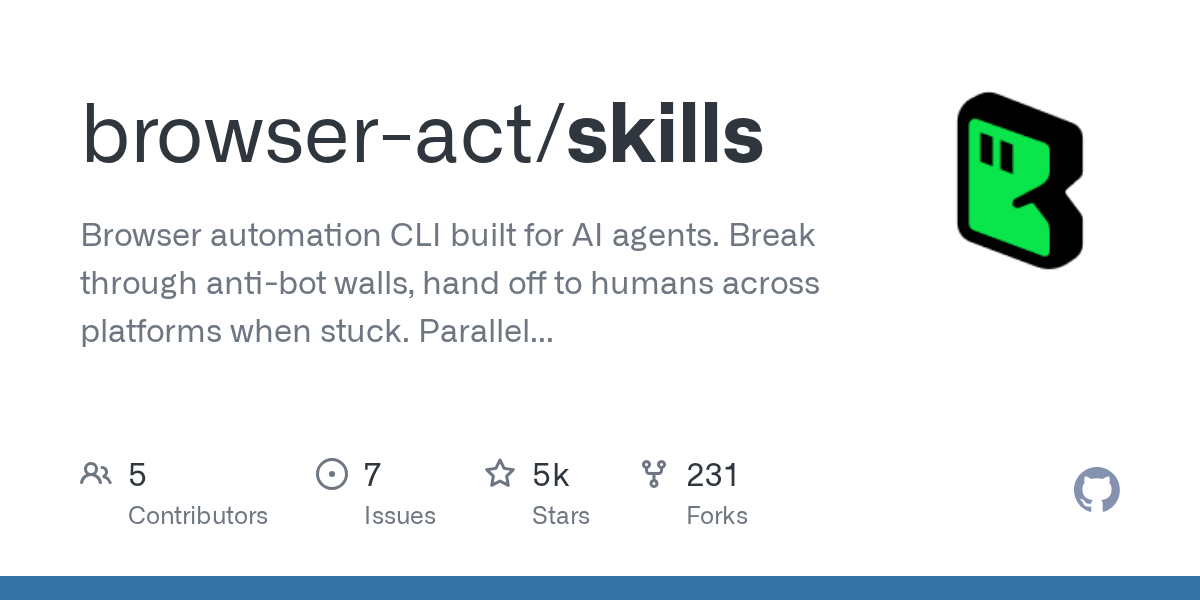
BrowserAct Skills has been introduced—a specialized CLI tool designed to serve as a bridge between language models and web interfaces, ensuring more stable and autonomous navigation.
What Happened
Developers have released BrowserAct Skills, a command-line tool that allows AI agents to interact with the browser via optimized text output, saving LLM tokens. The system supports stealth mode to bypass anti-bot protections, the use of local Chrome profiles, parallel independent sessions, and a "remote assist" feature to hand over control to a human in complex situations.
Context
Modern web agents often face the problem of "fragility" when attempting to automate navigation, especially on websites with advanced anti-bot mechanisms. Traditional tools like Selenium or Playwright require writing bulky and complex scripts, which makes it difficult to create truly autonomous systems.
Why It Matters for the Industry
For the industry, this solution offers a standardized abstraction layer between LLMs and the browser, lowering the technical barrier to creating reliable agentic systems. In the long term, this could lead to the standardization of the interaction interface between neural networks and the web environment within the open-source ecosystem.
Why It Matters for Users
Developers and users will be able to create more powerful AI assistants capable of performing complex tasks on the internet—from booking tickets to parsing protected data—without the need for deep configuration of complex automation libraries.
What Is Not Yet Known / Limitations
There is a fundamental contradiction between the technical efficiency of the tool (bypassing protections) and the potential legal risks associated with violating the Terms of Service (ToS) of various web platforms.
Sources
Author
Look at AI, Editorial Team