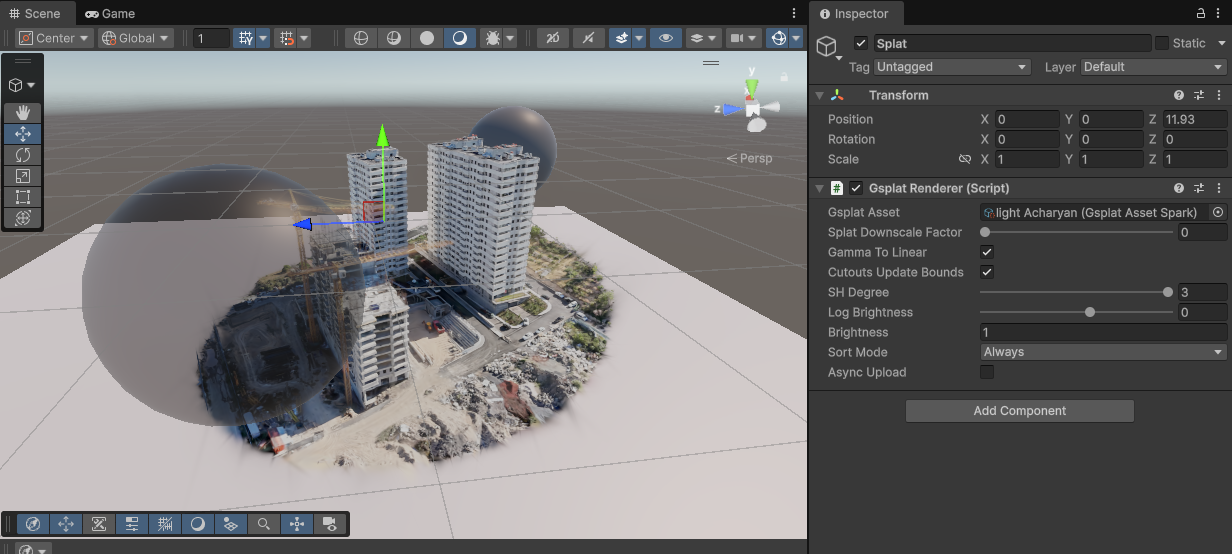
UnitySplats has been released—a cross-platform package for Unity 6 that enables the import and rendering of 3D scenes based on Gaussian Splatting (3DGS) technology. The tool provides support for popular formats and works with modern graphics APIs, opening new possibilities for creating photorealistic content.

What Happened
Developers have introduced UnitySplats, a package for Unity 6 that supports .ply, .sog, .spz, and .glb formats (via the KHR_gaussian_splatting extension). The tool is compatible with Built-in, URP, and HDRP render pipelines and is optimized for mobile platforms, WebGL 2, desktops, and XR devices, including Meta Quest 3. The package supports modern graphics APIs such as Vulkan, Metal, and Direct3D 12, and allows for working with dynamic 4D scenes.
Context
Gaussian Splatting (3DGS) technology is a neural rendering method that enables the creation of highly detailed 3D scenes. Before the advent of specialized tools, integrating such methods into standard game engines required writing complex custom shaders and deep configuration of GPU pipelines.
Why It Matters for the Industry
UnitySplats simplifies the implementation of highly realistic neural fields into standard production workflows, lowering the technical barrier for companies. Support for native rendering at the Unity shader level with minimal dependencies allows for scaling the production of photorealistic content for mobile and XR segments, which could lead to new standards for integrating AI-based volumetric rendering methods into commercial engines.
Why It Matters for Users
Developers and enthusiasts now have a ready-made solution for rapid prototyping and implementing 3D scans into their Unity 6 projects without the need for deep development of custom rendering systems. This enables the creation of high-quality digital twins and interactive scenes for mobile applications, web, and virtual reality using proven compression formats.
What Is Not Yet Known / Limitations
At this time, there is no data regarding asset management capabilities or corporate security considerations when using the tool in large-scale enterprise projects.
Sources
Author
Look at AI, Editorial Team